
A supplement manufacturer audit checklist turns a vague question (“Is this factory any good?”) into a short list of documents you can request and check. For mushroom supplement OEM and ODM projects, six areas matter most: certifications, raw material traceability, regulatory support for your market, testing, R&D, and project management.
Send the same checklist to every factory on your shortlist, then judge each one by the evidence it sends back. A low price or a polished case study is easy to show. Matching paperwork, delivered on time, is much harder to fake.
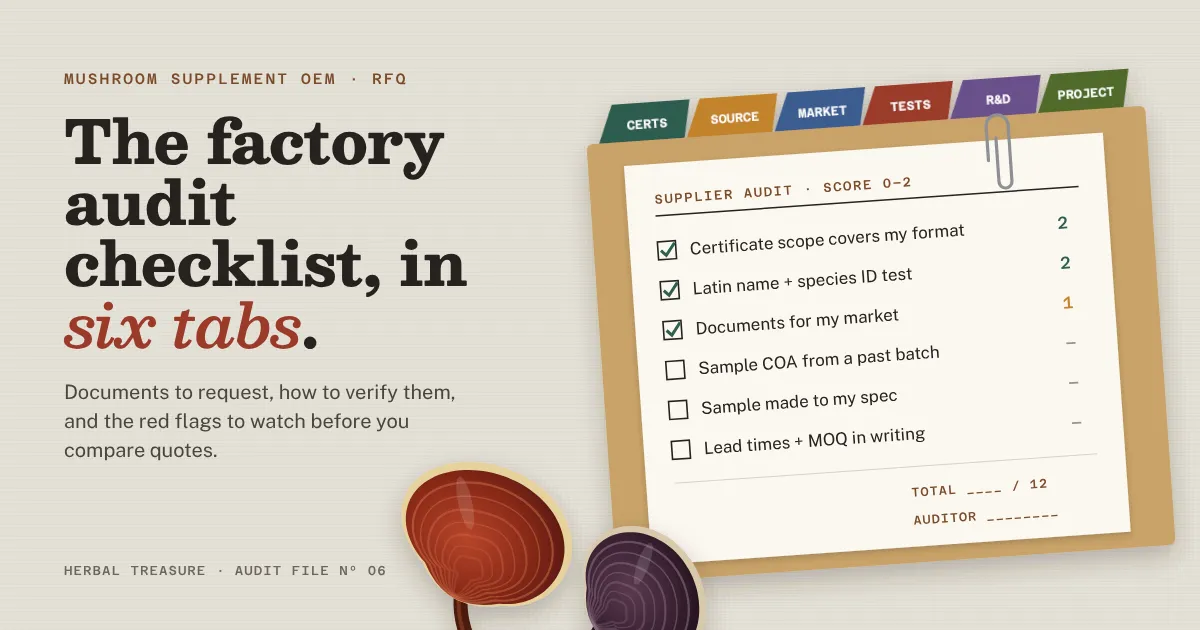
How to Use This Supplement Manufacturer Audit Checklist
Use the checklist before you ask for a quote, not after. Send all six areas to each factory in writing, ask for documents rather than yes-or-no answers, and score every reply. By the time prices arrive, you will already know which factories can back up what they say.
A few habits make the checklist work:
- Ask in writing.Email the questions so every factory answers the same list and you keep a record.
- Ask for documents, not adjectives.“Yes, we are certified” is not evidence. A certificate copy with a number you can look up is.
- Score as you go.Give each area 0 (no answer), 1 (answer but no document) or 2 (document received and checked).
- Treat the RFQ as a trial run.How a factory handles your questions now is a fair preview of how it will handle your order.
The 6 Areas to Verify in a Mushroom Supplement Factory
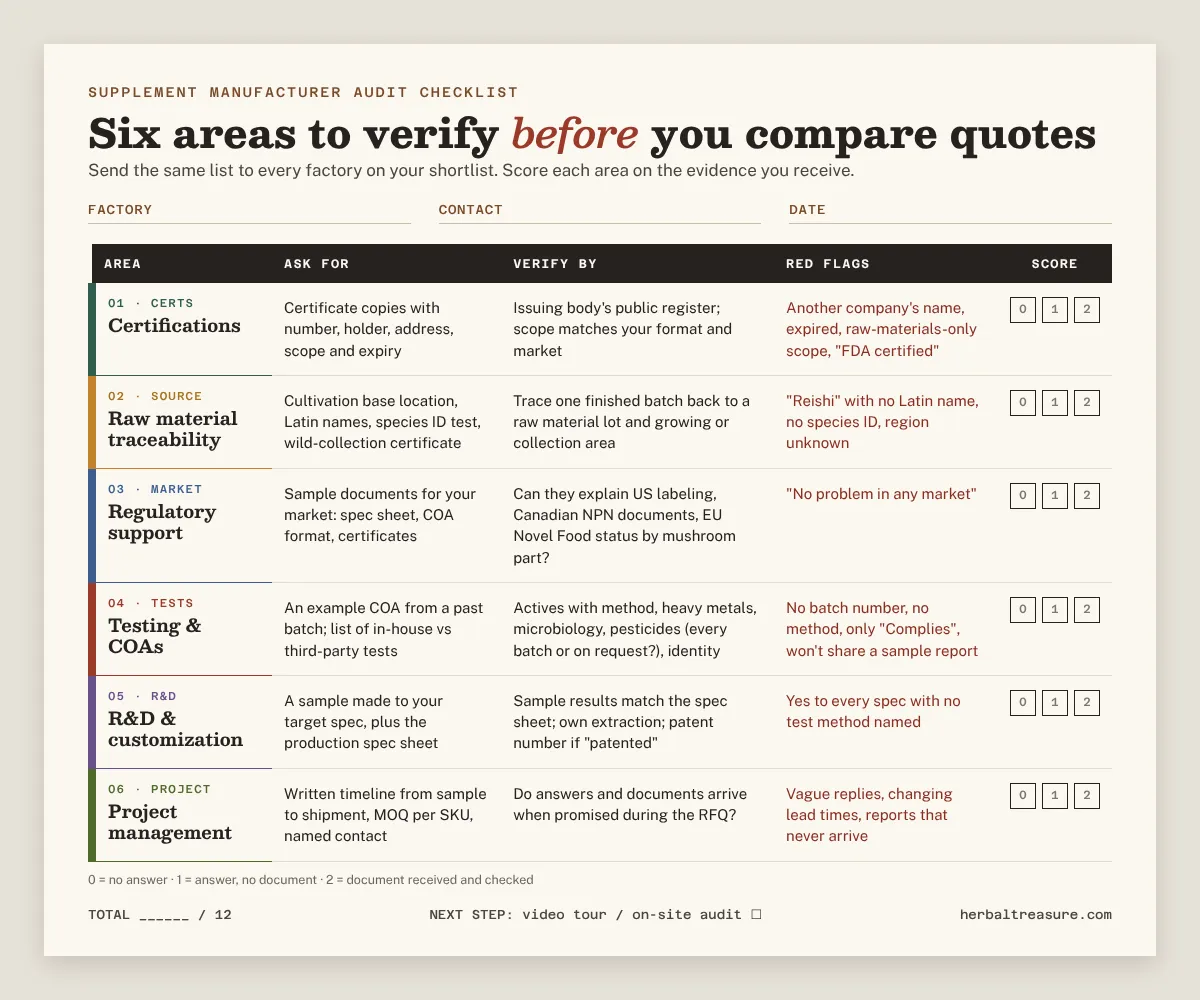
1. Certifications: Do They Cover Your Product and Your Line?
Count matters less than coverage. A certificate only helps you if it is held by the factory that will make your product, is still valid, and lists your product type in its scope.
What to request: copies of each certificate showing the holder’s name and address, certificate number, scope and expiry date.
How to verify: look the certificate up in the issuing body’s public register, where one exists. The USDA Organic Integrity Database and the FSSC 22000 register of certified organizations are two examples. Then check the scope line by line against your format, whether that is capsules, powder, gummies or tinctures.
Match certificates to your market:
- United States:dietary supplement cGMP, and an FDA-registered facility. Registration is a listing, not an FDA approval or certification.
- Canada:a foreign factory does not hold a Canadian site license. Your importer does, and it will need GMP evidence from the factory.
- EU and other organic markets:an organic certificate whose scope includes the ingredient you are buying.
- Faith-based markets:Halal or Kosher certificates, if your customers expect them.
Red flags: certificates in another company’s name, expired certificates, a scope that covers raw materials only, or any claim that a factory is “FDA certified” or “FDA approved.”
2. Raw Material Traceability: Can They Show Where the Mushrooms Come From?
Ask whether the factory has its own or contracted cultivation base, and which materials are wild-harvested rather than cultivated. A traceable supplier can follow one finished batch back through extraction to a raw material lot and a growing or collection area.
What to request: the cultivation base location, the Latin name of each mushroom, a species identification test, and, for wild materials, the wild-collection certificate that organic certification requires.
For reishi, check the species. The Chinese Pharmacopoeia lists two species as lingzhi: red reishi (chi zhi, Ganoderma lucidum) and purple reishi (zi zhi, Ganoderma sinense). A strong triterpene figure on a COA tells you nothing about which species is in the drum. Identity is a separate test, so ask for it.
Red flags: “reishi” on a spec sheet with no Latin name, no species ID test, or a supplier that cannot name the region its mushrooms come from.
3. Regulatory Support: Does the Factory Know Your Target Market?
The rules differ by market, and a good manufacturer knows which documents each one needs. Ask how familiar the team is with:
- US labeling:the Supplement Facts panel and dietary supplement cGMP.
- Canada:Natural Product Numbers (NPNs), which the brand or importer applies for using the factory’s documents.
- EU:Novel Food status, which can differ by mushroom part. Reishi fruiting body and mycelium, for example, have been assessed separately.
What to request: sample documents you will need for your market, such as a specification sheet, a COA format and certificate copies.
Final label compliance stays with the brand. The factory’s role is to supply accurate documents and flag what it knows. Be wary of any supplier that says every market is “no problem.”
4. Testing and COA Transparency: What Does Each Batch Report Cover?
Every production batch should ship with a certificate of analysis (COA). This is a basic requirement, not a premium service. What separates factories is how much the COA covers and how openly they share it.
What to request: an example COA from a past batch (with client details removed), plus a list of which tests are run in-house and which go to a third-party lab.
Check the scope:
- Active compounds relevant to your product, such as polysaccharides, beta-glucans or triterpenes, with the method named.
- Heavy metals.
- Pesticide residues. Ask whether this is tested on every batch or on request.
- Species identity.
Read the units, methods and limits, not just the word “Complies.” A result shown as “<LOQ” means below the limit of quantification. It is not the same as zero.
Red flags: COAs without batch numbers, results with no method, or reluctance to share a sample report.
5. R&D and Formula Customization: Can They Build to Your Spec?
Ask about the size of the R&D team and what it actually does: formula development, extraction, stability checks or troubleshooting in production. Then ask whether the factory runs its own extraction and whether it can adjust specifications, such as polysaccharide, beta-glucan or triterpene content, or supply ratio extracts instead of standardized ones.
What to request: a sample made to your target specification, along with the spec sheet the factory would use for the full production run. If a supplier describes a process as patented, ask for the patent number.
Red flags: saying yes to every spec without naming a test method, or samples that do not match the spec sheet.
6. Project Management and Communication: Will You Get Answers on Time?
Ask for sample lead time, production lead time and MOQ in writing, and ask who your day-to-day contact will be. Then notice how the answers arrive.
What to request: a written timeline from sample to shipment, the MOQ per SKU, and the documents that come with each order.
Red flags: vague replies, lead times that change from one email to the next, and spec sheets or test reports that never quite arrive. These problems rarely improve after you pay a deposit.
What Good Problem-Solving Looks Like: A Client Example
A European client of ours was developing a mushroom electrolyte drink mix and kept running into two problems: the taste was off, and the powder caked during production. Our R&D, production and equipment teams worked on it together. We replaced flavoring ingredients and adjusted the equipment, and the full-scale order was delivered.
The lesson for your audit is simple. Ask every factory to describe a production problem it solved for a client. The answer shows whether R&D, production and engineering actually work together, or only appear together in the brochure.
How to Compare Factories With Your Audit Checklist
Once the replies are in, add up the scores. A factory with 2 points in all six areas has shown you evidence for everything. A factory with several zeros has told you something too.
- Weight the areas that matter most for your product.A reishi brand selling organic capsules in the EU might double the weight of sourcing and certifications.
- Compare prices only between factories with similar scores.A cheaper quote with weaker evidence is not the same offer.
- Verify the top one or two in person or on video.A video tour or an on-site audit, by you or a third party, confirms what the documents describe.
How Herbal Treasure Answers the 6 Areas
- Certifications:NSF cGMP, FSSC 22000, ISO 22000, HACCP, USDA Organic, EU Organic, Canada Organic, Halal and Kosher, each within its certified scope. Our facility is FDA-registered. For Canada, it was previously assessed under Health Canada’s Foreign Site Reference Number (FSRN) process, and we now supply GMP evidence for each Canadian importer’s site license application.
- Traceability:we grow both red reishi ( lucidum) and purple reishi (G. sinense) on our 200+ mu (about 13 hectares or 33 acres) log-grown forest base in Jiangle County, Sanming, Fujian. Wild-harvested materials come with wild-collection certificates, and our lab runs genetic identification tests.
- Regulatory support:products we manufacture have received more than 50 NPNs, and we prepare documents for each client’s target market.
- Testing:our in-house lab tests every batch for heavy metals, active content and microbiology, and every batch ships with a COA. Third-party testing is available on request, with lab fees paid by the client. We keep a retained sample of every batch for two years.
- R&D:a team of more than 100 people, more than 5,000 proven formulas, in-house extraction, and both standardized and ratio extracts, with specifications customized per client.
- Project management:a reply within two business days and a quote within one to three business days. Samples take 5 to 7 days (7 to 14 days for custom formulas), standard production 15 to 20 days and deep customization 4 to 6 weeks. The MOQ is 500 units per SKU.
Video tours, site visits and audits by clients or third parties are welcome. If you would like to run this checklist on us, ask for our document pack or book a video tour.
Frequently Asked Questions
What should a supplement manufacturer audit checklist include?
It should cover six areas: certifications and their scope, raw material traceability, regulatory support for your market, batch testing and COAs, R&D and customization, and project management. For each area, ask for a document you can check, not just a yes-or-no answer.
How can I check if a supplement manufacturer’s certificate is real?
Ask for a copy showing the certificate number, holder name, scope and expiry date. Then look the number up in the issuing body’s public register, such as the USDA Organic Integrity Database, and confirm the holder and scope match the factory and your product.
Should every batch of mushroom supplements come with a COA?
Yes. A COA for every batch is standard practice, not an extra. Check that it shows the batch number and covers active compounds, heavy metals and microbiology, and ask whether pesticide residues and species identity are tested on every batch or on request.
Which reishi species should a supplier use?
The Chinese Pharmacopoeia lists two species as lingzhi: red reishi (Ganoderma lucidum) and purple reishi (Ganoderma sinense). Whatever the species, ask your supplier for the Latin name on the spec sheet and a species identification test, and check what your target market requires.