
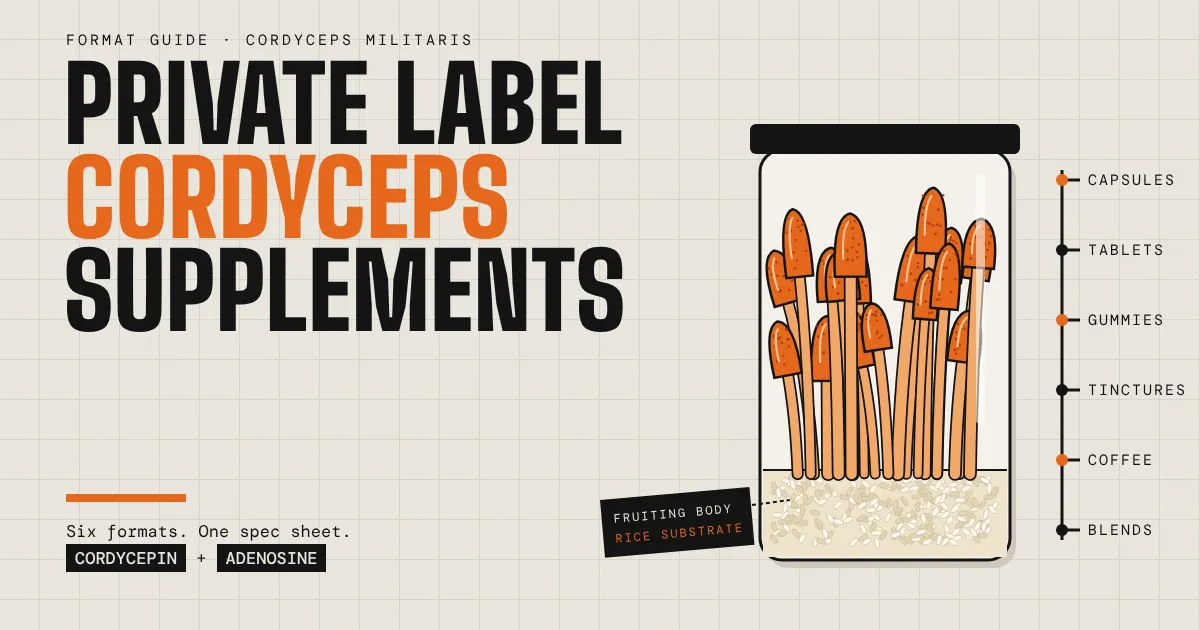
Private label cordyceps supplements come in many forms: capsules, tablets, gummies, tinctures, mushroom coffee and multi-mushroom blends. Whichever you choose, product quality comes down to the same two numbers, cordycepin and adenosine, and to writing them into your specification before you place an order.
Cordyceps is one of the best-known ingredients in the sports nutrition and energy category in North America and Europe, and many cross-border brands now sell cordyceps capsules and cordyceps coffee. This guide explains which cordyceps goes into a commercial product, the six formats brands ask us about most, and what to put on your spec sheet for each one.
A note on positioning: “sports nutrition and energy” describes where cordyceps products sit on the shelf, not what they do. Check which wellness statements are allowed in each market before you write a label or product listing. The rules in the European Union are stricter than those in the United States and Canada.
Cordyceps Militaris vs Wild Cordyceps: Which One Is in Your Product?
Almost all commercial cordyceps supplements use Cordyceps militaris (yong chong cao), a species that can be cultivated. Wild cordyceps, Ophiocordyceps sinensis (dong chong xia cao), grows on caterpillar larvae in the high grasslands of the Tibetan Plateau. It is scarce and is not practical for supplements made at scale.
Because Cordyceps militaris is cultivated, it can be grown under controlled conditions and harvested on a schedule, and that is what makes batch-to-batch consistency possible. Name the species and the part used, usually the bright orange, club-shaped fruiting body, on your label and specification so shoppers know exactly which cordyceps they are buying.
Cordycepin and Adenosine: The Two Numbers That Decide Quality
Cordycepin and adenosine are the two marker compounds buyers use to judge Cordyceps militaris. Two cordyceps powders that look identical can differ widely in both, so color and appearance tell you very little. Set a required content for each in your specification, and check it on every batch.
When a buyer checks only the words “cordyceps powder” on a quote, the next shipment may not match the last. Shoppers notice when a product changes, and on Amazon or a brand’s own website that shows up quickly as negative reviews and complaints.
Both compounds are heat-sensitive and can break down at high processing temperatures, which is why low-temperature extraction matters. Specifications also vary widely. At Herbal Treasure, cordycepin can be specified anywhere from 1% to 99%, and adenosine from 0.1% to 10%, depending on the ingredient and the finished product. Highly purified ingredients may be regulated differently from mushroom extracts in some markets, so confirm the rules for your market before you set a high figure. Our cordyceps militaris extract guide goes deeper into both markers.
Cordyceps Powder or Cordyceps Extract?
Cordyceps powder is the dried fruiting body, milled fine. Cordyceps extract has been processed to concentrate the mushroom’s compounds and is standardized to a measured cordycepin and adenosine content. Powder suits simple, whole-mushroom products, while an extract gives you a number to put on the label and to check on every batch.
6 Private Label Cordyceps Supplement Formats, and What to Specify
1. Cordyceps Capsules
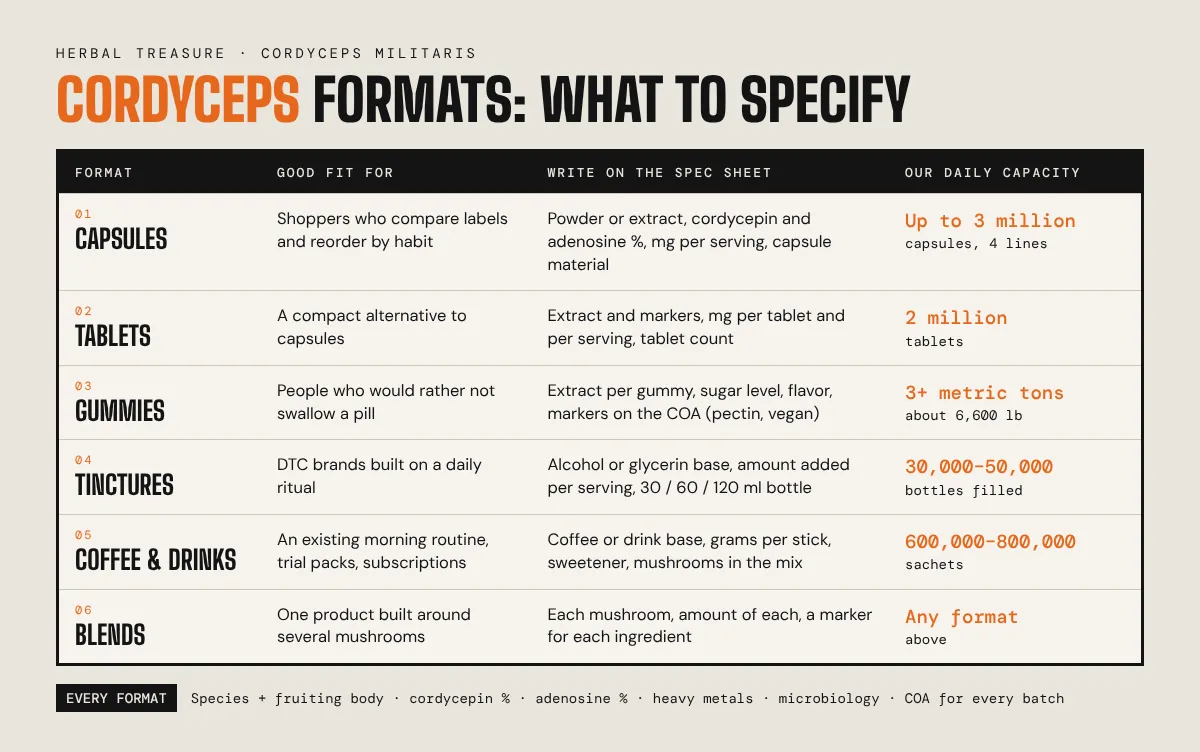
Capsules are the classic cordyceps format and the easiest for shoppers to compare on price per serving. They suit brands that want a clean, single-ingredient product with a clear number on the label.
- Specify:powder or extract, cordycepin and adenosine content, milligrams per capsule and per serving, and bottle count.
- Ask about:capsule material, for example plant-based capsules if you want a vegan claim.
- Capacity:four capsule lines with a combined output of up to 3 million capsules a day.
2. Cordyceps Tablets
Tablets are a compact alternative to capsules and suit brands that want a firm, easy-to-pack serving.
- Specify:the cordyceps ingredient and its markers, milligrams per tablet and per serving, and tablet count.
- Capacity:2 million tablets a day.
3. Cordyceps Gummies
Gummies reach shoppers who would rather not swallow a pill. A gummy has limited room for active ingredients, so the strength of the extract inside matters more than it does in a capsule.
- Specify:the cordyceps extract, the amount per gummy, sugar level, flavor, and the markers you want reported on the certificate of analysis (COA).
- Herbal Treasure gummies:made with pectin only, never gelatin, so they suit vegan positioning. Low-sugar and sugar-free versions are possible.
- Capacity:more than 3 metric tons (about 6,600 lb) of gummies a day, from a dedicated gummy workshop.
4. Cordyceps Tinctures
Tinctures give shoppers a liquid they can take by the dropper or add to water, coffee or tea. They are a natural fit for DTC brands that sell on a story of daily ritual. Learn more in our mushroom tincture manufacturer guide.
- Specify:the base (alcohol or glycerin), the amount of cordyceps added per serving, and the bottle size: 30 ml (1 fl oz), 60 ml (2 fl oz) or 120 ml (4 fl oz).
- Ask about:dual extraction (hot water plus alcohol), and a dark or amber dropper bottle to protect the liquid from light. For Halal markets, tinctures use a glycerin base.
- Capacity:automatic filling lines that fill 30,000–50,000 bottles a day.
5. Cordyceps Coffee and Drink Mixes
Mushroom coffee and powdered drink mixes put cordyceps into a habit people already have, and single-serve stick packs make them easy to sell as trial packs and subscriptions. Our most requested blend is a four-mushroom coffee with reishi, lion’s mane, cordyceps and chaga, and the mushroom mix can be changed, down to cordyceps alone.
- Specify:the coffee base (instant or ground, arabica or robusta, regular or decaf), grams per serving (a black coffee stick pack is usually 2–3.5 g), the sweetener, and the mushrooms in the mix.
- Ask about:non-coffee bases such as matcha, chai and cocoa, sugar-free sweeteners such as monk fruit and stevia, and packaging design for stick packs, pouches and gift boxes. See our mushroom coffee manufacturer
- Capacity:600,000–800,000 sachets a day.
6. Multi-Mushroom Blends
Cordyceps is often blended with lion’s mane (hou tou gu), reishi (ling zhi) and chaga, and a blend can be made in any of the formats above. Blends let a brand build one product around a wider routine instead of a single mushroom.
- Specify:each mushroom in the formula, the amount of each per serving, and a marker for each ingredient, not just one figure for the whole blend.
What to Put on Your Cordyceps Spec Sheet
Whatever format you choose, the specification sheet ties the product together. The label, the factory’s batch records and any test report are all checked against it. A complete cordyceps spec sheet includes:
- Species and part:Cordyceps militaris, fruiting body.
- Ingredient type:powder, extract, or both.
- Markers:a required cordycepin and adenosine content, each as a percentage.
- Amount per serving:in milligrams, matching the label exactly.
- Contaminant limits:heavy metals and microbiology.
- Certifications:for example organic, if you plan to make an organic claim.
- Batch documents:a COA for every batch, using the same markers as the spec.
If you also want an independent report, agree on it up front. At Herbal Treasure, every batch is tested in our in-house laboratory, and third-party testing can be arranged on request, with the lab fee paid by the client.
How Herbal Treasure Makes Private Label Cordyceps Supplements
Herbal Treasure has worked with edible and medicinal mushrooms in Fujian, China, since 2003. Here is how we support cordyceps brands:
- Raw material:Cordyceps militaris fruiting bodies grown in greenhouses under standardized cultivation, mostly on a rice-based substrate, at our base in Jiangle County, Sanming, Fujian. Organic cordyceps is available.
- Processing:low-temperature extraction to protect cordycepin and adenosine.
- Ingredients:cordyceps powder and cordyceps extract, with cordycepin from 1% to 99% and adenosine from 0.1% to 10%.
- Finished products:capsules, tablets, gummies, tinctures, drink mixes and coffee, as single-mushroom products or blends.
- Formulas:bring your own formula (OEM), or start from more than 5,000 proven formulas (ODM), with ready cordyceps formulas in every format above.
- Testing:an in-house laboratory that tests active content, heavy metals, microbiology and species identity on every batch.
- Certifications:NSF cGMP, ISO 22000, FSSC 22000, HACCP, USDA Organic, EU Organic, Canada Organic, Halal and Kosher. Our facility is FDA-registered and holds a Health Canada Foreign Site Reference Number (FSRN). Each certificate applies within its stated scope.
- Orders:minimum order from 500 units per product; samples in 5–7 days for standard products or 7–14 days for custom formulas; production in 15–20 days for standard orders or 4–6 weeks for deep customization.
Our ingredients and finished products are exported to more than 40 countries and regions across North America, Europe and Southeast Asia.
Choosing Your First Cordyceps Product
The right first product depends on who you are selling to. Capsules and tablets suit shoppers who compare labels and reorder by habit. Gummies and tinctures reach people who want something easier than a pill. Cordyceps coffee fits a morning ritual, and a blend lets you build a range around one product. Brands planning a wider line can compare our format guides for private label lion’s mane supplements and private label reishi supplements.
Ready to plan your cordyceps line? Request a manufacturing quote and tell us your market, format, formula and packaging.
Frequently Asked Questions
What is the difference between Cordyceps militaris and Cordyceps sinensis?
Cordyceps militaris is a cultivated species and the one used in almost all commercial supplements. Wild cordyceps, now classified as Ophiocordyceps sinensis, grows on caterpillar larvae on the Tibetan Plateau and is too scarce for products made at scale.
What cordycepin content should I specify?
It depends on your ingredient, formula and market. At Herbal Treasure, cordycepin can be specified from 1% to 99% and adenosine from 0.1% to 10%. Choose a level, write it into your spec, and check it on every batch’s COA.
Can cordyceps gummies be vegan?
Yes. Herbal Treasure gummies are made with pectin only, never gelatin, so they suit vegan positioning. Low-sugar and sugar-free versions are also possible.
What is the minimum order for private label cordyceps supplements?
At Herbal Treasure, orders start from 500 units per product. The exact minimum depends on the format, formula and packaging.