
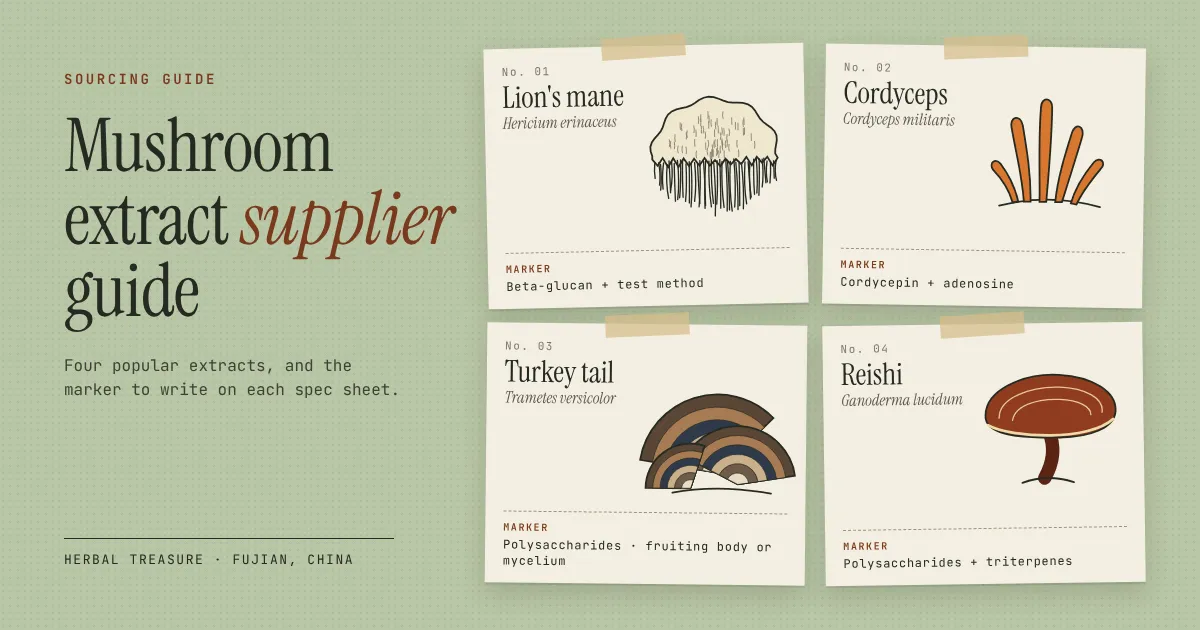
Choosing a mushroom extract supplier comes down to one question: can they prove what is in every batch? For lion’s mane, cordyceps, turkey tail and reishi, that means a written specification for the right marker compound, a test method behind every number, and a certificate of analysis (COA) for each lot, not just for the sample.
Lion’s mane, cordyceps, turkey tail and reishi have become some of the most searched-for natural ingredients among shoppers on Amazon and independent brand websites. As these products have moved into the mainstream, more cross-border brands are looking past traders and going directly to source factories in China. This guide explains what has changed, what to put on the spec sheet for each extract, and how to tell a capable supplier from a reseller.
Why Brands Are Rethinking Their Mushroom Extract Supplier
Not long ago, most overseas buyers judged a mushroom supplier on two things: price per kilogram and how much it could ship. A low quote and a full container were enough.
That is no longer the case. Brands selling on Amazon and their own websites now compete on reviews, repeat purchases and clean compliance records. One weak batch can undo months of work. So today’s buyers ask harder questions:
- Standardized actives:is the extract made to a measurable marker, and does every batch hit it?
- International certifications:does the factory hold the credentials the target market expects?
- Finished formats:can the same supplier turn the extract into capsules, gummies, tinctures or mushroom coffee?
- Export compliance:will the documents hold up at customs and on marketplace review?
A trading company that only resells mushroom powder struggles to answer all four. It rarely controls cultivation or extraction, so it cannot explain why one lot differs from the next. That gap is why demand has shifted toward manufacturers that grow, extract and produce under one roof. For figures on how fast the category is growing, see our overview of the mushroom supplement market.
What Should a Mushroom Extract Supplier Put on the Spec Sheet?
A mushroom extract spec sheet should name the species and the part used (fruiting body or mycelium), the marker compound and its target level, the test method for that marker, the extraction approach, and limits for heavy metals and microbiology. Each batch should then ship with a COA that reports actual results against every line.
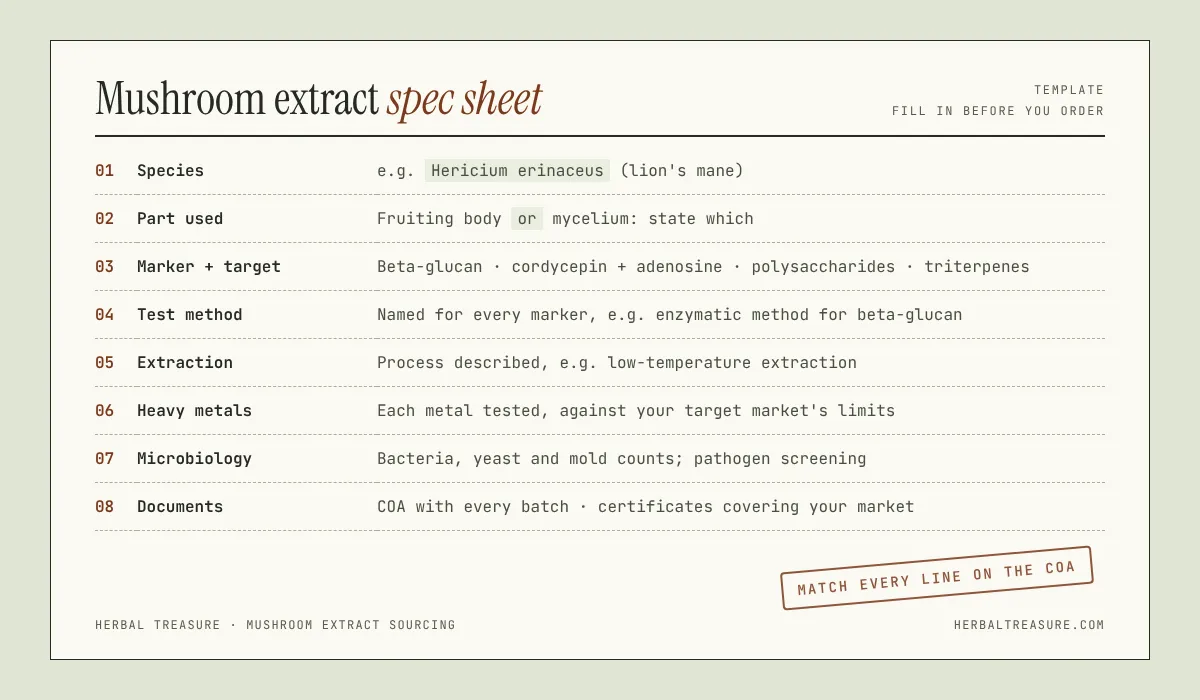
The marker you lock in depends on the mushroom. Here is where to focus for the four extracts buyers ask us about most.
Lion’s Mane Extract (Hou Tou Gu): Ask for Beta-Glucan
Total polysaccharides are the most common number on a lion’s mane quote, but on their own they can mislead. The figure that tells you more is beta-glucan, a specific group of polysaccharides. Ask for a beta-glucan target and the method used to measure it; beta-glucan is usually measured with an enzymatic method, while total polysaccharides are commonly measured with the phenol-sulfuric acid method.
At Herbal Treasure, lion’s mane is cultivated in greenhouses and extracted at low temperature. Polysaccharide content can be customized from 20% to 50%, and extracts with 15% or more beta-glucan are available.
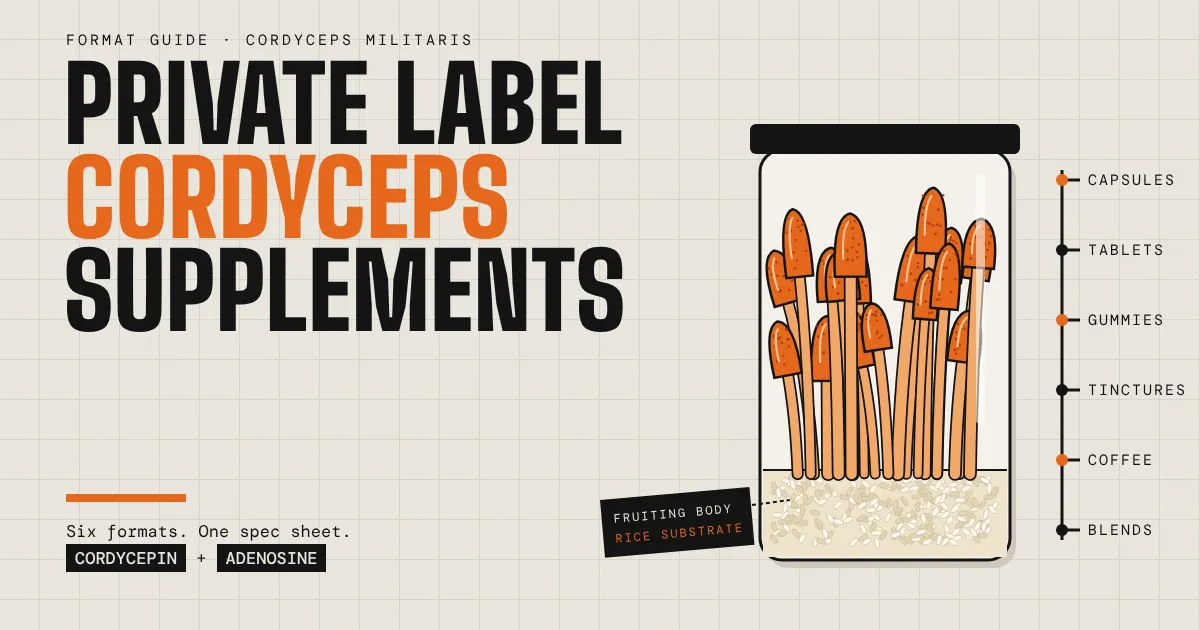
Cordyceps Militaris Extract (Yong Chong Cao): Ask for Cordycepin and Adenosine
For cordyceps militaris, the two numbers that matter are cordycepin and adenosine. Two powders can look identical and still differ widely in both. Because these compounds are sensitive to heat, ask how the extract is made and look for a low-temperature process.
Put a required content for both compounds in your specification, and check each batch against it before the goods ship. Our cordyceps militaris is grown in greenhouses under standardized conditions, which helps keep one harvest close to the next.
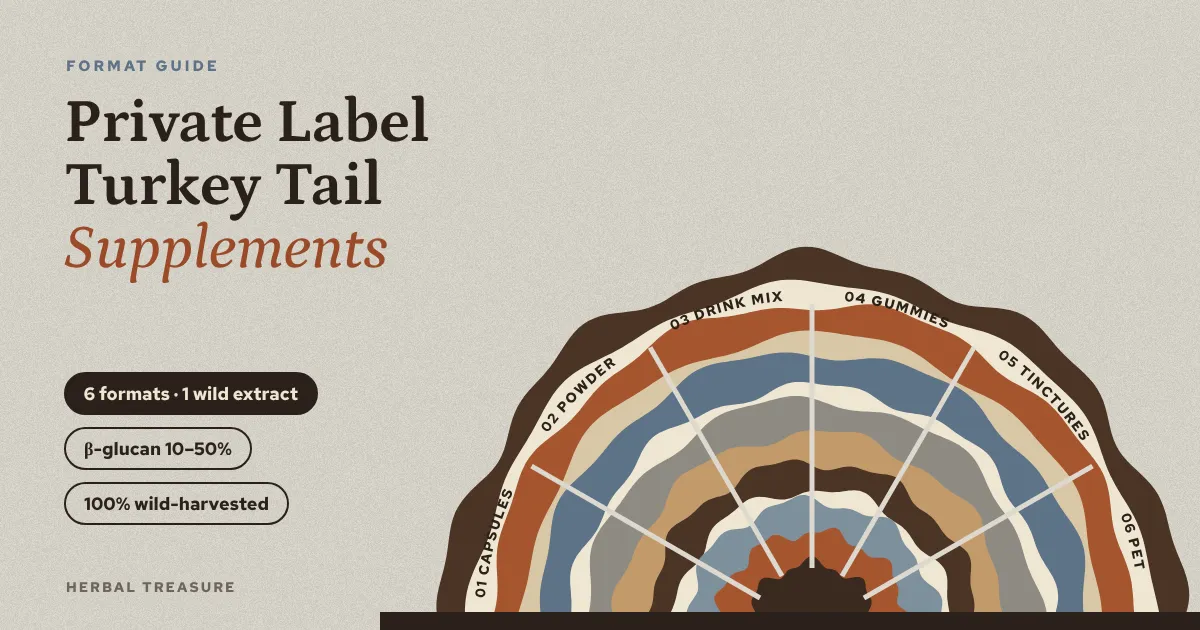
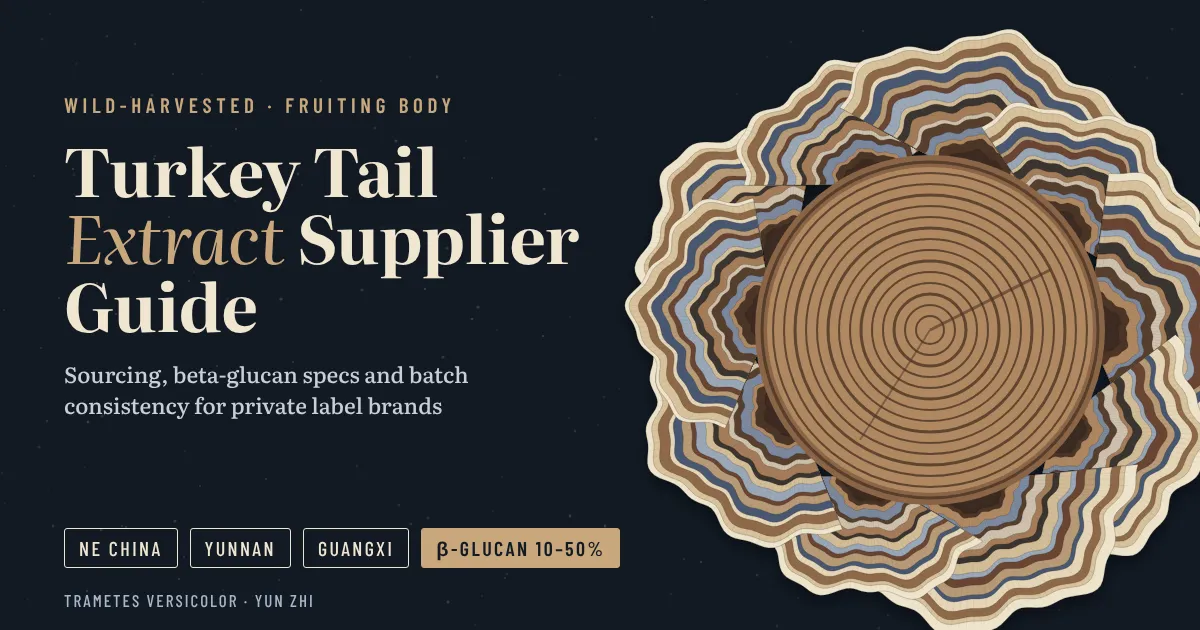
Turkey Tail Extract (Yun Zhi): Ask for Polysaccharides and the Raw Material
Turkey tail, named for its banded, fan-shaped caps, is usually specified by its polysaccharide content. Ask for the polysaccharide level to be stated on the COA together with the test method, and ask whether the extract comes from the fruiting body or from mycelium. Those are different raw materials, so the price and the label should reflect which one you are buying.
Reishi Extract (Ling Zhi): Ask for Polysaccharides and Triterpenes
Reishi extracts are usually specified by two markers: polysaccharides and triterpenes. The most common sourcing traps are mycelium sold as fruiting body extract and overstated triterpene figures, so ask for both markers, the test methods, and a clear statement of the part used.
Our reishi is grown on hardwood logs at our own forest base in Fujian. Extracts can be standardized to 20–50% polysaccharides and 4–10% triterpenes, depending on your product. For more detail, see our guide to log-grown reishi extract.
Matching Mushroom Extracts to the Formats Shoppers Buy
Shoppers overseas increasingly reach for formats that fit into daily routines. Capsules remain the classic choice, while gummies, tinctures and mushroom coffee have helped brands stand out on crowded marketplaces. The format you choose affects what you should ask of your extract.
- Capsules and tablets:a fixed amount of material fits in each one, so a standardized extract with a known marker level makes dosing consistent from bottle to bottle.
- Gummies:each gummy carries only a small amount of extract alongside its base, flavor and color, so consistent concentration and a reliable COA matter even more.
- Tinctures and liquids:ask your supplier to confirm which extract suits a liquid format and how the marker level is stated in the finished product.
- Mushroom coffee and drink mixes:extracts are blended with coffee or other powders, so agree on the extract amount per serving and keep the spec sheet with the blend formula.
Single-mushroom products and multi-mushroom blends, for example lion’s mane with cordyceps and reishi, can be made in most of these formats. Working with a supplier that also makes finished products lets you test a second format later without starting over with a new factory. Our guide to private label mushroom supplements covers that path in more detail.
Trader or Source Factory? 5 Questions to Ask a Mushroom Extract Supplier
A supplier’s answers to these questions will tell you quickly whether you are talking to a manufacturer or a middleman:
- Where are the mushrooms grown?Look for an owned cultivation base and traceable raw materials.
- Who does the extraction?An in-house extraction workshop means the supplier controls the step that creates most of the value.
- Which test method stands behind each number?A marker without a method is hard to compare between suppliers.
- Will every batch come with a COA?Ask for one with each production lot, not only with the sample, and consider a third-party test on your first order.
- Do the certificates cover your market?Check that each certificate is issued to the factory that makes your product and that your product falls within its scope.
Certification needs differ between the United States, Canada and the EU. Our mushroom supplement compliance guide explains what each market typically asks for.
How Herbal Treasure Works as a Mushroom Extract Supplier
Fujian is home to a number of manufacturers that now cover the full chain from cultivation to finished product. Herbal Treasure is one example. Founded in 2003, we grow, extract and manufacture medicinal mushroom products in-house, and supply both ingredients and finished products to brands worldwide.
- Cultivation:our own forest-grown base of more than 200 mu (about 13 hectares, or 33 acres) in Jiangle County, Sanming, in the southern Wuyi Mountains, plus greenhouse cultivation for species such as lion’s mane and cordyceps militaris.
- Extraction and production:a 1,000 m² (about 10,800 sq ft) extraction workshop and more than 8,000 m² (about 86,000 sq ft) of cGMP workshops.
- Ingredients we supply:bulk mushroom powders and mushroom extracts, plus reishi spore powder and reishi spore oil.
- Finished products:capsules, tablets, powders, gummies, tinctures, liquids, drink mixes and mushroom coffee, made under OEM or from more than 5,000 proven ODM formulas.
- Testing:an in-house lab with atomic absorption spectroscopy (AAS), high-performance liquid chromatography (HPLC) and high-performance thin-layer chromatography (HPTLC), checking species identity, active content, heavy metals and microbiology.
- Certifications:USDA Organic, EU Organic, NSF cGMP, Halal and Kosher, in an FDA-registered facility.
- Reach:more than 1,000 brand clients in over 40 countries and regions.
For finished products, our minimum order starts from 500 units per SKU, for both OEM and ODM.
The Bottom Line: Choose a Supplier on Standards, Not Just Price
The competition among mushroom extract suppliers has moved from price to proof: standardized markers, documented testing, multi-market compliance and the ability to develop finished products. For a cross-border brand, choosing a source factory that controls cultivation, runs its own extraction and holds the right certificates can mean fewer surprises between batches and a smoother path from sample to launch.
Ready to compare specifications? Send us the extract, marker and target market you have in mind, and request a quote.
Frequently Asked Questions
What does a mushroom extract supplier provide?
A mushroom extract supplier provides bulk mushroom powders or concentrated extracts standardized to a marker such as beta-glucan, polysaccharides, triterpenes or cordycepin, with a COA for each batch. Many source factories can also turn those extracts into finished capsules, gummies, tinctures or mushroom coffee.
What should a mushroom extract COA include?
A COA should show the batch number, the species and part used, each marker with its specification and actual result, the test method for each figure, and results for heavy metals and microbiology.
What is the difference between fruiting body and mycelium extract?
The fruiting body is the mushroom itself, the cap and stem. Mycelium is the root-like network that grows in the substrate. They are different raw materials, so your spec sheet and label should state which one you are buying.