The mushroom supplement market is growing quickly, and the brands that win on Amazon and their own websites are no longer competing on cheap raw powder. They compete on standardized extracts, finished products and export-ready compliance. That makes your choice of manufacturer one of the most important decisions you will make.
Lion’s mane, reishi, cordyceps and turkey tail supplements are taking up more and more shelf space in cross-border e-commerce. Below, we look at how big the market is, how buyers’ expectations are changing, and what to look for in a Chinese OEM or ODM partner.
How Big Is the Medicinal Mushroom Market?
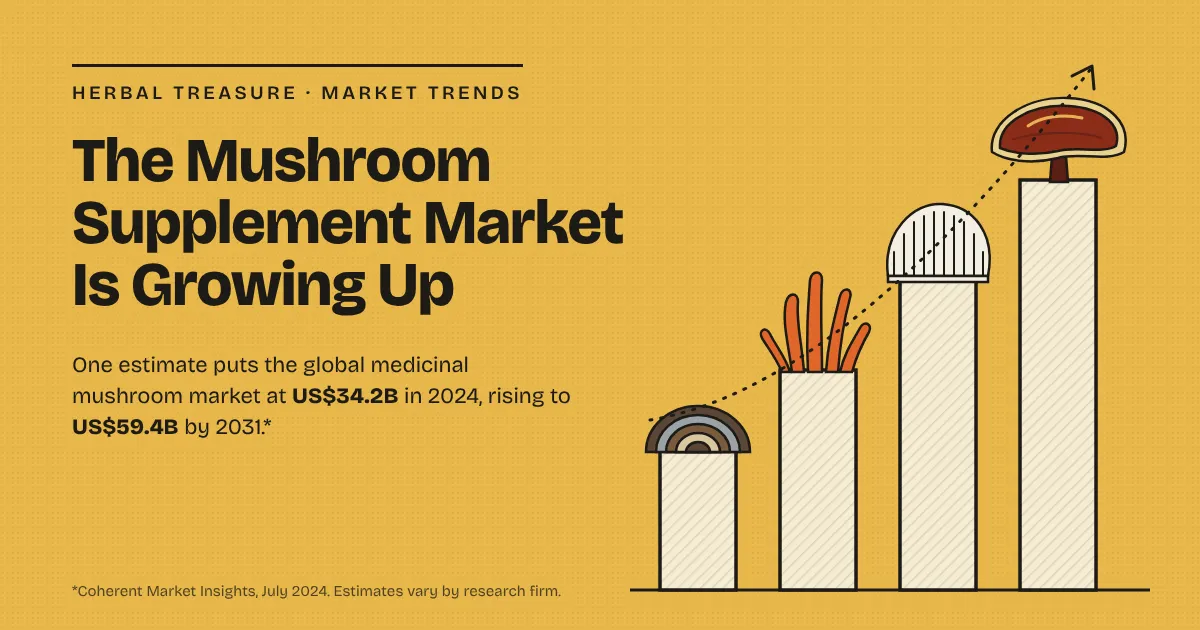
Estimates vary by research firm and by how the market is defined. Coherent Market Insights valued the global medicinal mushroom market at US$34.22 billion in 2024 and projects it will reach US$59.41 billion by 2031, a compound annual growth rate (CAGR) of 8.2%.
Other firms publish different figures, so treat any single number as a sign of direction rather than a precise forecast. The direction, though, is consistent: demand for mushroom-based supplements is expanding, and the category is maturing.
Which Mushrooms Lead the Mushroom Supplement Market?
Four medicinal mushrooms come up again and again in mushroom supplement listings on Amazon and independent brand stores:
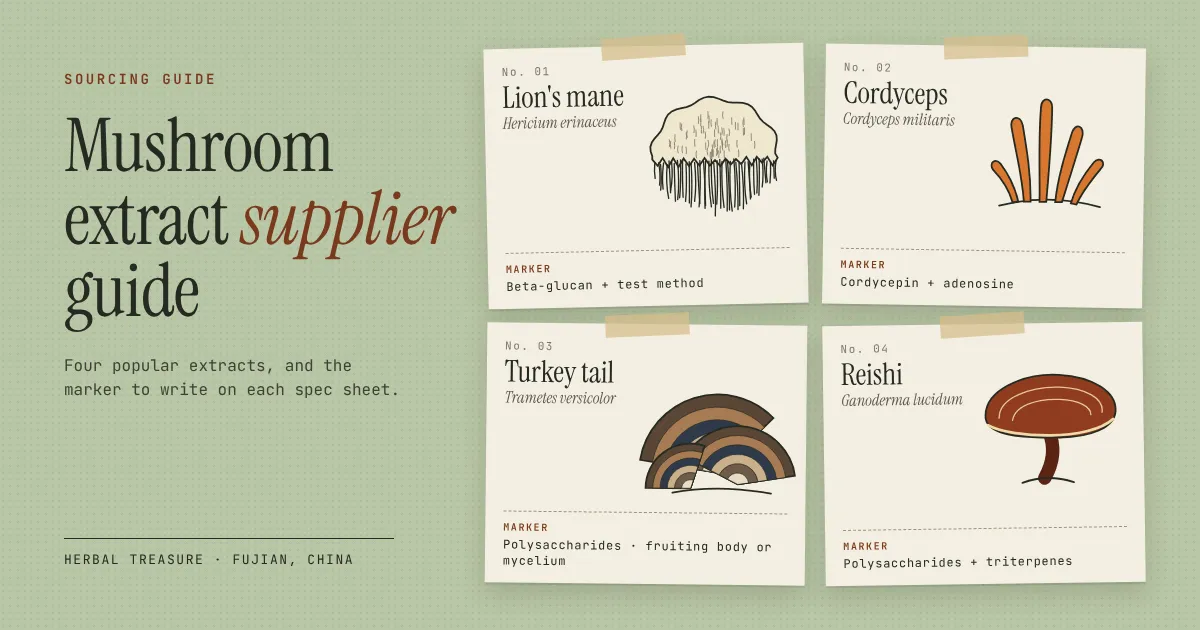
- Lion’s mane (hou tou gu):the shaggy white mushroom found in many capsules, powders and blends.
- Reishi (ling zhi):a glossy, woody mushroom with a long history in traditional Chinese wellness practice.
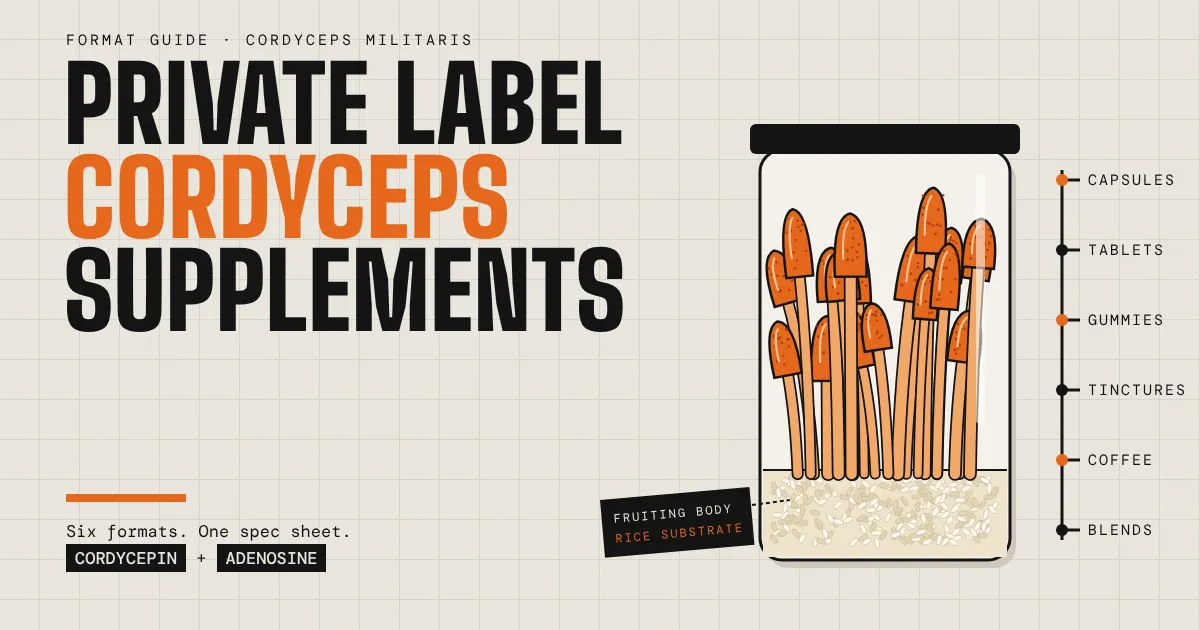
- Cordyceps militaris (yong chong cao):a cultivated species of cordyceps with distinctive orange fruiting bodies.
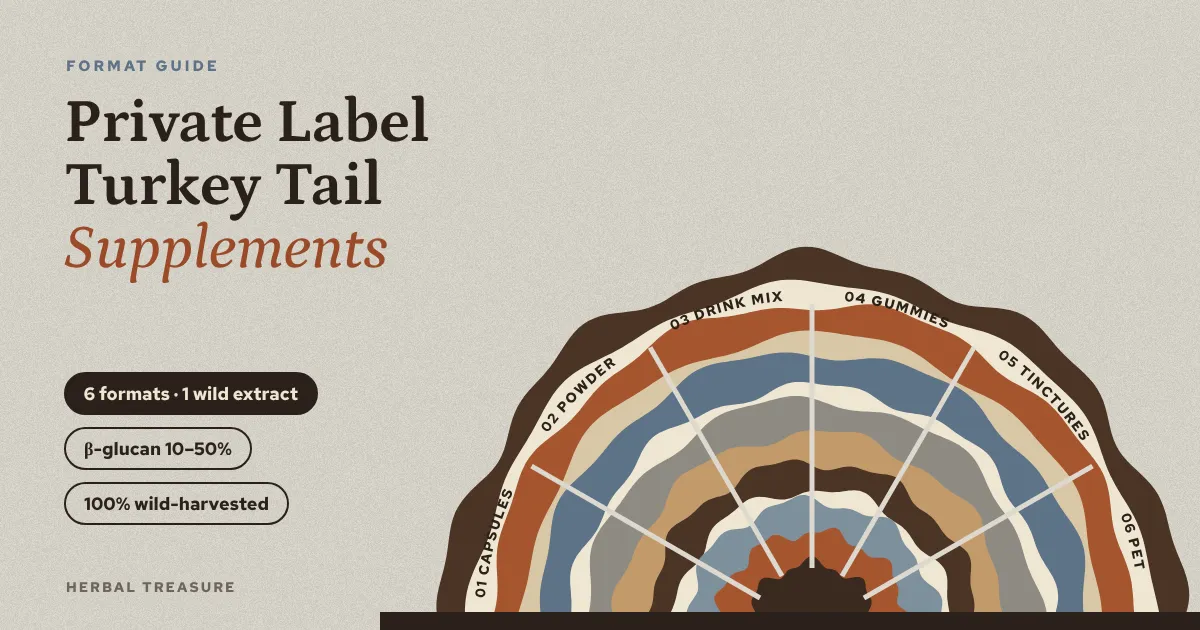
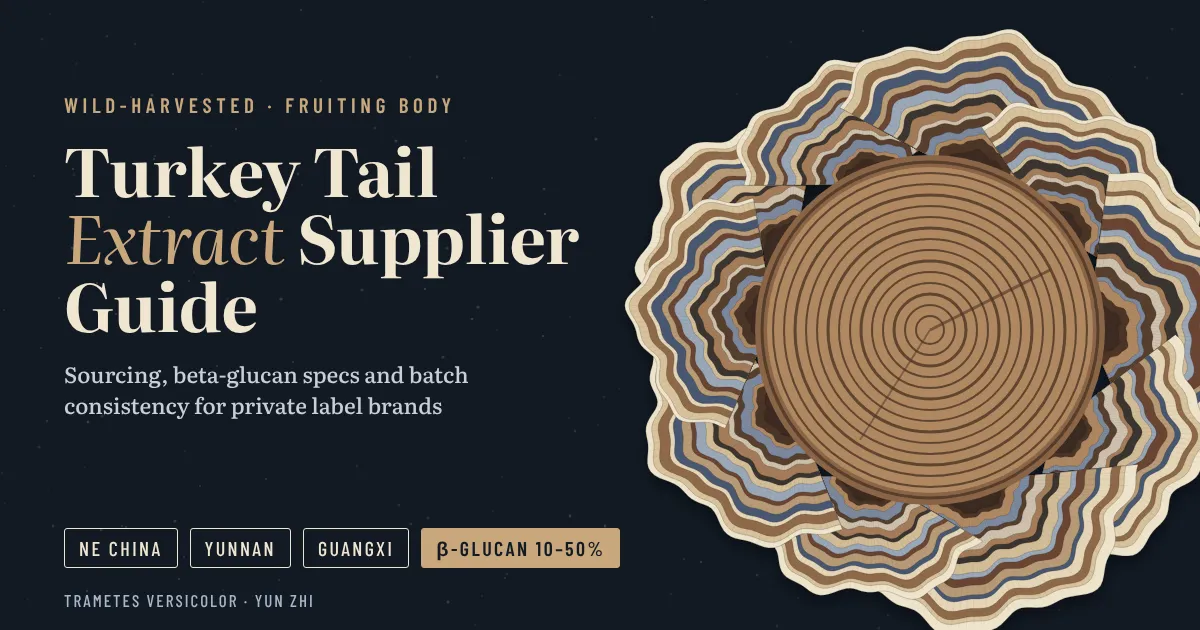
- Turkey tail (yun zhi):named for its banded, fan-shaped caps.
Many brands also sell multi-mushroom blends that combine several of these in a single formula, in formats that range from capsules and gummies to drink mixes and mushroom coffee.
How Mushroom Supplement Buyers’ Expectations Are Changing
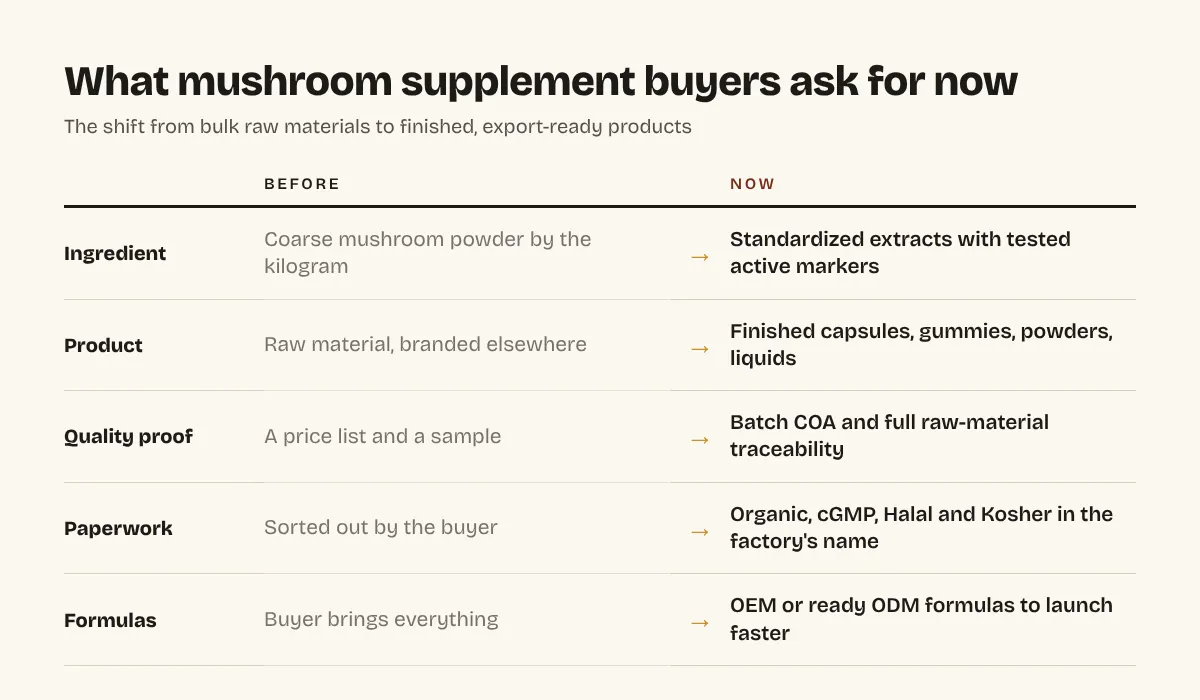
Brands no longer buy coarse mushroom powder by the kilogram and work out the rest themselves. Today they want a factory that can supply standardized extracts, finished products in several dosage forms, and a complete set of export compliance documents, all from one source.
From Raw Powder to Standardized Extracts
Overseas shoppers pay close attention to active ingredient levels on the label. That pushes brands toward extracts standardized to measurable markers, such as polysaccharides or beta-glucans, with test results to back up every batch.
From Ingredients to Finished Products
Amazon sellers and DTC (direct-to-consumer) brands want products they can list, not ingredients they still have to turn into capsules or gummies. A manufacturer that handles the finished dosage form saves them a whole step in the supply chain.
From Promises to Documented Compliance
Organic certification, batch traceability and market-specific paperwork now decide whether a product can be sold at all. Buyers expect these documents up front, in the manufacturer’s own name.
Why China Sits at the Center of the Mushroom Supplement Supply Chain
China is the world’s leading supplier of medicinal mushroom raw materials. For many years, though, much of what left the country was basic material, such as dried mushrooms and coarse powders sold on thin margins.
Cross-border e-commerce is changing that. As brand owners ask for more, Chinese manufacturers are moving from raw materials to finished products, adding extraction, formulation and compliance capability along the way.
Why a Trading Company Is No Longer Enough
A trading company can find you a product, but it does not control how that product is grown, extracted or made. When a brand needs consistent active ingredient levels, batch-level traceability and certificates that match the factory doing the work, a middleman struggles to deliver.
That is why more cross-border sellers are going straight to source manufacturers.
What to Look for in a Mushroom Supplement OEM Manufacturer
The key question is not whether a supplier can ship goods, but whether it controls the chain behind them. Look for four things: its own cultivation, its own extraction workshop, compliance credentials for several markets, and in-house formulation (ODM) capability.
1. Its Own Cultivation
A manufacturer that grows its own mushrooms can trace every raw material back to its source and keep quality steady from season to season.
2. Its Own Extraction Workshop
Extraction is where active ingredient levels are set. An in-house workshop lets the manufacturer standardize extracts to your specification and keep them consistent from batch to batch.
3. Compliance for Multiple Markets
If you plan to sell in North America, Europe and beyond, your manufacturer needs certifications that cover each market, held in its own name.
4. ODM Formulation and R&D
Ready-made formulas let you launch without developing a product from scratch. OEM is still there when you have your own formula.
Why It Matters for Your Launch
The right partner lowers the cost of testing new products and shortens the time it takes to get them listed. At Herbal Treasure, for example:
- Samples take 5–7 days for standard formulas and 7–14 days for custom ODM work.
- Standard production takes 15–20 days.
- The minimum order is 500 units per SKU, for both OEM and ODM.
How Herbal Treasure Helps Brands Enter the Mushroom Supplement Market
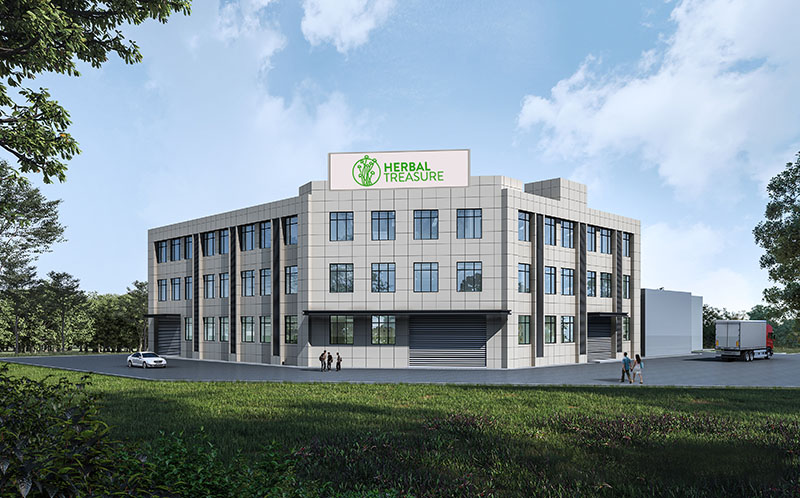
Founded in 2003 in Fujian, Herbal Treasure is a source manufacturer that covers the whole chain in-house, from cultivation and proprietary extraction to finished products and global delivery.
- Cultivation:our own forest-grown base of more than 200 mu (about 13 hectares, or 33 acres) in Jiangle County, Sanming, in the southern Wuyi Mountains.
- Facilities:more than 10,000 m² (about 108,000 sq ft) of production space, including over 8,000 m² (about 86,000 sq ft) of cGMP workshops and a 1,000 m² (about 10,800 sq ft) extraction workshop.
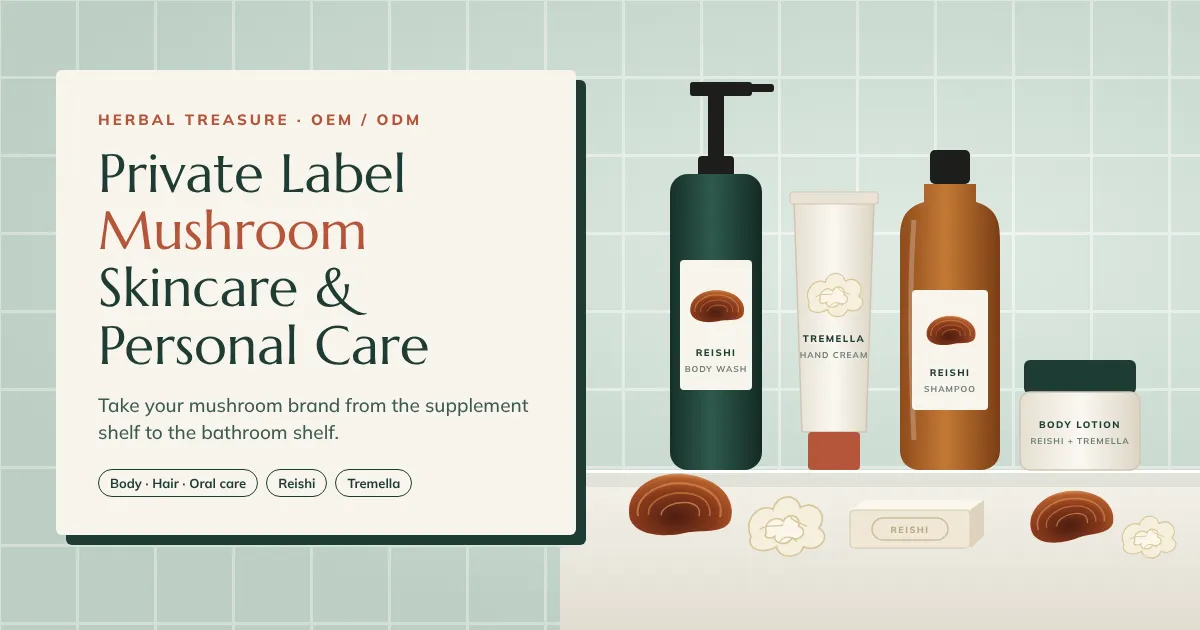
- Dosage forms:capsules, tablets, powders, gummies, liquids, tinctures and powdered drink mixes, plus mushroom personal care products.
- Certifications:USDA Organic, EU Organic, NSF cGMP, Halal and Kosher, an FDA-registered facility, and a Health Canada Foreign Site Reference Number (FSRN).
- Formulas and packaging:more than 5,000 proven formulas, plus packaging design for bottles, pouches, stick packs and gift boxes.
- Reach:more than 1,000 brand clients in over 40 countries and regions.
The Mushroom Supplement Opportunity Has Moved From Price to Capability
The window for mushroom supplements in cross-border e-commerce is open. But supply-chain competition has shifted from price wars to standardization, compliance and custom R&D.
For brands entering the market, the safest path is a source manufacturer with its own cultivation, its own extraction, multi-market compliance and formulation strength. That combination helps you launch faster and spend less on trial and error.
Frequently Asked Questions
How big is the mushroom supplement market?
Estimates vary by research firm. Coherent Market Insights valued the global medicinal mushroom market at US$34.22 billion in 2024 and expects it to reach US$59.41 billion by 2031, growing about 8.2% a year.
Why do brands source mushroom supplements from China?
China is the leading supplier of medicinal mushroom raw materials, and many Chinese manufacturers now handle cultivation, extraction, finished products and export documents in one place.
What is the minimum order for private label mushroom supplements?
It depends on the manufacturer. At Herbal Treasure, the minimum order is 500 units per SKU for both OEM and ODM products.
What dosage forms can a mushroom supplement manufacturer make?
At Herbal Treasure, we make capsules, tablets, powders, gummies, liquids, tinctures and powdered drink mixes, as well as mushroom personal care products.