
For many supplement brands, a mushroom supplement business is one of the more promising ways to grow in 2026. Demand keeps rising in North America, Europe and Southeast Asia, one mushroom can become a whole product line, and quality can be measured and printed on a label. The catch is that success depends less on clever marketing than on a dependable supply chain.
This article is for brands deciding whether to enter the category, or to expand into it. We look at why medicinal mushrooms stand out, where new brands most often lose money, and what a supply chain should cover before you place a first order.
Why Medicinal Mushrooms Are a High-Potential Supplement Category
Why are mushroom supplements growing? Shoppers increasingly take mushroom products as part of their everyday routine, not as an occasional extra. At the same time, the category suits the way brands sell today: many formats, measurable quality markers, and a mature supply base that can deliver finished products rather than raw powder.
Here is what sets the category apart.
Everyday Use Across Several Regions
Reishi (ling zhi), lion’s mane (hou tou gu), cordyceps and chaga have moved from specialty health stores into mainstream online shopping. More and more consumers in North America, Europe and Southeast Asia take them daily, in a capsule with breakfast or in a morning coffee.
The main sales channels are Amazon, independent brand websites (DTC, direct-to-consumer) and social commerce. Each one rewards brands that can restock reliably and show clear product information.
Published market estimates vary widely between research firms, so we do not quote a single figure here. What they agree on is the direction: the category is still growing.
One Mushroom, Many Product Formats
Few ingredients travel across formats as easily as medicinal mushrooms. The same extract can become:
- Capsules and tablets
- Powders and stick packs
- Gummies
- Tinctures
- Mushroom coffee and lattes
- Personal care products, such as soap, shampoo and hand cream
For a brand, that means one hero ingredient can grow into a full range. A lion’s mane capsule can be followed by a lion’s mane coffee and a gummy, all under the same story.
Quality You Can Measure and Show
Mushroom extracts have measurable markers. Depending on the species, these include polysaccharides, beta-glucan, cordycepin, adenosine and triterpenes. A brand can specify a level, test every batch against it and show the result on a certificate of analysis (COA).
That matters to buyers who read labels closely. A specification backed by test results is far easier to trust than a vague promise of “high potency.”
A Supply Base That Has Moved Up the Value Chain
China grows most of the world’s cultivated mushrooms. For years, its exports were mostly dried mushrooms, canned goods and coarse powders. Today, a growing share is high-value product: standardized extracts, capsules, gummies and functional coffee.
Fujian Province, with its long tradition of mushroom growing and the forests of the Wuyi Mountains, is home to several manufacturers that run the whole chain from cultivation to finished product. Herbal Treasure is one of them.
Where New Mushroom Supplement Brands Lose Money
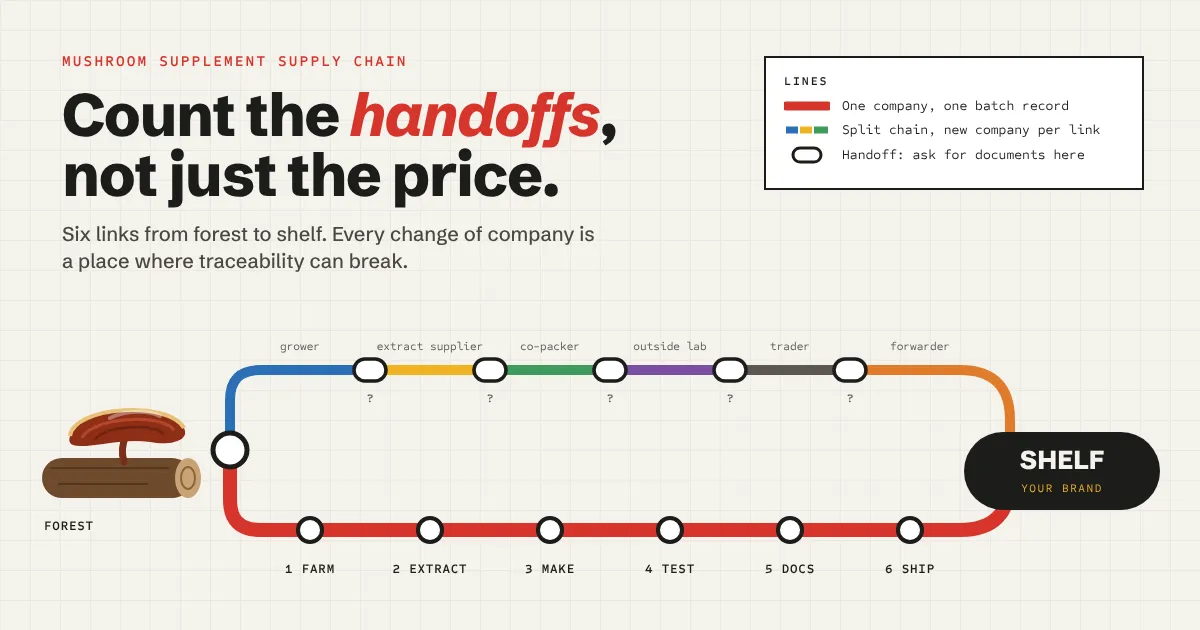
What is the biggest risk when starting a mushroom supplement business? For most new brands, it is the supply chain, not demand. Buying through a trading middleman can mean inconsistent batches, missing export documents and products that cannot be listed or cleared through customs. Each of these turns finished stock into a loss.
These are three of the most common risks, and each one can be avoided.
1. Batches That Do Not Match
A trader may buy from different farms or factories from one order to the next. The mushroom species, the part used (fruiting body or mycelium) and the marker levels can all shift. If the second batch tests differently from the first, your label and your reviews both suffer.
2. Missing Documents That Block Your Listing
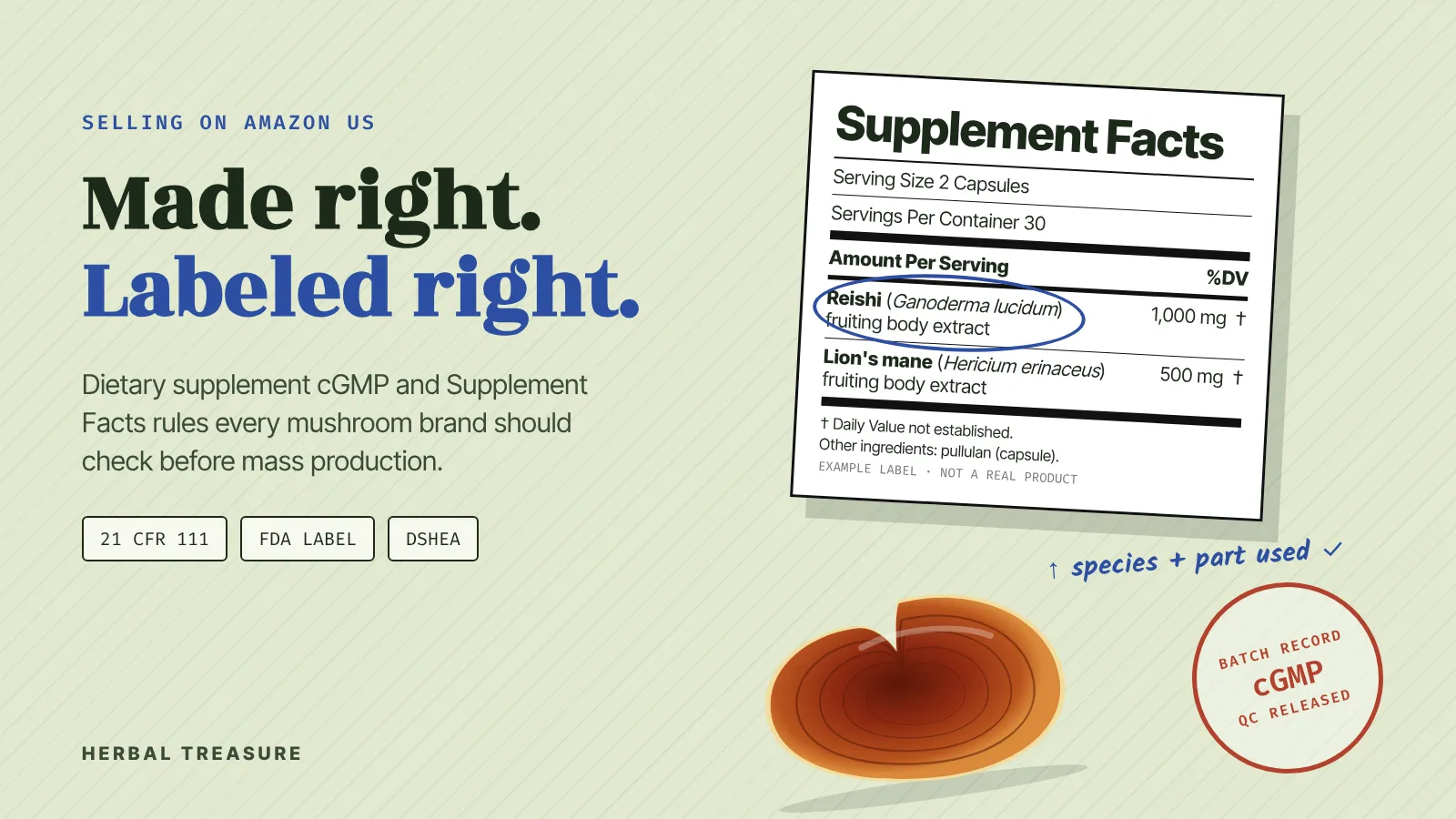
Marketplaces increasingly ask for proof before a supplement goes live. In Amazon’s US store, for example, dietary supplements must be verified by an approved third-party testing organization. If your supplier cannot provide matching COAs, facility certificates and label information, a finished product can sit in a warehouse instead of on the shelf.
3. Shipments Held at Customs
Each destination has its own paperwork. A shipment without the right certificates for its market, such as organic, Halal or facility registration documents, may be delayed or refused at the border. Storage fees and lost selling time add up quickly.
What a Reliable Mushroom Supplement Supply Chain Looks Like
What should a mushroom supplement manufacturer control? Look for one partner that connects five links: cultivation, extraction, finished dosage forms, compliance and export delivery. When one company controls all five, every batch can be traced back to its source, and every document is issued in the manufacturer’s own name.
| Link in the chain | What to ask | Why it matters |
| Cultivation | Where are the mushrooms grown or harvested? Do you own the base? | Traceable, consistent raw material |
| Extraction | Is extraction done in-house? Which markers do you standardize? | Stable marker levels from batch to batch |
| Dosage forms | Which formats can you produce under one roof? | Room to grow your range with one supplier |
| Compliance | Which certificates do you hold, in your own name? | Documents that match your market and channel |
| Export delivery | Can you prepare market-specific paperwork and support customs clearance? | Products that arrive and can be sold |
Is Your Mushroom Supplement Business Ready? A Pre-Launch Checklist
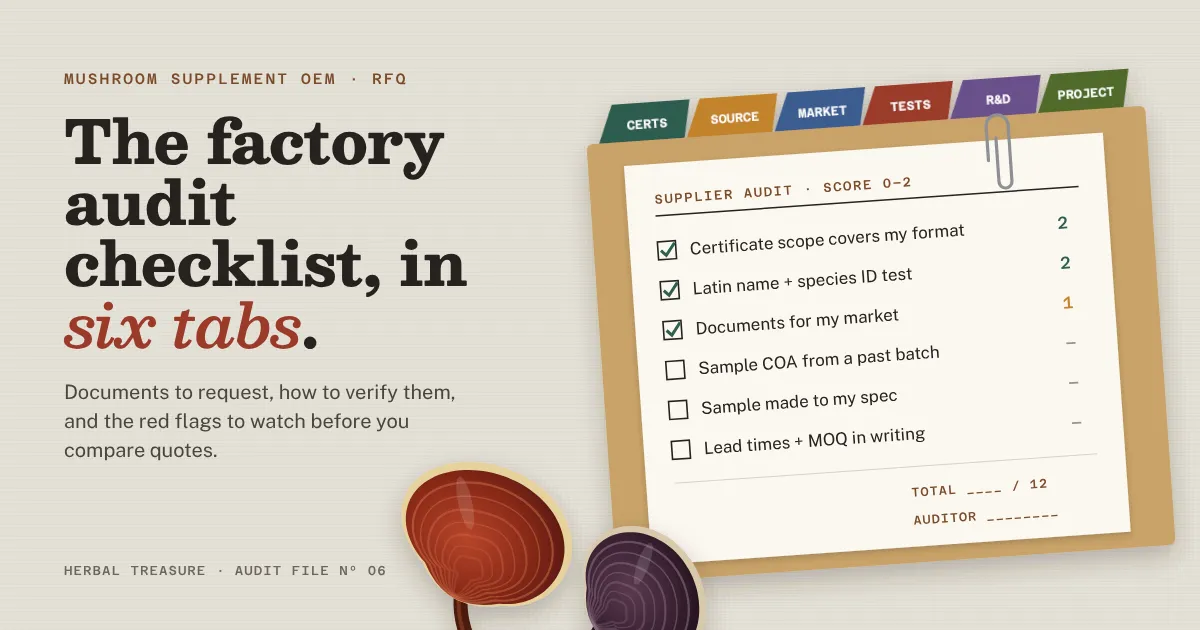
Before you contact a manufacturer, check that you can answer these six questions. They make your first quote more accurate and your first order faster.
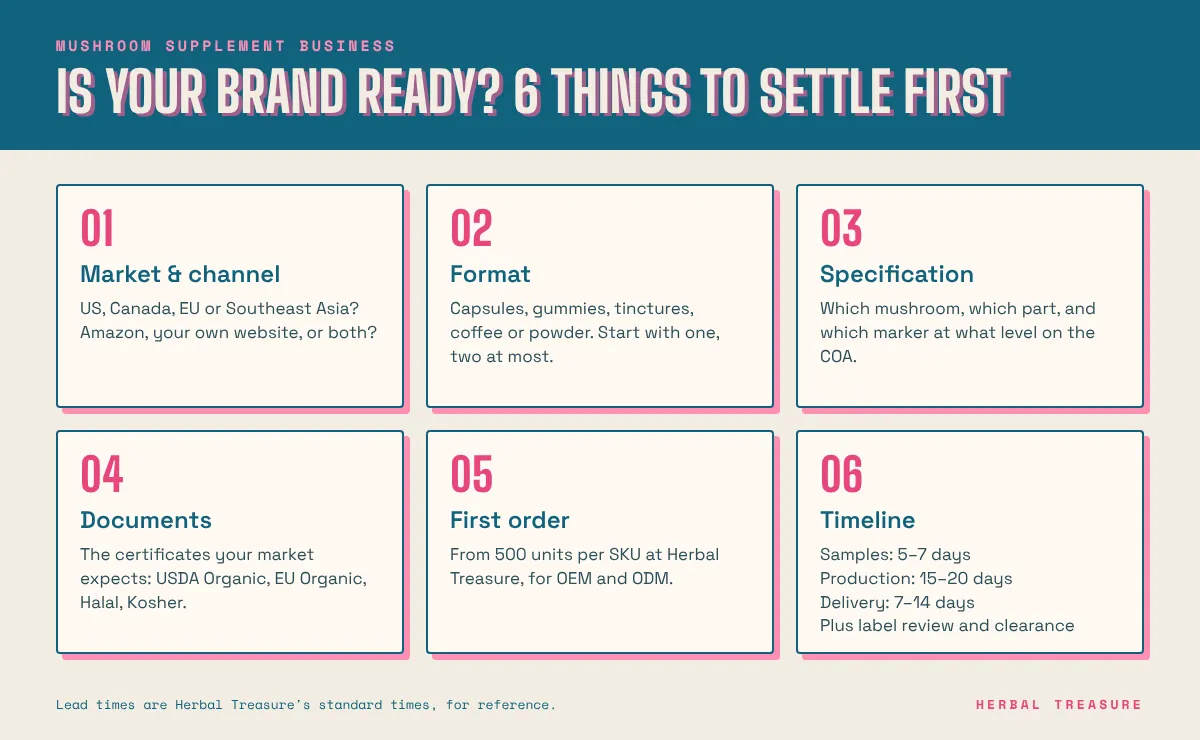
- Market and channel.Where will you sell first: the US, Canada, the EU or Southeast Asia, and on Amazon, your own website or both?
- Capsules, gummies, tinctures, coffee or a powder? Pick one to start, or two at most.
- Which mushroom, which part, and which marker at what level should appear on the COA?
- Which certificates does your market or marketplace expect, such as USDA Organic, EU Organic, Halal or Kosher?
- First order.At Herbal Treasure, the minimum order is 500 units per SKU, for both OEM and ODM.
- Standard samples take 5–7 days and standard production 15–20 days. International delivery usually takes 7–14 days. Label review, import clearance and marketplace approval can add time, so plan your launch date around all of them.
Herbal Treasure: A Source Manufacturer From the Wuyi Mountains
Herbal Treasure grew out of a family business growing reishi. Today we serve more than 1,000 brands, and our products reach more than 40 countries and regions.
Here is what sits behind each order:
- Our own cultivation base.More than 200 mu (about 13 hectares, or 33 acres) of forest-grown reishi in Jiangle County, Sanming, in the southern Wuyi Mountains, plus wild-harvested species such as turkey tail (yun zhi) and chaga (bai hua rong), supplied with wild-collection certificates.
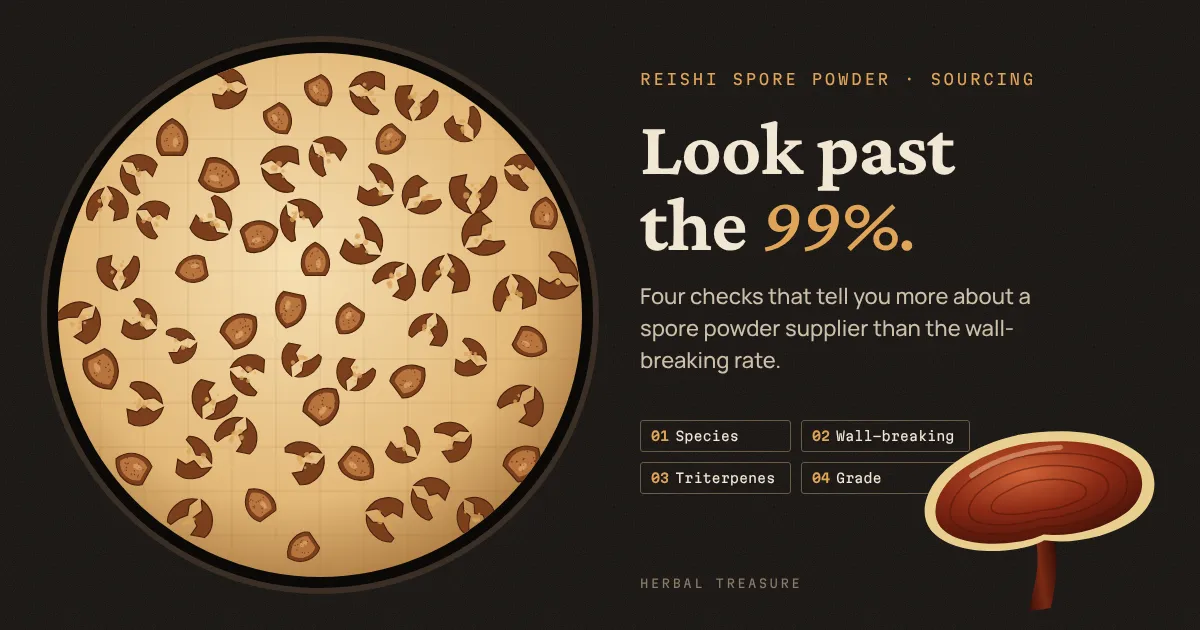
- A wide range of mushrooms.Reishi, lion’s mane, Cordyceps militaris, chaga, turkey tail and more, supplied as powders, extracts, reishi spore powder and spore oil.
- In-house extraction and production.A facility of more than 10,000 m² (about 108,000 sq ft), with cGMP workshops, a dedicated extraction workshop and lines for capsules, tablets, powders, gummies and tinctures.
- Four capsule lines with up to 3 million capsules a day, 2 million tablets a day, 600,000–800,000 powder sachets a day, more than 3 tonnes of gummies a day, and automatic filling of 30,000–50,000 bottles a day.
- Our in-house lab tests every batch for active content, heavy metals, microbiology and species identity. Third-party testing is available on request, at the client’s cost.
- NSF cGMP, ISO 22000, FSSC 22000, HACCP, USDA Organic, EU Organic, Canada Organic, Halal and Kosher, plus an FDA-registered facility.
- OEM and ODM.Bring your own formula, or start from more than 5,000 proven formulas. We also offer packaging design for bottles, pouches, stick packs and gift boxes.
Factory visits and audits, by you or a third party, are always welcome.
The Bottom Line
The window for medicinal mushroom supplements is open, and it rewards brands that build on solid ground. Choose a market and a format, set a clear specification, and work with a source manufacturer that understands overseas requirements. That first decision shapes everything that follows.
Tell us your market, format and channel, and we will suggest a starting formula and send you a quote.
Frequently Asked Questions
Is a mushroom supplement business worth starting in 2026?
For many brands, yes. Consumer interest in reishi, lion’s mane, cordyceps and chaga keeps growing, and the category works across many formats. Success depends mainly on a reliable supply chain: consistent batches, complete documents and a manufacturer that understands your target market.
Which mushrooms are most common in supplements?
Reishi, lion’s mane, cordyceps (usually Cordyceps militaris), chaga and turkey tail are the most widely used. Many brands also sell multi-mushroom blends that combine several of them.
Should I buy from a trading company or a manufacturer?
A manufacturer that controls cultivation, extraction and production can trace every batch and issue documents in its own name. A trader may change sources between orders, which makes consistency and paperwork harder to guarantee.
What is the minimum order for a new mushroom supplement brand?
At Herbal Treasure, the minimum order is 500 units per SKU, for both OEM and ODM projects. The exact quantity can depend on the product, formula and packaging.