
Reishi Spore Powder Supplier Checklist: Four Checks That Matter More Than a 99% Wall-Breaking Rate
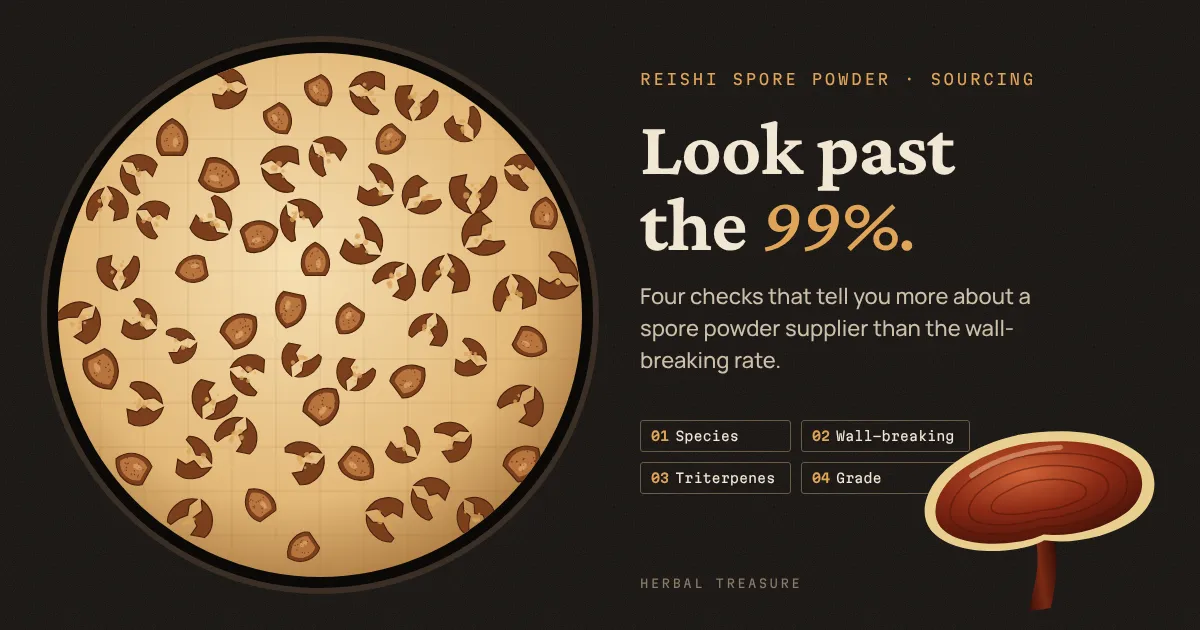
Choosing a reishi spore powder supplier? A 99% wall-breaking rate is the starting line, not the finish. Before you compare prices, confirm four things in this order: the reishi species, the wall-breaking report, batch triterpene results, and whether the powder is broken-wall or shell-removed. Each check answers a question the headline number cannot.
Spore powder is one of the most heavily marketed reishi ingredients. Sales pages lead with “99% broken” and “high triterpenes,” and two lots with the same headline figures can still be very different materials. This guide explains what each claim does and does not tell you, which documents to ask for, and how we handle these points at Herbal Treasure, from our forest base in Fujian, China.
What Is Reishi Spore Powder?
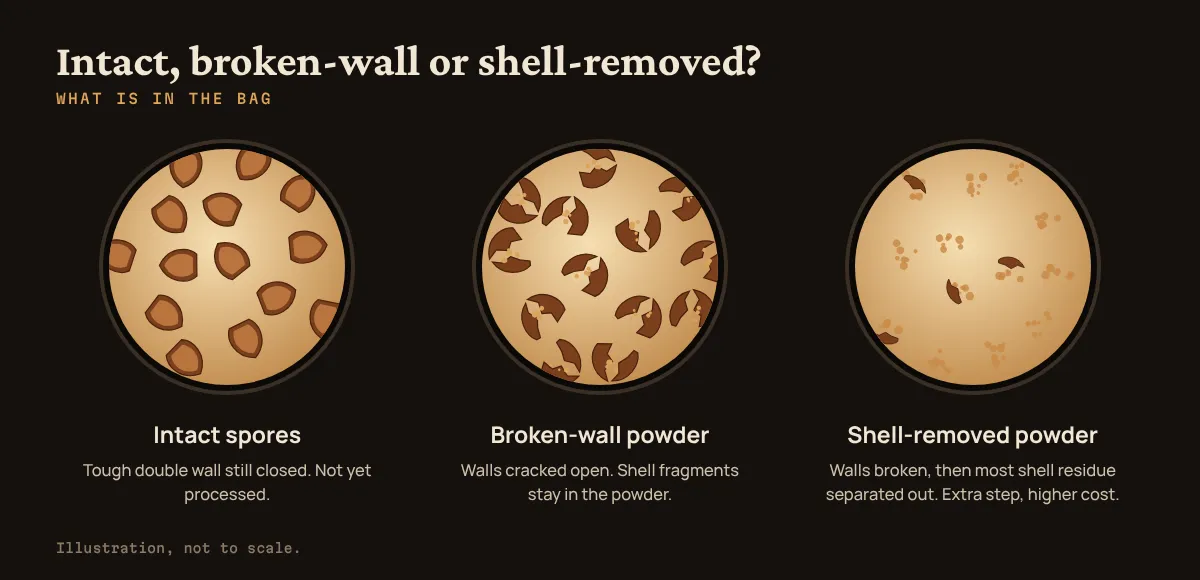
Reishi spore powder is made from the tiny spores a mature reishi mushroom (ling zhi) releases from the underside of its cap. Each spore has a tough outer wall, so the powder is usually processed to break that wall open. Broken-wall powder keeps the shell fragments; shell-removed powder has the shell residue separated out after wall breaking.
Spore powder is a different raw material from reishi fruiting body extract, which is made from the cap and stem. It is specified differently too. For spore powder, buyers look at species, wall-breaking rate, triterpenes and grade, so those are the four places where weak suppliers cut corners.
Pitfall 1: A High Wall-Breaking Rate on the Wrong Species
A wall-breaking rate measures processing, not identity. A 99% figure tells you the milling worked. It says nothing about which mushroom the spores came from, and that question comes first.
The Chinese Pharmacopoeia names two species for ling zhi: red reishi (chi zhi, Ganoderma lucidum) and purple reishi (zi zhi, Ganoderma sinense). Spores from other Ganoderma species can be sold as “reishi spore powder” too. If the species is not the one your specification and label name, a high wall-breaking rate does not fix that basic problem.
Do not rely on a triterpene test to settle the question. A routine triterpene test measures a group of compounds; it cannot tell you which species produced them. Species is confirmed by molecular (DNA) identification.
What to ask for:
- A DNA identification report that names the species and links to your batch or source material.
- The Latin name your supplier uses on the specification, so it matches your label.
- Where the spores were grown and collected.
Pitfall 2: Triterpene Numbers Boosted With Added Extract
Triterpenes are a common quality marker for reishi spore products, which makes them a tempting number to inflate. Some sellers raise the triterpene reading by blending in reishi extract, so the result no longer reflects the spore powder alone.
Keep two kinds of material apart when you compare offers:
- Native triterpenes: the triterpenes naturally present in the spore powder itself.
- Enriched triterpenes: higher levels obtained from a spore extract, where triterpenes have been concentrated.
Both can be legitimate products. The problem starts when an enriched or blended material is sold and priced as plain spore powder, or when a plain powder is compared against an enriched one as if they were the same thing.
What to ask for:
- A written composition statement: 100% spore powder, or a declared blend with each component named.
- The triterpene test method and the basis of the result, so you can compare like with like.
- A batch report whose batch number matches your delivery. If you want independent confirmation, request a third-party report for that batch.
Pitfall 3: Broken-Wall Powder Sold as Shell-Removed
Broken-wall and shell-removed powders are two different grades. Wall breaking cracks the spore shells open. Shell removal is a further step: after wall breaking, the shell residue is separated and removed, giving a higher-purity raw material. Because of that extra step, the cost difference between the two is large.
That price gap is exactly why some sellers offer ordinary broken-wall powder as shell-removed powder. The two may share a product name on a price list, but they are not the same material.
What to ask for:
- The grade named clearly on the specification: broken-wall or shell-removed.
- The same grade on the quotation, invoice and COA for each batch.
- Samples of both grades if you are deciding between them, so your team can compare them side by side.
How to Check a Reishi Spore Powder Supplier: Four Steps in Order
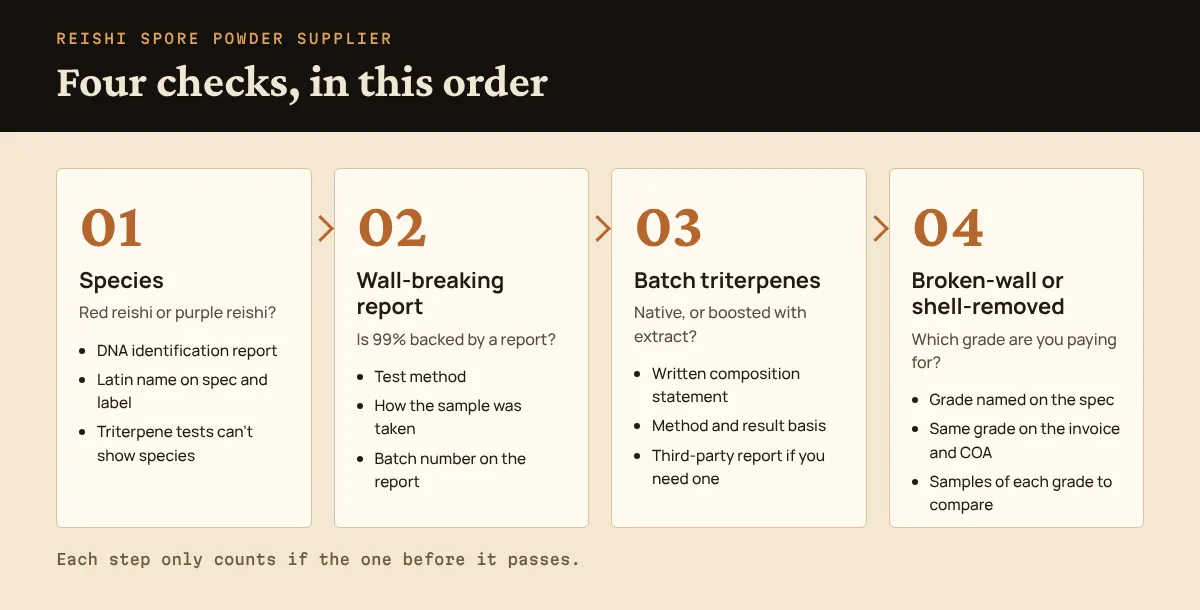
Check species first, then the wall-breaking report, then batch triterpene results, and finally the grade. The order matters because each step only counts if the one before it passes: a strong triterpene figure means little on the wrong species, and a premium grade is only worth paying for once the basics are confirmed.
- Confirm red or purple reishi with a DNA identification report.
- Wall-breaking report. Ask how the rate was measured, how the sample was taken, and which batch it covers.
- Batch triterpenes. Ask for the method, the result basis and a composition statement; add third-party testing if you need it.
- Confirm broken-wall or shell-removed on every document for the batch.
Beyond the Headline Claims: Storage, Safety Tests and Capsule Filling
The four checks above deal with the most common marketing claims. A few practical details also separate a reliable spore powder supplier from a risky one.
Packaging and Storage
Once the wall is broken, the spore contents are open to the air, so packaging and storage deserve a line on your specification. Ask how the powder is packed, what shelf life the supplier assigns, and the storage conditions that shelf life depends on.
Batch Safety Testing
Beyond species and triterpenes, ask for heavy metals and microbiology results on each batch report. As with any COA, read what the report actually states: the method, the limits, the units and the result for each item.
Capsule Filling
If you plan to sell spore powder capsules, ask how your manufacturer handles the powder’s flow. Spore powder flows poorly and is hard to fill into capsules consistently. At Herbal Treasure, we granulate and sieve the powder first, then check that its bulk density meets the target before filling. Ask your manufacturer to describe its own process, and confirm anything added during processing is declared on your label.
How Herbal Treasure Produces Reishi Spore Powder
We have grown medicinal mushrooms in Fujian since 2003. Our spore powder comes from our own forest base, and the four checks above are built into how we grow, process and document it.
- Source: a forest base of more than 200 mu (about 13 hectares, or 33 acres) in Jiangle County, Sanming, on the southern slopes of the Wuyi Mountains, where reishi is log-grown under near-wild conditions.
- Collection: each reishi on the base gets its own small canopy to collect its spores.
- Species: red reishi (Ganoderma lucidum) and purple reishi (Ganoderma sinense). We work with research institutes on species identification and strain selection, and a DNA identification report is available.
- Wall breaking: low-temperature jet wall-breaking, with a wall-breaking rate of 99% or higher. We supply both broken-wall and shell-removed grades.
- Testing: our in-house lab tests every batch, including heavy metals and microbiology, and each batch ships with its test report. Third-party testing can be arranged on request, paid by the client.
- Packaging and storage: nitrogen-flushed aluminum-foil bags, 25 kg (55 lb) bulk packs, and a two-year shelf life. Powder is held in cave storage or in cool, dry storage.
- Finished products: spore powder capsules filled after granulation and bulk-density checks, plus packaging design support. Finished products start from 500 units per SKU.
- Facility: NSF cGMP, ISO 22000, FSSC 22000 and HACCP certifications. Free samples are available (the client pays shipping), and we keep a retained sample of every batch for two years.
The Bottom Line
A 99% wall-breaking rate is worth checking, but it is only one of four questions. The right reishi spore powder supplier can show you the species, the report behind the wall-breaking figure, honest batch triterpene results and the grade you are paying for, all tied to the same batch number.
If you are sourcing reishi spore powder for bulk supply or private label capsules, contact Herbal Treasure for samples, specifications and batch documents.
Frequently Asked Questions
What does a 99% wall-breaking rate mean for reishi spore powder?
It means about 99% of the spores in the sample had their outer wall broken open during processing. It describes the processing only. It does not confirm the reishi species, the triterpene content or whether shell residue was removed, so check those separately.
What is the difference between broken-wall and shell-removed reishi spore powder?
Broken-wall powder has had its spore shells cracked open, and the shell fragments stay in the powder. Shell-removed powder goes through a further step that separates out the shell residue after wall breaking, giving a higher-purity material at a higher cost.
How can I verify the species in reishi spore powder?
Ask for a molecular (DNA) identification report. A routine triterpene test cannot tell species apart. The Chinese Pharmacopoeia names red reishi (Ganoderma lucidum) and purple reishi (Ganoderma sinense) for ling zhi.
Does a high triterpene result prove spore powder quality?
Not on its own. Some materials are boosted with added extract. Ask for a composition statement, the test method and result basis, and a batch report that matches your delivery, and compare plain spore powder only with plain spore powder.
This article is general sourcing information for brands and buyers. It is not medical, legal or regulatory advice, and it makes no claims about the health effects of reishi spore powder.