
Dietary supplement cGMP rules decide how your product must be made, and FDA labeling rules decide what its bottle must say. If you plan to sell reishi, lion’s mane or cordyceps supplements on Amazon US, both have to be right before mass production starts, because a non-compliant label or an undocumented batch can take a listing down after the money has been spent.
We see the same story again and again. A brand launches reishi spore powder or lion’s mane capsules on Amazon’s US store, sales begin, and a few weeks later a removal notice arrives. The product itself is often fine. What went wrong was a rule nobody checked before the order was placed.
This guide covers the two areas that matter most in the US: how supplements must be manufactured under 21 CFR Part 111, and what a compliant Supplement Facts label looks like. It ends with a checklist to run with your manufacturer before mass production.
How the FDA Regulates Dietary Supplements
In the United States, the FDA regulates dietary supplements after they reach the market, not before. No one approves a mushroom supplement or registers the product itself before it goes on sale. Instead, the law sets two duties: make the product under cGMP rules in an FDA-registered facility, and label it truthfully. The brand is responsible for both.
That is why “FDA registered” means less than many sellers think. Facility registration tells the FDA where a product is made. It is not an inspection result, a certificate or an approval of the product. Registration is renewed every two years, and a facility outside the US must name a US agent.
There are only two situations where the FDA hears about a supplement before or soon after launch:
- New dietary ingredients (NDIs):an ingredient not marketed in the US before October 15, 1994 generally needs a notification to the FDA before the product is sold.
- Structure/function claims:if the label describes how an ingredient affects the body’s normal structure or function, the brand must notify the FDA no later than 30 days after it starts marketing the product.
Neither one is an approval. Both are notices, and the brand stays responsible for the claim and the product.
What Dietary Supplement cGMP (21 CFR Part 111) Requires
Dietary supplement cGMP is the FDA rule, published as 21 CFR Part 111, that sets how supplements must be manufactured, packaged, labeled and held. Its core idea is that quality cannot be tested into a product at the end. It has to be built in through controlled, documented steps, so that every batch can be traced and explained.
In practice, cGMP covers far more than a clean workshop. These are the areas buyers should ask about:
- Specifications for every component.Each raw material needs written specs for identity, purity, strength and composition, and limits for contaminants.
- Identity testing.At least one appropriate identity test must be run on every dietary ingredient before it is used. For mushrooms, that means confirming the species, and ideally the part used.
- A master manufacturing record.One controlled document sets out the formula, the steps and the checks for each product.
- A batch production record.Every batch gets its own record showing what was used, who did each step and what the in-process checks found.
- Quality control release.A batch is released only after quality control reviews the records and confirms the finished product meets its specifications.
- Reserve samples.Samples of each batch must be kept for a set period linked to the product’s shelf life, so questions can be answered later.
- Complaints and returns.Product complaints must be reviewed and recorded, and returned products handled under written procedures.
Why a Local GMP Certificate Is Not Enough
A certificate from a factory’s home market shows that the site meets that market’s rules. It does not show that it meets 21 CFR Part 111. US-facing brands and retailers usually want evidence of cGMP aligned with US rules, and third-party certification such as NSF cGMP is one of the most common ways to provide it.
Amazon also asks for this evidence. Its US store requires dietary supplements to be verified by an approved testing and certification organization, and that review includes manufacture in a cGMP-compliant facility.
Your Brand Is Responsible Too
Outsourcing production does not outsource responsibility. The FDA has made clear that a company selling a supplement under its own name remains responsible for the product meeting cGMP, even when a contract manufacturer makes it. Keep copies of specifications, batch records and COAs for every lot you sell, and choose a manufacturer that can supply them quickly.
Supplement Facts Label Requirements: The Most Common Pitfall
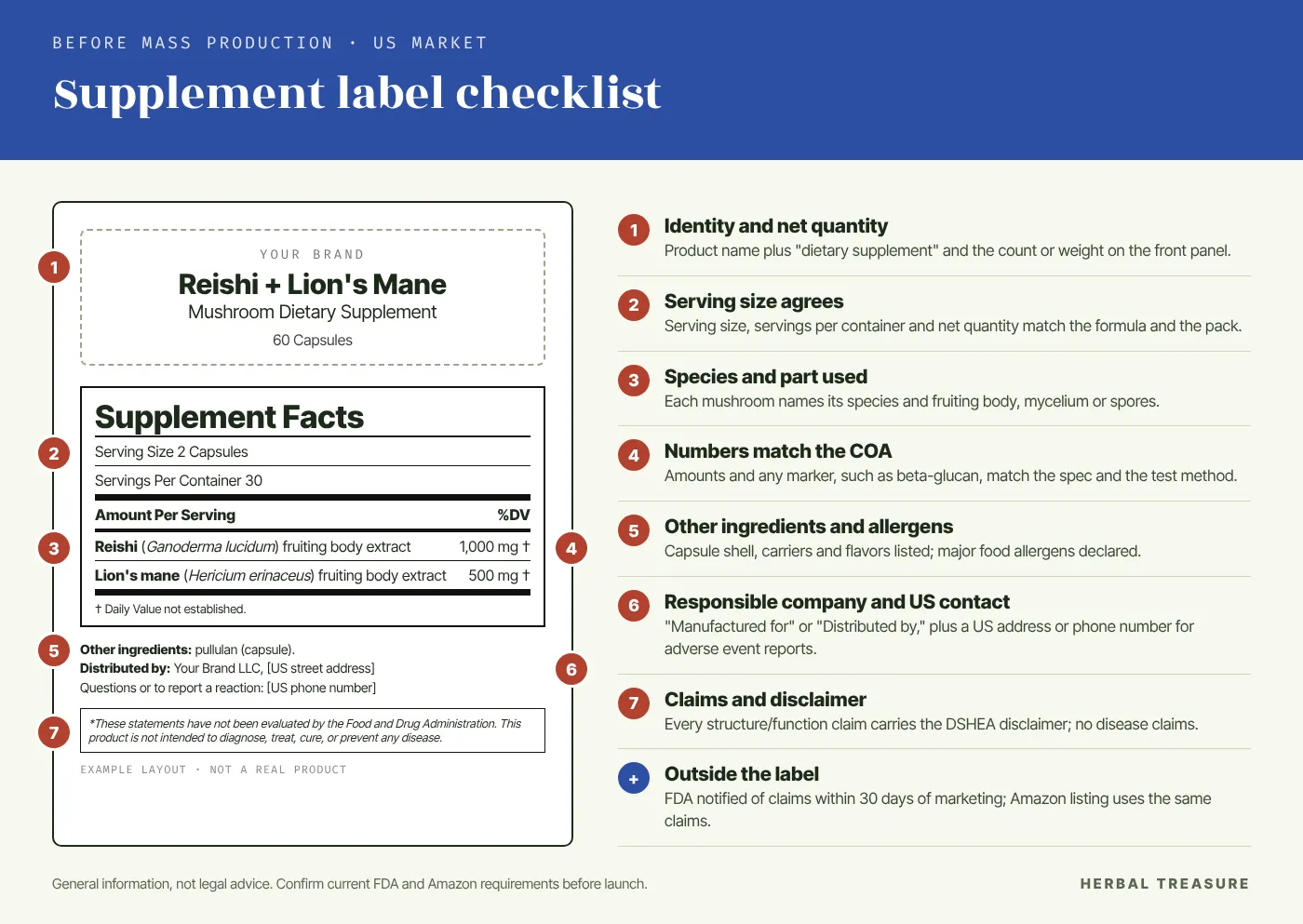
A US supplement label must show five core elements: a statement of identity, the net quantity, a Supplement Facts panel, an ingredient list, and the name and place of business of the manufacturer, packer or distributor. It also needs a domestic US address or phone number for adverse event reports, plus allergen information and the FDA disclaimer where they apply.
This is where many shipments fail. Plenty of factories make the product well and leave the label to the brand. If no one checks it against US rules before mass production, the error shows up only when the goods are packed and the listing is rejected.
Statement of Identity and Net Quantity
The front panel must name the product and identify it as a dietary supplement, for example “Reishi Mushroom Dietary Supplement.” The net quantity, such as 60 capsules or 3.5 oz (100 g), must appear on the principal display panel.
The Supplement Facts Panel
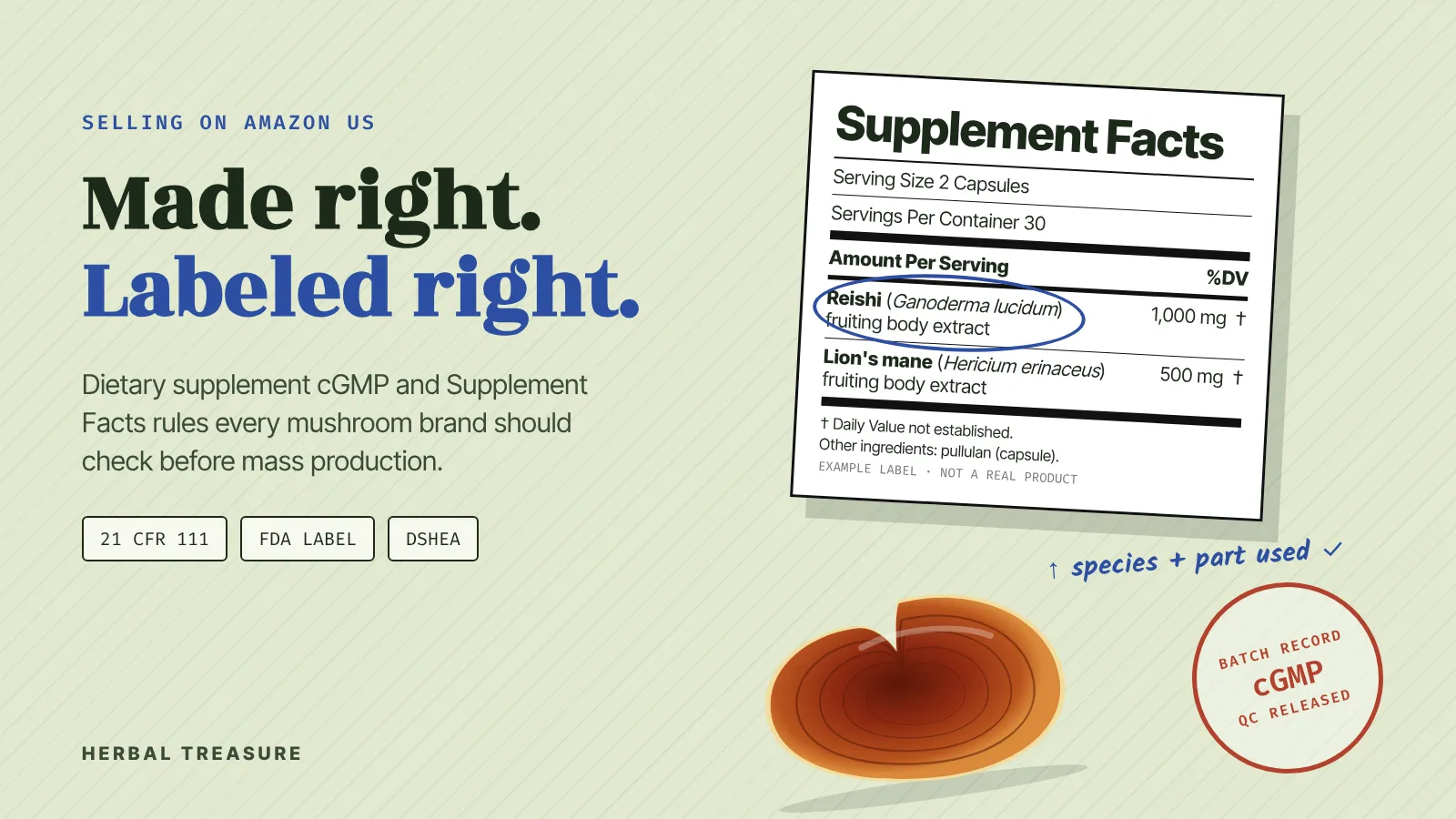
The panel must follow the FDA format: serving size, servings per container, and the amount per serving of each dietary ingredient. Nutrients with a Daily Value show a percentage. Ingredients without one, such as mushroom extracts, are marked with a symbol and a footnote stating that no Daily Value is established.
For mushrooms, two details deserve extra care:
- Name the part used.Botanical ingredients must identify the part of the plant, and for mushrooms that means stating fruiting body, mycelium or spores. Mycelium grown on grain and fruiting body extract are different ingredients, and the label should say which one is in the bottle.
- Match the numbers to the COA.If the panel lists 30% beta-glucan or a cordycepin level, the specification and every batch COA must support it.
Ingredient List, Allergens and Business Details
Other ingredients, such as capsule shells, flow agents and sweeteners, go in an “Other ingredients” list below the panel. The label must declare any of the nine major food allergens, including milk, soy, wheat and tree nuts, which can turn up in creamers, coffee blends and flavors.
The label must also give the name and place of business of the company responsible, often written as “Manufactured for” or “Distributed by.” It must include a US address or phone number where consumers can report serious adverse events.
Structure/Function Claims and the DSHEA Disclaimer
A structure/function claim describes how an ingredient supports the body’s normal structure or function, such as “supports a healthy immune system.” Any label that makes one must carry the disclaimer set by the Dietary Supplement Health and Education Act (DSHEA):
“This statement has not been evaluated by the Food and Drug Administration. This product is not intended to diagnose, treat, cure, or prevent any disease.”
The disclaimer does not make a disease claim acceptable. Words such as “treats,” “cures” or “prevents” a disease are not allowed on a supplement, with or without it.
A Pre-Production Label Checklist for Mushroom Brands
Run this check with your manufacturer before the order goes to mass production. It takes a few days and is far cheaper than relabeling a finished batch:
- The front panel names the product and says “dietary supplement.”
- The serving size, servings per container and net quantity agree with the formula and the pack.
- Every mushroom ingredient states its species and the part used.
- Each marker on the panel, such as beta-glucan or cordycepin, matches the written specification and the COA method.
- Other ingredients are listed in full, and allergens are declared.
- The responsible company and a US address or phone number are on the label.
- Every structure/function claim carries the DSHEA disclaimer, and no claim mentions a disease.
- The FDA has been notified of structure/function claims within 30 days of marketing.
- The Amazon listing, images and A+ content use the same claims as the label.
Import steps sit outside the label but can still stop a shipment. The US importer generally needs a Foreign Supplier Verification Program (FSVP) in place, with modified requirements for supplement importers, and each shipment needs FDA Prior Notice before it arrives.
How Herbal Treasure Supports US Supplement Brands
Our facility has been registered with the FDA since 2018 and holds NSF cGMP certification. Over years of working with overseas brands, many of them in the US, we have come to know where US supplement labels tend to go wrong.
- Label review before mass production:we check your label against US rules and suggest changes before production begins, so problems are caught while they are still cheap to fix. Final compliance stays with your brand and its regulatory advisor.
- Packaging design:our design team can lay out bottles, pouches, stick packs and gift boxes with the Supplement Facts panel built in.
- Batch records and testing:our in-house lab tests every batch for heavy metals, active content and microbiology, and runs genetic identification tests. Every batch ships with a COA, and we keep a retained sample of every batch for two years. Third-party testing is available on request, with lab fees paid by the client.
- Certifications:NSF cGMP, ISO 22000, FSSC 22000, HACCP, USDA Organic, EU Organic, Canada Organic, Halal and Kosher, each within its certified scope.
Choose a Manufacturer With US Experience, Not Just a Certificate
A certificate shows that a factory passed an audit. It does not show that the team knows how a Supplement Facts panel should read or what Amazon’s verification will ask for. When you compare manufacturers, ask for an example US label they have reviewed, a sample batch record and a recent COA, and see how quickly the documents arrive.
This article is general information, not legal advice. FDA rules and Amazon policies change, so confirm current requirements with the FDA, Amazon Seller Central or a qualified regulatory advisor before you launch.
Frequently Asked Questions
Do dietary supplements need FDA approval before selling on Amazon?
No. The FDA does not approve dietary supplements before sale. The product must be made under cGMP in an FDA-registered facility and labeled correctly. Amazon’s US store adds its own requirement: verification by an approved third-party testing organization.
What is 21 CFR Part 111?
It is the FDA’s cGMP rule for dietary supplements. It sets requirements for raw material specifications and identity testing, master and batch production records, quality control release, reserve samples, and complaint handling.
Is FDA registration the same as FDA certification?
No. Registration tells the FDA where a facility is and must be renewed every two years. The FDA does not certify supplement factories or products, so treat any “FDA certified” or “FDA approved” claim for a supplement with caution.
Does a mushroom supplement label need to say fruiting body or mycelium?
Yes. US rules require botanical ingredients to name the part used, and for mushrooms that means fruiting body, mycelium or spores. The claim on the label should match the specification and the COA.