
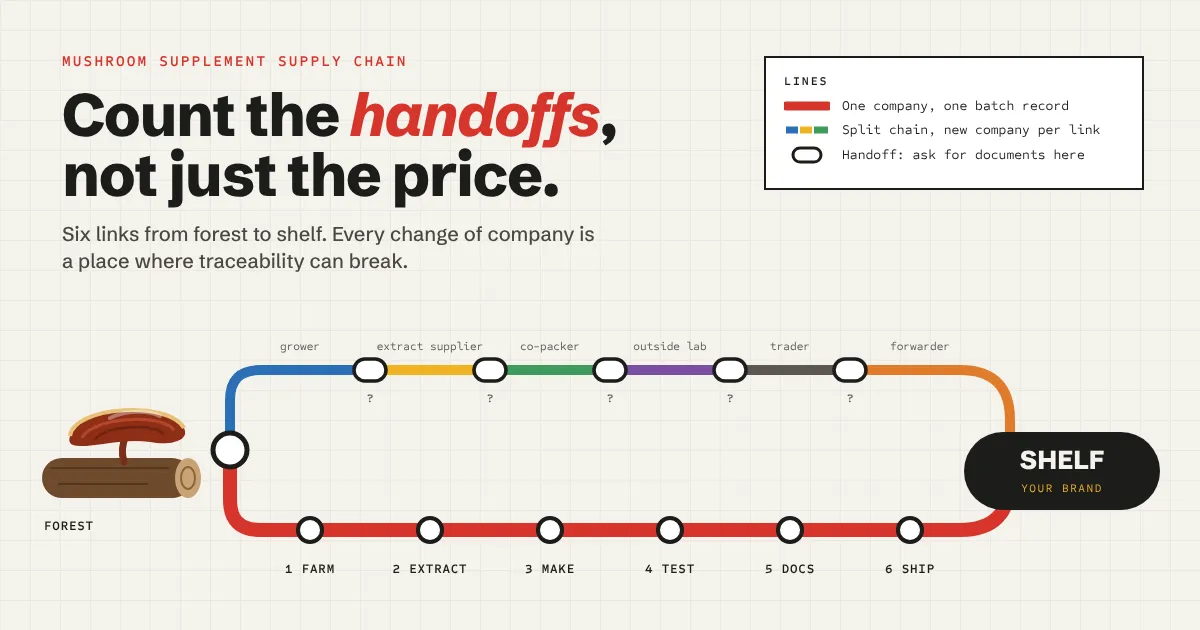
A mushroom supplement supply chain has six links: growing the raw material, extraction, finished-product manufacturing, testing, compliance documents, and packing and delivery. Every time one of those links passes to a different company, your brand loses a little traceability and gains one more party to chase when a batch fails.
That is why more brands now compare a local co-packer with a source manufacturer in China before they place an order. The useful question is not “Where is the factory?” but “How many companies touch my product, and what evidence does each one hand over?”
Why the Mushroom Supplement Supply Chain Is Being Redrawn
For years, China’s role in medicinal mushrooms was mostly upstream. Much of what leaves the country is still dried mushrooms and other primary products, while finished capsules, gummies and drink powders make up a much smaller share. That gap is closing as manufacturers add their own extraction and finished-product lines.
Demand is pushing in the same direction. Shoppers in North America and Europe are moving toward formats that feel more like food than medicine:
- Gummiesthat are easy to take and taste good
- Mushroom coffee and drink powdersthat fit an existing daily habit
- Tinctures and dropsthat are portable and simple to dose
- Blended formulasthat combine several mushrooms, or mushrooms with other botanicals
Many younger buyers also push back on large traditional capsules. For a factory, this is a double test. It has to control the raw material, and it has to master several finished formats, each with its own production hurdles. A supplier that can do only one of those jobs has to hand the other to someone else.
The 6 Links in a Mushroom Supplement Supply Chain
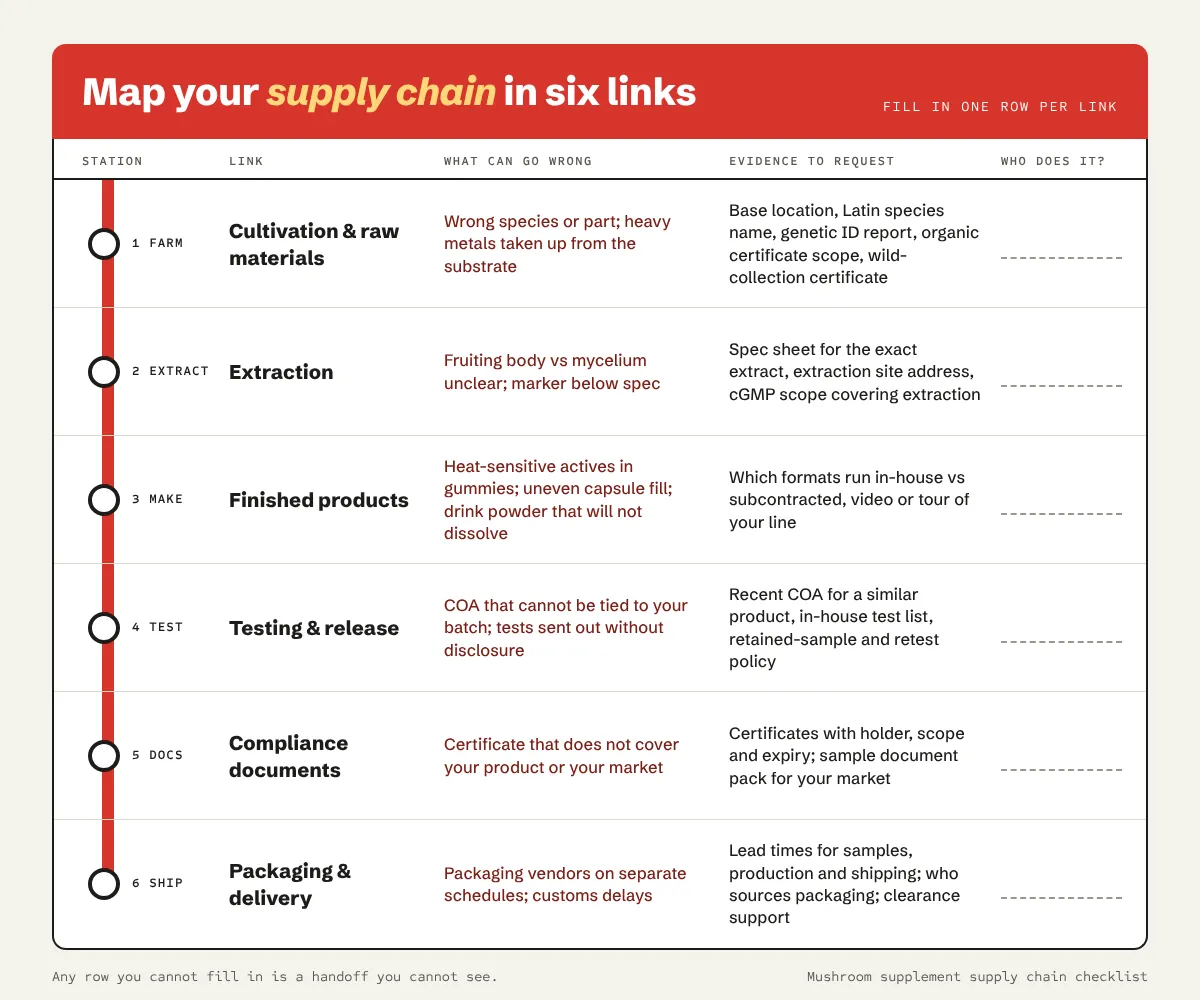
Map each link before you compare prices. For every link, write down who does the work, where, and what document proves it. If a supplier cannot name the company behind a link, treat that link as outsourced until you see evidence otherwise.
1. Cultivation and Raw Materials
Quality starts on the farm. The species, the part of the mushroom used, the growing substrate and the harvest all shape the final product, and mushrooms can take up heavy metals from what they grow on.
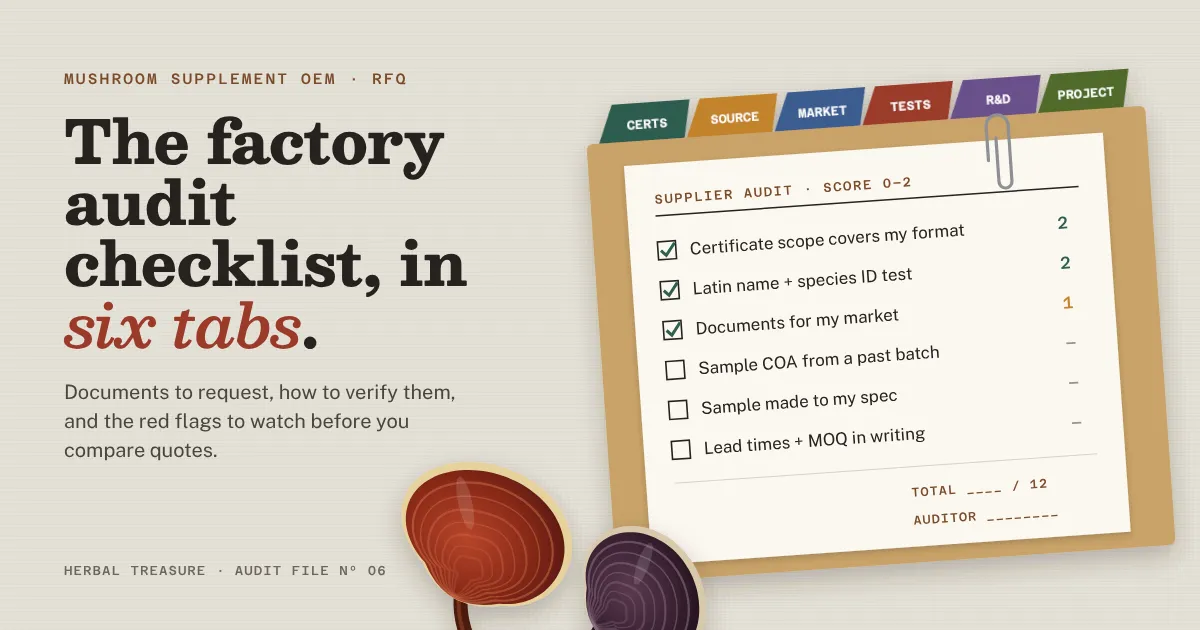
Evidence to request: the base location, the Latin name of each species, a genetic identification report, the organic certificate with its scope, and, for wild-harvested materials such as turkey tail, a wild-collection certificate.
2. Extraction
Extraction decides what your label can claim. Ask whether the extract uses the fruiting body or mycelium, whether it is hot-water or dual extraction (hot water plus alcohol), and whether it is a standardized extract (a guaranteed level of a marker compound such as polysaccharides or beta-glucan) or a ratio extract (for example, 10:1).
Evidence to request: a specification sheet for the exact extract, the name and address of the site that ran the extraction, and confirmation that the extraction workshop is covered by the factory’s cGMP certificate.
3. Finished-Product Manufacturing
Each format has its own pitfalls. Gummy actives can be sensitive to prolonged heat during cooking, spore powder flows poorly and can make capsule weights uneven, and drink powders must dissolve and taste right in a cup.
Evidence to request: a list of which formats are made in the factory’s own workshops and which are subcontracted, plus a production video or site tour of the line that will run your product.
4. Testing and Batch Release
A certificate of analysis (COA) is only as useful as the lab and batch behind it. Ask which tests run in-house, which go to outside labs, and how long retained samples are kept.
Evidence to request: a recent COA for a comparable product, the list of in-house test methods (heavy metals, active content, microbiology, species identity), and the policy on third-party retesting.
5. Compliance Documents
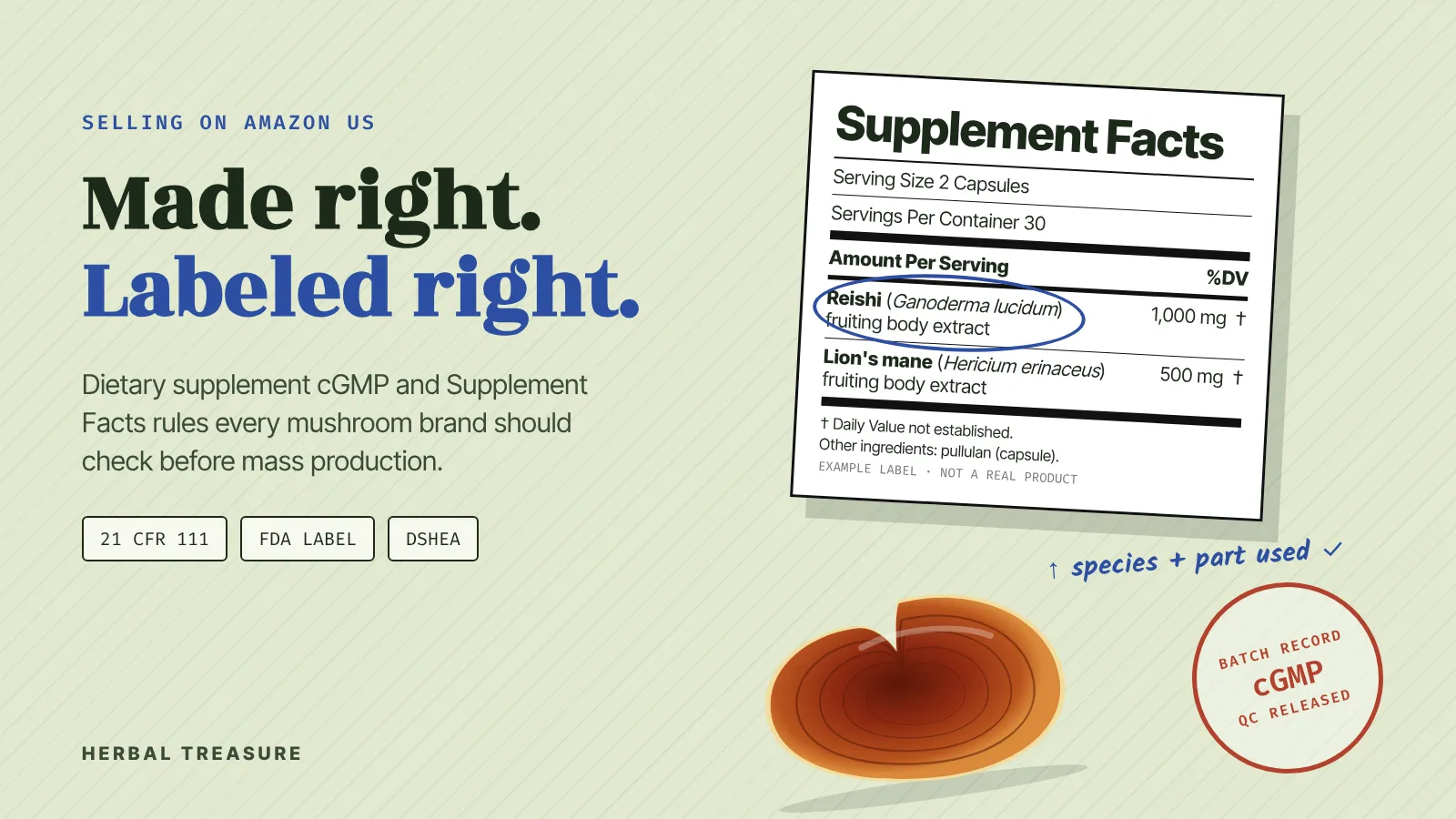
Your market sets the paperwork. A US brand needs a different document set from a Canadian importer applying for a Natural Product Number (NPN) or an EU brand checking Novel Food status.
Evidence to request: copies of each certificate showing holder, scope and expiry date, and examples of document packs the factory has prepared for your market.
6. Packaging and Delivery
The last link is where launch dates slip. Labels, pouches, bottles and cartons often come from separate suppliers, and every extra supplier adds a schedule you do not control.
Evidence to request: confirmed lead times for samples, production and shipping, who designs and sources packaging, and what export and customs clearance support is included.
What Every Handoff Costs Your Brand
Plenty of suppliers call themselves a “source factory” while sending core steps to third parties: no farm of their own, no extraction workshop, sometimes no finished-product line. Outsourcing is not wrong in itself. The risk is outsourcing you cannot see.
When a batch fails for heavy metals or comes in below its active-content spec, each hidden handoff adds a cost:
- The batch cannot be followed back to a specific harvest, so you cannot tell whether the problem is isolated.
- The seller points to the extract supplier, who points to the grower. Meanwhile, the stock sits in your warehouse.
- Re-testing, re-sourcing and re-labeling all happen after the problem is found, and usually on your launch calendar.
A shorter chain does not guarantee a perfect batch. It does mean one company holds the records, and one company has to answer.
Local Co-Packer or Source Manufacturer: When Each Makes Sense
Neither model is right for every brand. The choice depends on what you need to control most.
A local co-packer may suit you when you need very fast, small reorders, same-time-zone communication, or packaging in your home market. If you go this way, ask who makes the mushroom extract it uses and request that maker’s documents too.
A source manufacturer may suit you when raw material control, one continuous batch record and several formats from a single partner matter most. Plan for international shipping, import clearance and a time-zone gap in communication.
Some brands split the difference: they buy bulk extract or mushroom powder from a source manufacturer and finish the product closer to home. That shortens the chain at the link where quality problems usually start.
How Our Own Supply Chain Took Shape
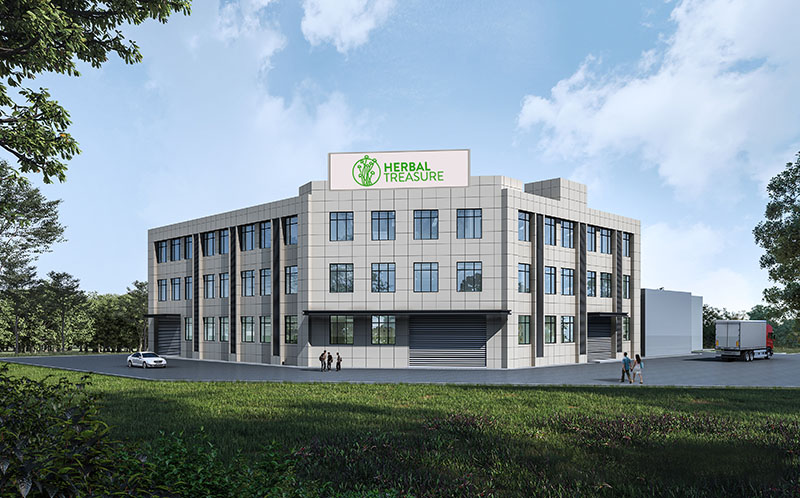
Herbal Treasure grew out of a family business growing reishi (ling zhi). In the early days, before we had our own finished-product lines, we relied on a partner factory. When orders were urgent, our own team worked night shifts there, packing products by hand.
That experience convinced us to build a complete base of our own. Today the chain runs under one company:
- Cultivation:a 200+ mu (about 13 hectares or 33 acres) log-grown forest base in Jiangle County, Sanming, in Fujian’s southern Wuyi Mountains, plus organic reishi greenhouses. We grow both red reishi (Ganoderma lucidum) and purple reishi ( sinense). Wild-harvested materials come with wild-collection certificates.
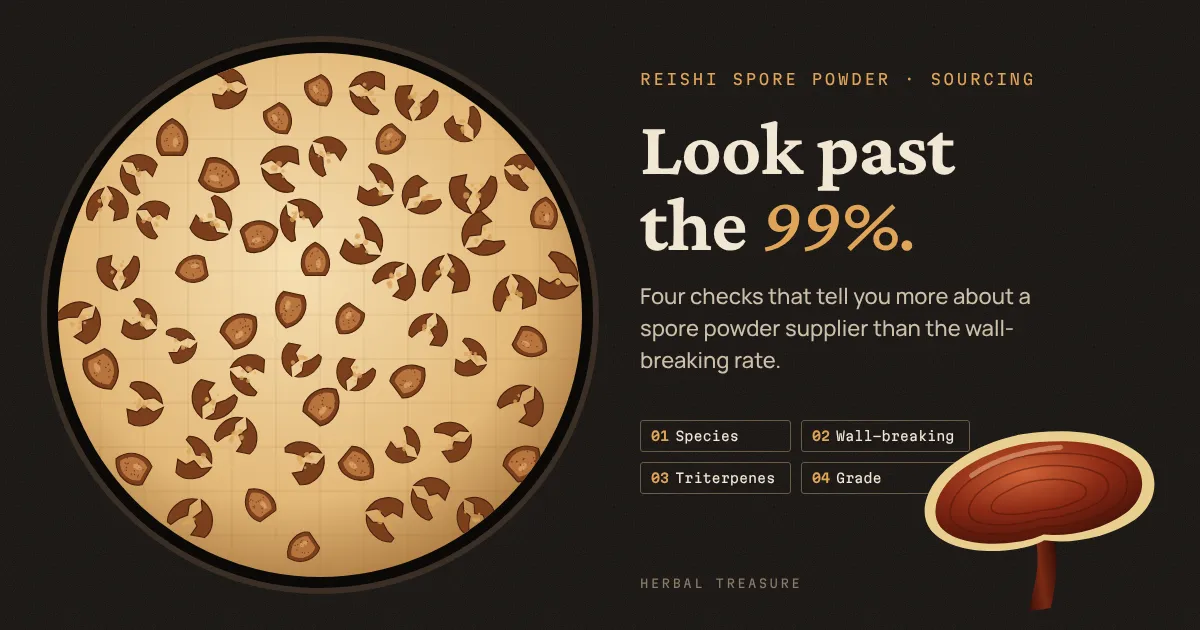
- Extraction:an extraction workshop certified to NSF cGMP, using our proprietary processes. We make both standardized and ratio extracts, plus reishi spore powder and spore oil.
- Finished products:a 10,000+ m² (about 108,000 sq ft) facility with workshops for capsules, tablets, powders, gummies, mushroom coffee and drink powders, and tinctures. We also develop formulas for mushroom personal care products.
- Testing:our in-house lab tests every batch for heavy metals, active content and microbiology, and runs genetic identification tests. Every batch ships with a COA, and we keep a retained sample of every batch for two years. Third-party testing is available on request, with lab fees paid by the client.
- Compliance:NSF cGMP, ISO 22000, FSSC 22000, HACCP, USDA Organic, EU Organic, Canada Organic, Halal and Kosher, each within its certified scope. We prepare documents for each client’s target market.
- Delivery:packaging design for bottles, pouches, stick packs and gift boxes; samples in 5 to 7 days (7 to 14 for custom formulas); standard production in 15 to 20 days (4 to 6 weeks for deep customization); and air or express shipping in 7 to 14 days.
Our minimum order is 500 units per SKU, and we offer more than 5,000 proven formulas. Raw materials and finished products from our base now reach more than 40 countries and regions.
Map Your Supply Chain Before You Compare Prices
As mushroom supplements mature, brands increasingly compete on their supply chains as much as on their labels. Take the six links above, write the name of the company behind each one, and attach the document that proves it. The supplier with the fewest blanks is usually the one that can answer fastest when something goes wrong.
If you would like to run this map on us, ask for our document pack or book a video tour. Site visits and third-party audits are welcome.
Frequently Asked Questions
What is a vertically integrated supplement manufacturer?
It is a manufacturer that runs most links of the supply chain itself, such as growing or sourcing raw materials, extraction, finished-product manufacturing and batch testing, instead of buying each step from separate companies. The benefit is a single batch record and a single party responsible for quality.
How can I tell if a manufacturer really makes its own mushroom extracts?
Ask for the address of the extraction site, check that the factory’s cGMP certificate covers extraction, and request a video or site tour of the extraction workshop. Then match the batch number on the extract COA to the finished-product COA.
Can I buy extract from a source manufacturer and finish the product locally?
Yes. Many source manufacturers sell bulk mushroom powders and extracts as well as finished products. You keep traceability at the raw-material link and can use a local co-packer for the final format and packaging.
How long does it take to produce mushroom supplements with an overseas manufacturer?
At Herbal Treasure, samples take 5 to 7 days (7 to 14 for custom formulas), standard production takes 15 to 20 days, and air or express shipping takes 7 to 14 days. Label review and import clearance in your market can add time.