Private label mushroom supplements have changed what brands expect from a factory. Amazon sellers and direct-to-consumer (DTC) brands no longer want to buy mushroom powder by the kilogram and figure out the rest. They want a manufacturer that can deliver a finished, shelf-ready product: the formula, the dosage form, the testing, the packaging and the export documents.
That shift is reshaping China’s medicinal mushroom industry. Below, we look at why it is happening, what a shelf-ready order actually includes, and the three things a manufacturer must control before it can make your mushroom supplements well.
From Raw Materials to Finished Products: Why the Shift Is Happening
China grows the majority of the world’s cultivated mushrooms and is a leading source of medicinal mushroom raw materials. For a long time, though, most of what it exported was basic material: dried whole mushrooms (fruiting bodies) and coarse powders, sold on thin margins.
Cross-border e-commerce changed the buyer. Amazon, independent brand websites and B2B sourcing platforms made it possible for small and mid-sized brands to sell mushroom supplements worldwide. Those brands rarely have their own extraction equipment or production lines, so they look for a factory that can take a product all the way to the shelf.
As a result, demand for finished capsules, gummies, tinctures and mushroom coffee made under OEM and ODM agreements has grown strongly. The factories that can meet it are moving from selling ingredients to selling complete product solutions.
What Does “Shelf-Ready” Mean for Private Label Mushroom Supplements?
A shelf-ready private label mushroom supplement is a finished product that arrives with everything a brand needs to start selling: a tested formula, a standardized extract, a finished dosage form, branded packaging, a certificate of analysis (COA) for each batch, and the documents needed to clear customs in the target market.
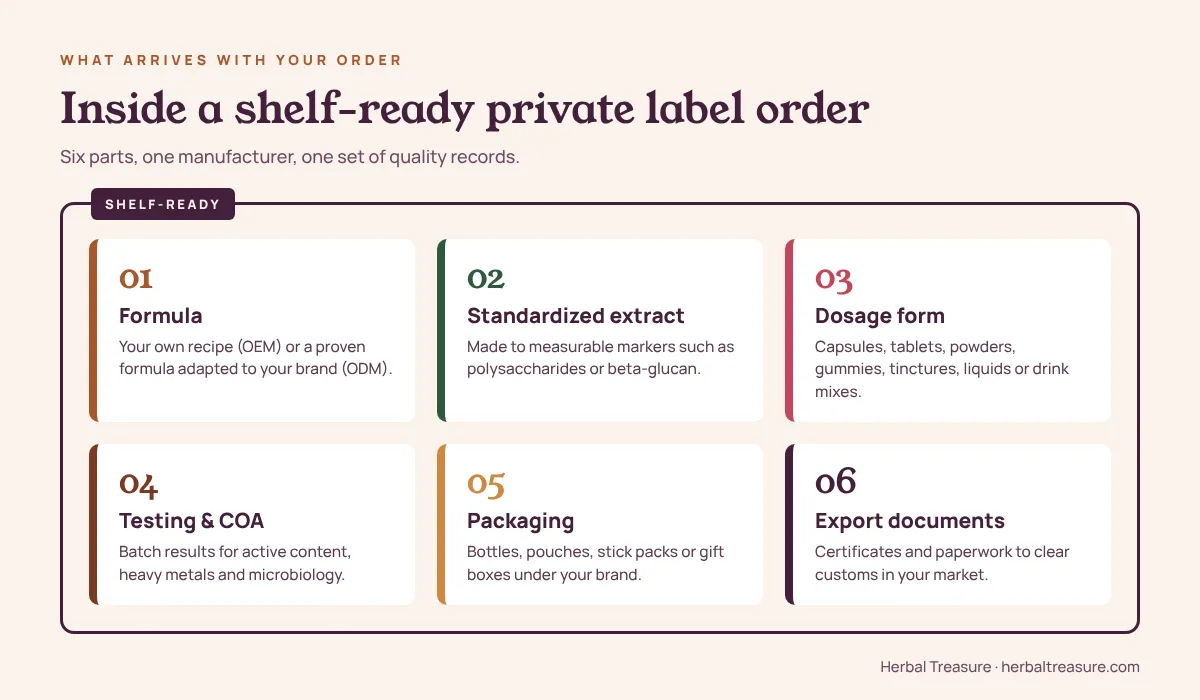
In practice, a complete order covers six parts:
- Either your own recipe (OEM) or a proven formula from the manufacturer, adapted to your brand (ODM).
- Standardized extract.Mushroom extract made to measurable markers, such as polysaccharides or beta-glucan, so every batch is consistent.
- Dosage form.Capsules, tablets, powders, gummies, tinctures, liquids or drink mixes.
- Testing and COA.Lab results for each batch, covering active content, heavy metals and microbiology.
- Bottles, pouches, stick packs or gift boxes, designed and filled under your brand.
- Export documents.The certificates and paperwork your shipment needs to clear customs.
When one factory handles all six, you deal with one partner, one timeline and one set of quality records.
3 Things a Private Label Mushroom Supplement Manufacturer Must Control
Not every supplier can deliver a finished product. Many can relabel goods; far fewer control what goes into them. Before you sign, check that a manufacturer controls these three things.
1. Traceable Raw Materials From Its Own Base
Consistent supplements start with consistent mushrooms. A manufacturer with its own cultivation base knows where each raw material comes from, how it was grown and when it was harvested.
Look for a supplier that runs its own forest-grown (log-grown) cultivation base, backed by greenhouse cultivation and a sustainable wild-harvesting network for species such as turkey tail (yun zhi) and chaga (bai hua rong). Every batch should be traceable back to its source. This is what keeps one production run close to the next.
2. In-House Extraction That Protects Active Compounds
Extraction is where the value of a mushroom supplement is created. Many key markers, including polysaccharides, beta-glucan, cordycepin and triterpenes, are sensitive to heat. Careless processing can lower them before the extract ever reaches a capsule.
A capable manufacturer runs its own extraction workshop rather than buying extracts from others and repackaging them. Proprietary processes such as low-temperature cell-wall disruption, jet-flow cell-wall disruption and membrane concentration help keep these compounds stable from batch to batch.
Ask how each batch is verified. An in-house lab equipped with atomic absorption spectroscopy (AAS), high-performance liquid chromatography (HPLC) and high-performance thin-layer chromatography (HPTLC) can check species identity, active content, heavy metals and microbiology before a product ships.
3. Certifications for Every Market You Sell In
A product that cannot clear customs cannot be sold. Each market has its own expectations, so your manufacturer’s credentials should match where you plan to sell.
| Where you sell | Credentials buyers commonly ask for |
| United States | FDA-registered facility, cGMP manufacturing, USDA Organic |
| Canada | Health Canada Foreign Site Reference Number (FSRN), Canada Organic |
| European Union | EU Organic, food safety certification such as FSSC 22000 |
| Middle East and Southeast Asia | Halal certification |
| Kosher-observant consumers | Kosher certification |
Always ask to see the certificates themselves. A certificate applies only to the products and sites listed in its scope, and it should be issued in the name of the factory that actually makes your product.
What Should a COA for Private Label Mushroom Supplements Show?
A certificate of analysis (COA) should show the batch number, the mushroom species and the part used, each active marker with both its specification and the actual result, the test method behind every figure, and results for heavy metals and microbiology. If a number has no method next to it, ask for one.
When you review a COA, check these lines first:
- Identity:the species and the part of the mushroom used, such as fruiting body or mycelium.
- Active markers:for example beta-glucan, total polysaccharides, triterpenes or cordycepin, each listed as specification versus result.
- Test methods:beta-glucan is usually measured with an enzymatic method, while total polysaccharides are commonly measured with the phenol-sulfuric acid method. The same powder can give very different numbers under different methods.
- Heavy metals:results for each metal tested, measured against the limits of your target market.
- Microbiology:counts for bacteria, yeast and mold, and screening for pathogens.
As an example, Herbal Treasure specifies its lion’s mane extract at 15% or higher beta-glucan. Ask for a COA with every production batch, not just with the sample, and consider an additional third-party test on your first order.
Choosing a Format for Your Private Label Mushroom Line
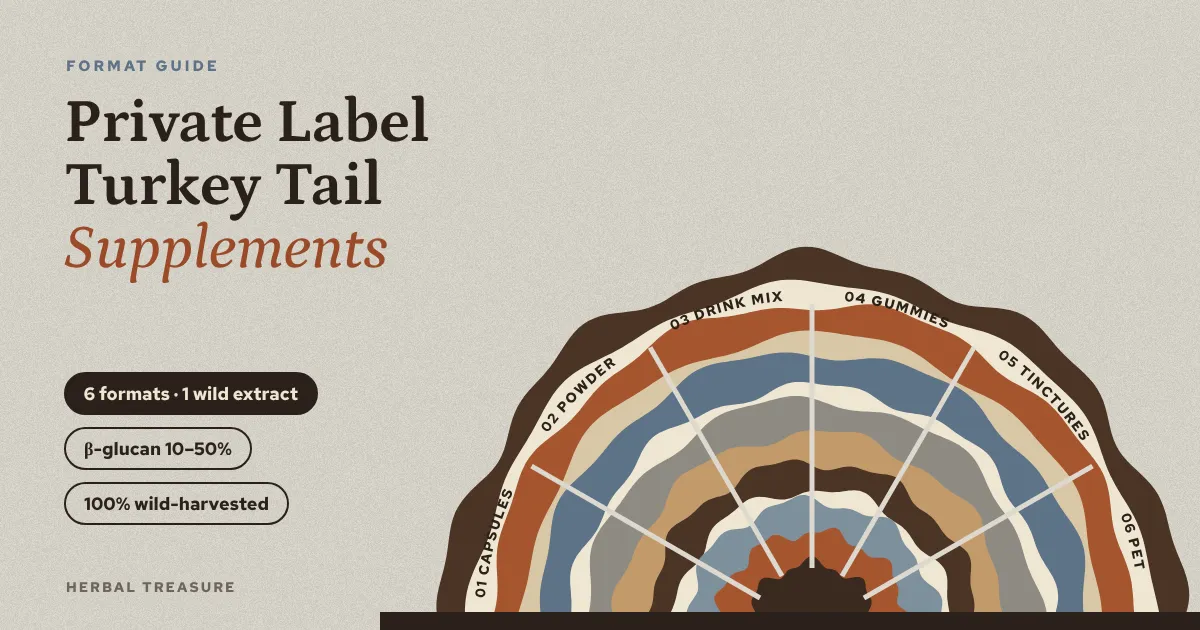
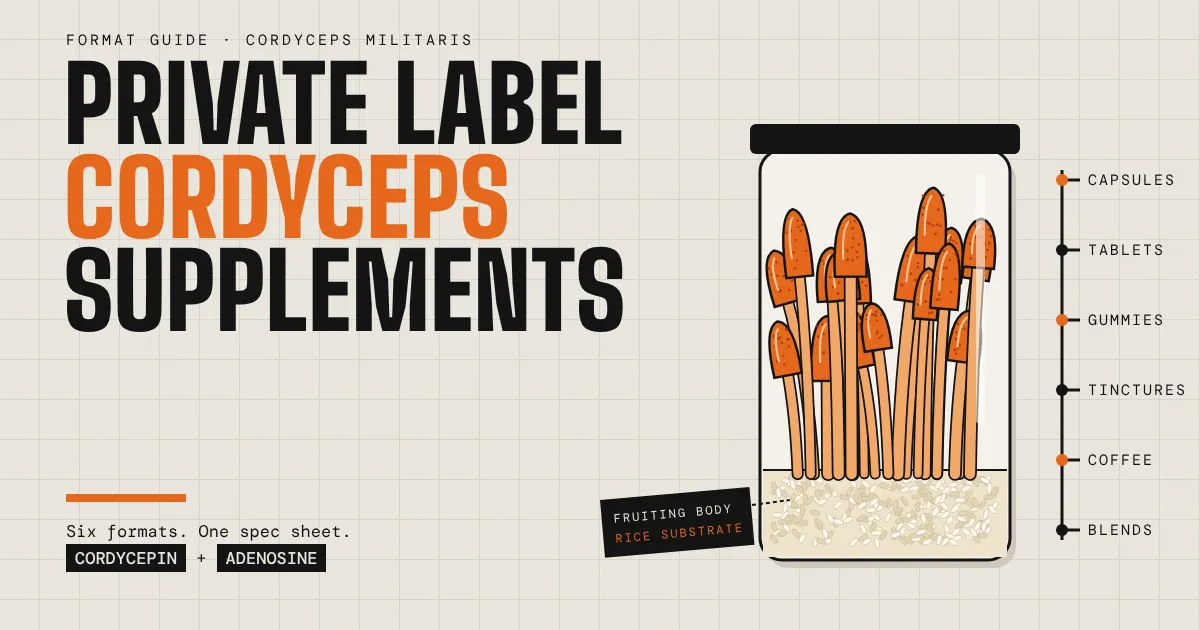
The right format depends on your customers and your channel. Among our North American customers, most of them in the United States, powders and capsules both make up a large share of orders, and gummy orders are increasing. A factory with several production lines lets you test more than one format, or extend a successful product into a new one, without changing suppliers. Common options include:
- Capsules and tablets:familiar, easy to dose and simple to ship.
- Powders and stick packs:convenient for stirring into drinks or smoothies.
- Gummies:a chewable format many shoppers enjoy.
- Tinctures and liquids:dropper bottles and ready-to-drink formats.
- Drink mixes and mushroom coffee:mushroom extracts blended into an everyday ritual.
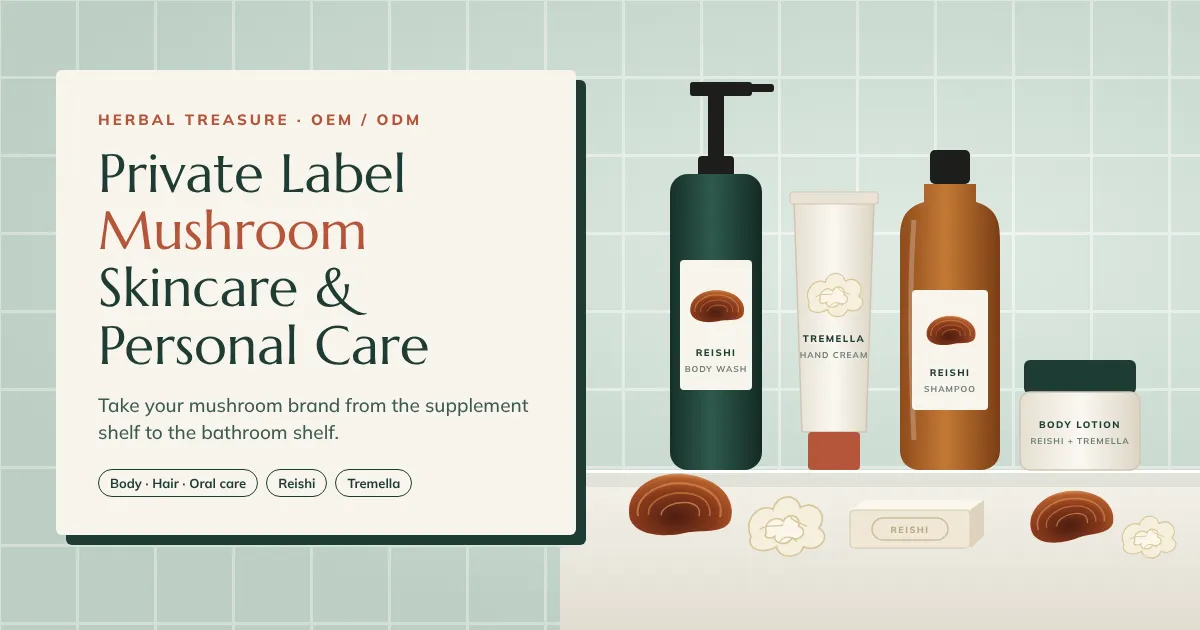
- Personal care:reishi-based soaps, shampoos, body lotions and other care products.
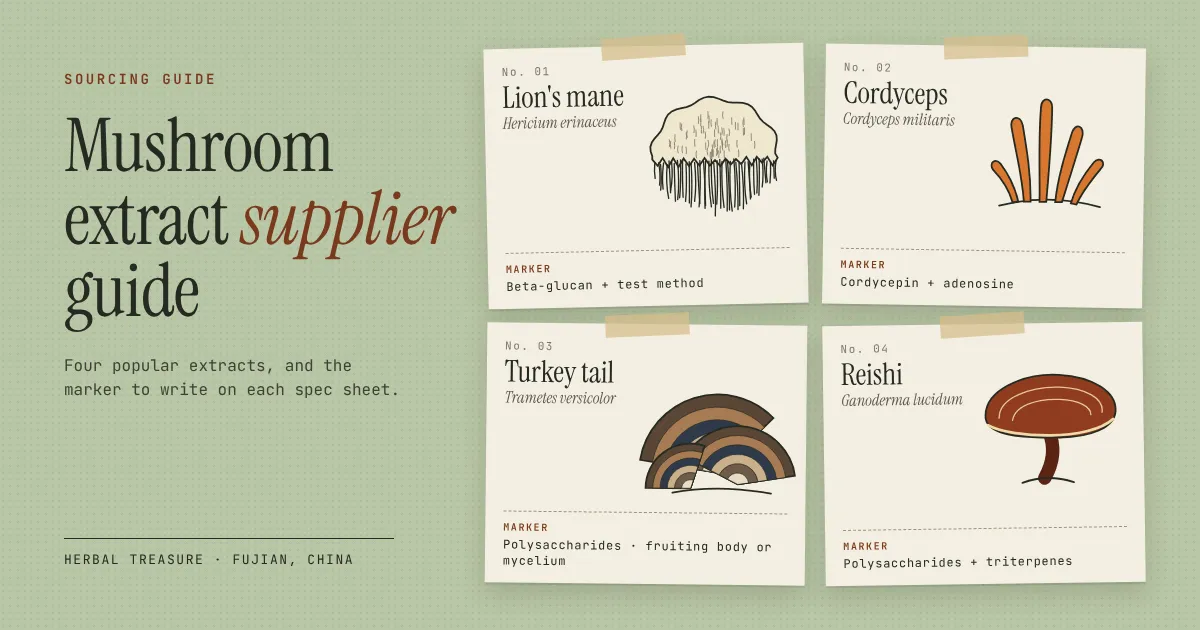
Single-mushroom products and multi-mushroom blends, for example lion’s mane (hou tou gu), reishi (ling zhi) and cordyceps together, can be made in most of these formats.
An Illustrative Path: From Ingredient Buyer to Private Label Brand
The following is a composite example, not the story of one specific client. A North American wellness brand has been buying functional mushroom powder as an ingredient and now wants a finished line under its own label.
It starts with a finished powder or capsule, because those formats build directly on the ingredient it already knows. The mushroom ingredients, formula and packaging are agreed during project discussions. Once the first product is established, the brand can evaluate gummies as an extension. Because every step stays with one supplier, adding a new format means one more conversation rather than a new supply chain.
How Long Does It Take to Launch Private Label Mushroom Supplements?
Launch time depends mostly on how much customization you need. A standard formula in a standard format moves fastest; a new formula or a deeply customized product needs more rounds of sampling. At Herbal Treasure, typical timelines are:
| Stage | Typical time |
| Quotation | 1–3 business days |
| Samples | 5–7 days (standard formula), 7–14 days (custom ODM) |
| Production | 15–35 days, depending on formula, packaging materials, order quantity and scheduling |
| International delivery | 7–14 days by air or express, with tracking and customs clearance support |
These are production estimates, not a guaranteed launch date. Label review, import clearance and sales-channel approval, such as listing approval on a marketplace, can all affect when your product actually goes on sale. Confirm the project schedule and the production start date in writing.
Our minimum order starts from 500 units per SKU for both OEM and ODM, which keeps the first run small enough to test a new product. The exact minimum depends on the product, formula and packaging, and is confirmed in your quotation.
How to Get a Quote for Private Label Mushroom Supplements
The fastest quotes start with a clear brief. Before you contact a manufacturer, prepare five things:
- Target market:where you plan to sell, such as the United States, Canada or the EU.
- Preferred format:powder, capsules, gummies or another dosage form.
- Formula concept:your own formula (OEM), or the type of product you want from a ready formula (ODM).
- Packaging needs:bottles, pouches, stick packs or gift boxes, and whether you need design support.
- Estimated order quantity:for the first run and, if you know it, for repeat orders.
With these details, a manufacturer can confirm the project scope, MOQ and production schedule in one round instead of several.
Herbal Treasure: A Source Factory for Private Label Mushroom Supplements
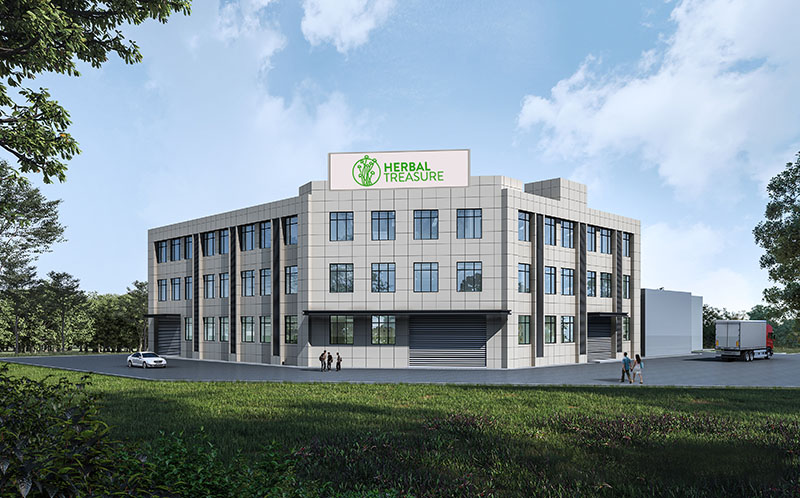
Herbal Treasure was founded in 2003 in Fujian, China. We grow, extract and manufacture medicinal mushroom products in-house, and supply both raw ingredients and finished private label products.
- Cultivation:our own forest-grown base of more than 200 mu (about 13 hectares, or 33 acres) in Jiangle County, Sanming, in the southern Wuyi Mountains.
- Facilities:more than 10,000 m² (about 108,000 sq ft) of production space, including over 8,000 m² (about 86,000 sq ft) of cGMP workshops and a 1,000 m² (about 10,800 sq ft) extraction workshop.
- Daily capacity:up to 3 million capsules across four capsule lines, 2 million tablets, 600,000–800,000 powder sachets, more than 3 metric tons (about 6,600 lb) of gummies, and 30,000–50,000 bottles on our automatic filling lines.
- Formulas and R&D:more than 5,000 proven formulas and an R&D team of more than 100 people, supporting OEM and ODM projects.
- Certifications:NSF cGMP, USDA Organic, EU Organic, Canada Organic, FSSC 22000, ISO 22000, HACCP, Halal and Kosher, an FDA-registered facility, and a Health Canada FSRN.
- Reach:more than 1,000 brand clients in over 40 countries and regions, including many in North America, especially the United States, with packaging design for bottles, pouches, stick packs and gift boxes.
The Bottom Line: Capability Now Matters More Than Price
Cross-border e-commerce has pushed the whole mushroom supply chain to upgrade. The factories that win global orders are the ones that can deliver standardized active markers, finished products in many formats and complete export documentation.
For brands launching private label mushroom supplements, that means you can expect more from your manufacturer. Look for control over raw materials, in-house extraction and multi-market compliance, and you will spend less time fixing problems and more time selling.
Ready to plan your line? Tell us your target market, format and quantity, and request a manufacturing quote.
Frequently Asked Questions
What are private label mushroom supplements?
Private label mushroom supplements are products made by a manufacturer and sold under your brand. You choose or supply the formula, dosage form and packaging, and the manufacturer produces, tests and packs the finished product for you.
What is the minimum order for private label mushroom supplements?
It varies by manufacturer. At Herbal Treasure, the minimum order starts from 500 units per SKU for both OEM and ODM products; the exact figure depends on the product, formula and packaging.
How long does it take to make private label mushroom supplements?
At Herbal Treasure, samples take 5–7 days for standard formulas, and production typically takes 15–35 days depending on formula, packaging and quantity. International delivery by air or express usually takes another 7–14 days.
Do I need my own formula to start a mushroom supplement brand?
No. With ODM, you can start from one of our more than 5,000 proven formulas and adapt it to your brand. If you already have a formula, we can produce it under OEM and source the raw materials for you.