
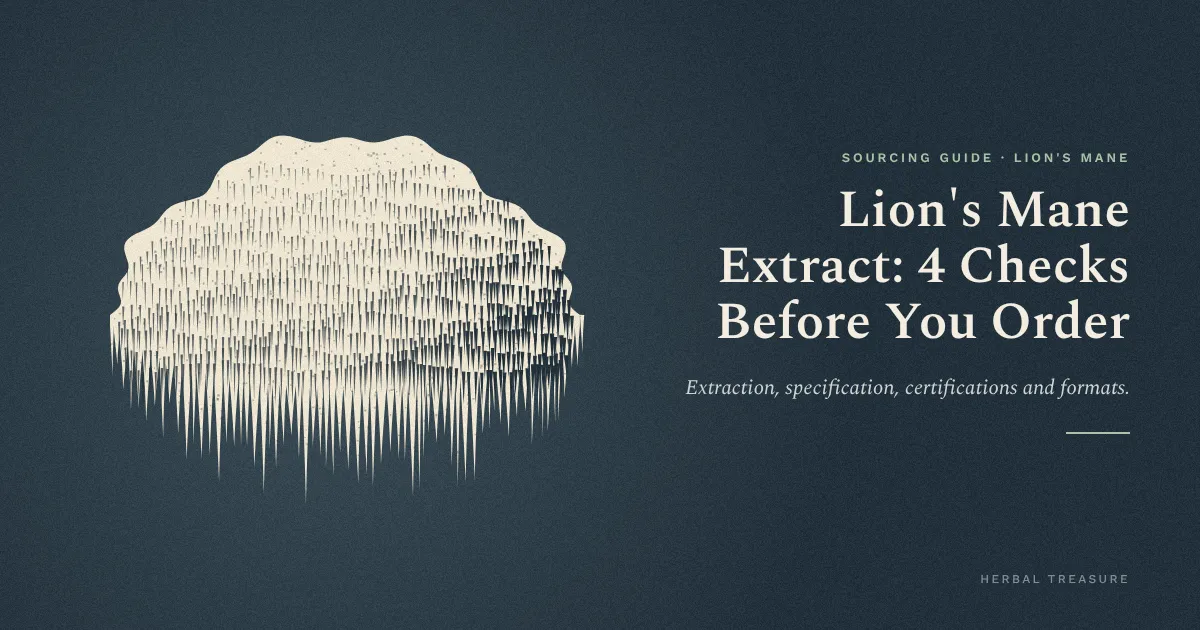
If you are developing a lion’s mane product for Amazon or your own online store, the manufacturer you choose matters as much as the mushroom itself. Four checks separate a reliable lion’s mane extract manufacturer from the rest: how the extract is made, what the specification guarantees, which certifications back it up, and which product formats the factory can produce.
Lion’s mane (hou tou gu) has become one of the best-known functional mushrooms in North America and Europe. Brands are building capsules, gummies, tinctures, and mushroom coffee around it. This guide walks through what to look for when you source lion’s mane extract from an OEM partner.
Why Lion’s Mane Is a Popular Choice for Amazon and DTC Brands
Overseas, lion’s mane products are mostly positioned around focus, cognition, and gut wellness, and the ingredient has a loyal following among North American shoppers in particular. China is a major producer of lion’s mane, which makes it a natural place to source both the raw material and the finished product.
Before you write your product listing, check which wellness claims are allowed in each market you sell in. The rules in the European Union are stricter than those in the United States and Canada.
What to Look for in a Lion’s Mane Extract Manufacturer
A good lion’s mane extract manufacturer uses low-temperature extraction, states beta-glucan content along with the test method behind it, supplies a certificate of analysis (COA) for every batch, holds recognized food-safety and organic certifications, and can turn the extract into the formats your customers actually buy, such as capsules, gummies, and tinctures.
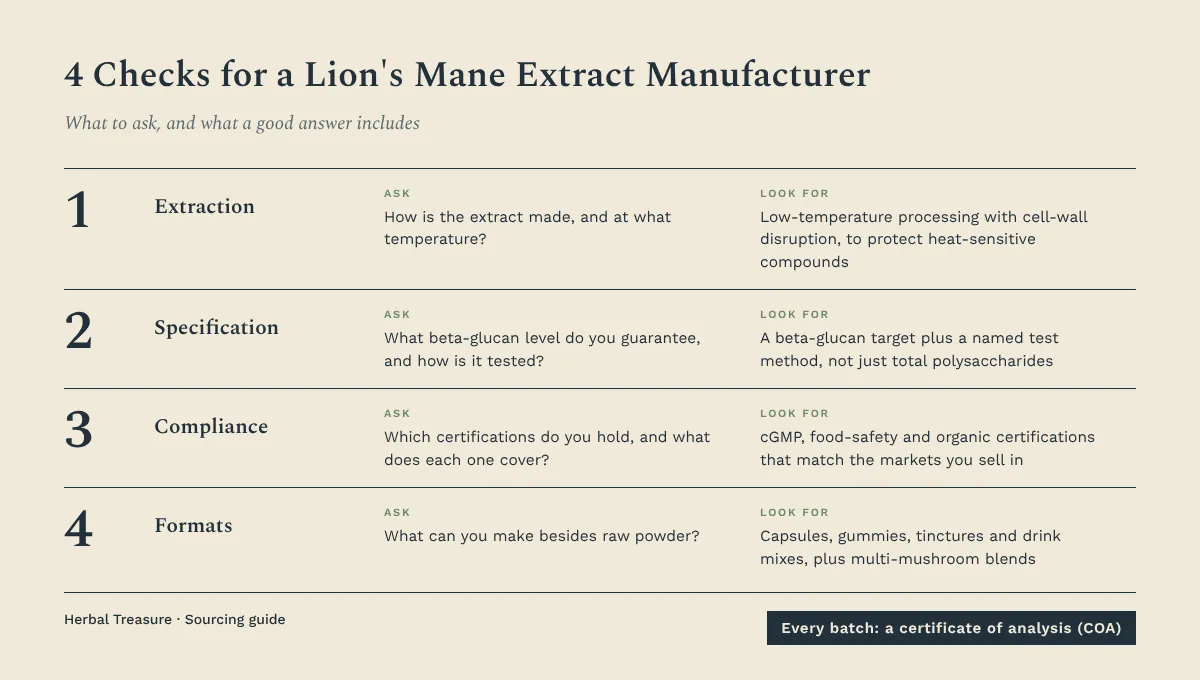
1. Extraction: Ask for Low-Temperature Processing
Lion’s mane contains heat-sensitive compounds, including hericenones, found mainly in the fruiting body, and erinacines, found mainly in the mycelium. High temperatures can break these compounds down.
Ask your supplier how the extract is made. Low-temperature processing combined with cell-wall disruption helps release more of the mushroom’s active constituents into the finished extract.
2. Specification: Beta-Glucan, Test Method, and a COA for Every Batch
Polysaccharide content in lion’s mane extract can usually be customized, typically somewhere between 20% and 50%. The number to lock in, though, is beta-glucan, a specific group of polysaccharides that says more about extract quality than the total figure does.
Make sure your purchasing specification:
- names a beta-glucan target, not just total polysaccharides
- states the test method used to measure it
- requires a COA for every batch
3. Compliance: Certifications That Match Your Markets
Ask which certifications the factory holds and what each one covers. For export markets, look for cGMP manufacturing for dietary supplements, food-safety management certification, organic certification for the regions you sell in, and facility registrations where they apply. Full documentation makes marketplace reviews and customs clearance smoother.
4. Formats: Look Beyond Raw Powder
Selling lion’s mane overseas is not just about raw powder. Capsules, gummies, powdered drink mixes, and tinctures are all popular formats with shoppers abroad, and a manufacturer that can make several of them lets you grow your range without changing suppliers.
How Herbal Treasure Makes Lion’s Mane Extract
At Herbal Treasure, our lion’s mane is cultivated in greenhouses, and we extract it using a proprietary low-temperature cell-wall disruption process designed to protect its heat-sensitive compounds.
What we offer:
- Ingredients:lion’s mane powder and standardized lion’s mane extract, with polysaccharides customizable from 20% to 50% and beta-glucan of 15% or higher available
- Finished products (OEM and ODM):capsules, gummies, tinctures, and powdered drink mixes
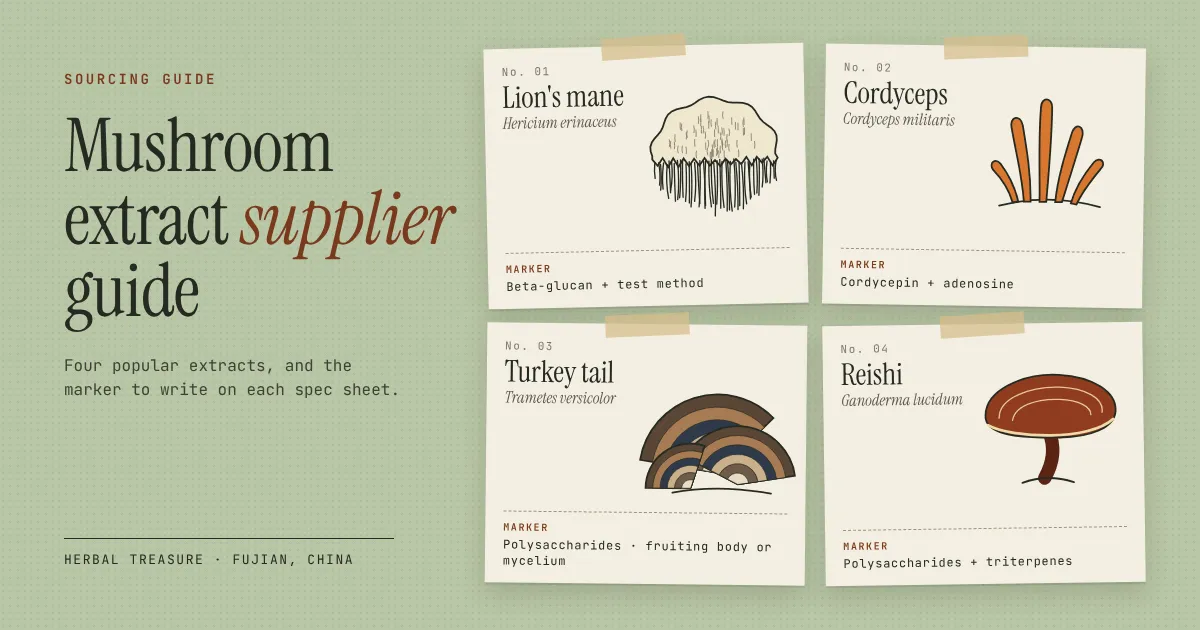
- Blends:multi-mushroom formulas with cordyceps (chong cao) and reishi (ling zhi)
- Quality and certifications:a COA with every batch; NSF cGMP, ISO 22000, FSSC 22000, HACCP, USDA Organic, EU Organic, Canada Organic, Halal, and Kosher certifications, in an FDA-registered facility with a Health Canada site license (FSRN). Each certificate applies within its stated scope.
- Minimum order:500 units per SKU
We work with many Amazon sellers and direct-to-consumer brands building lion’s mane products for international markets.
The Bottom Line on Choosing a Lion’s Mane Supplier
Demand for lion’s mane is strong, but quality varies widely from one supplier to the next. Low-temperature extraction, a clear beta-glucan specification, and complete compliance documentation are the first things to look for in a lion’s mane extract manufacturer.
Frequently Asked Questions
What should I look for in a lion’s mane extract supplier?
Look for low-temperature extraction, a stated beta-glucan content with a named test method, a certificate of analysis (COA) for every batch, and certifications that fit the markets you sell in.
Why does beta-glucan matter more than total polysaccharides?
Total polysaccharides can include ordinary carbohydrates such as starch. Beta-glucan is a specific group of polysaccharides, so it tells you more about the quality of a lion’s mane extract.
What lion’s mane products sell well online?
Besides capsules, overseas shoppers buy lion’s mane gummies, tinctures, powdered drink mixes, and mushroom coffee. Lion’s mane is also often blended with cordyceps and reishi.
What is the minimum order for private label lion’s mane supplements?
At Herbal Treasure, the minimum order is 500 units per SKU, for both OEM and ODM projects.