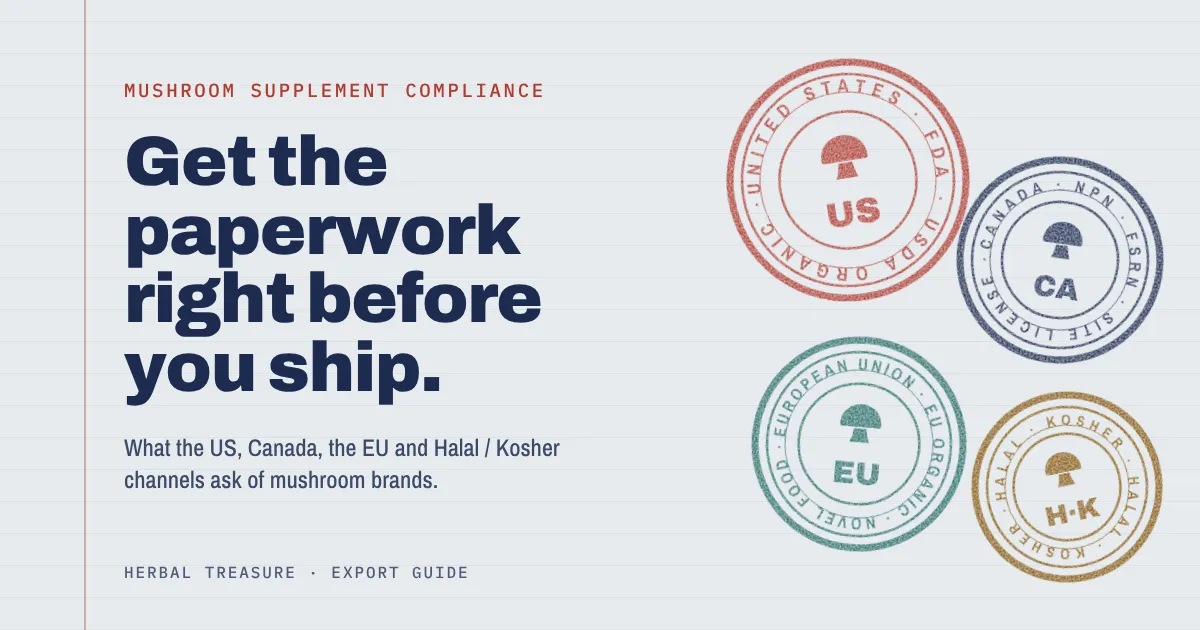
Mushroom supplement compliance decides whether your product stays on the shelf. Before you list lion’s mane or reishi capsules on Amazon or ship your first pallet overseas, you need the right registrations, certifications and labels for each market, and a manufacturer that can document all of it in its own name.
Medicinal mushrooms are a fast-growing category in cross-border e-commerce, and so are the stories of brands that learned the rules the hard way. This guide covers the compliance basics for the United States, Canada, the European Union, and Halal and Kosher sales channels.
Why Mushroom Supplement Brands Get Caught Out
Many new sellers assume that once they have a product, they can list it on Amazon and start selling. But dietary supplement rules differ from country to country, and a product that is fine in one market can be pulled in another.
The usual consequences look like this:
- Marketplace listings taken down
- Shipments held at customs
- Sales blocked by a missing certification
Compliance is not something to sort out after launch. It is the baseline for any brand that sells across borders.
Mushroom Supplement Compliance Requirements by Market
United States: FDA Registration, Not FDA Approval
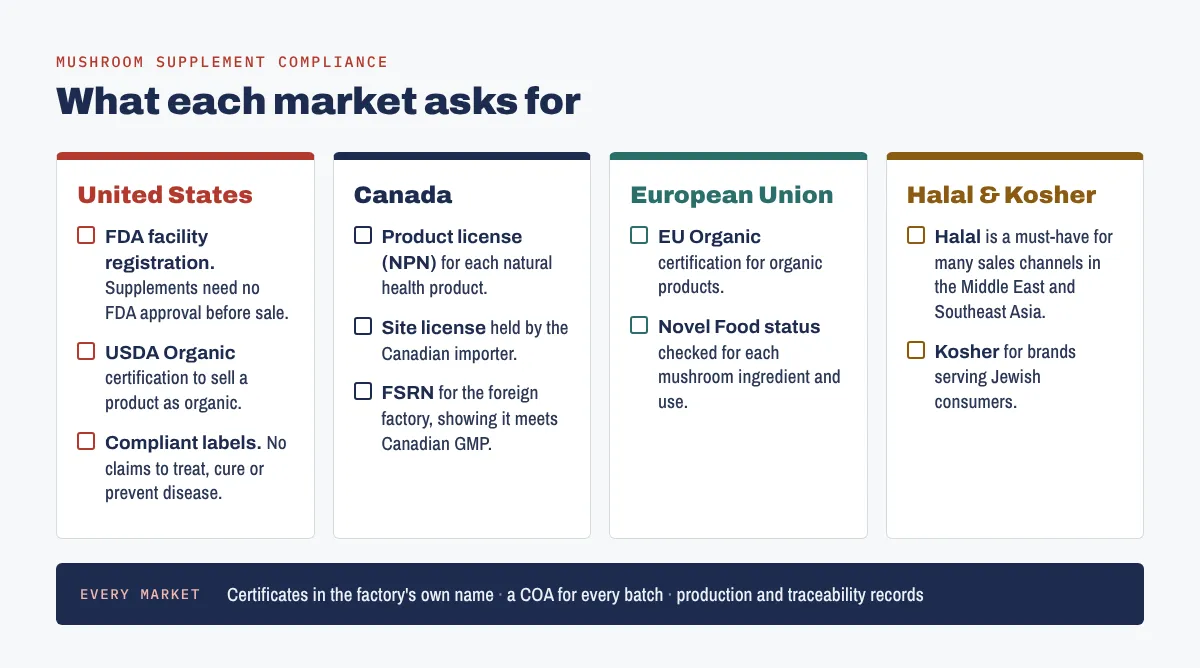
In the United States, the FDA does not approve dietary supplements before they go on sale. What it does require is that the facility making them is registered with the FDA. The brand is responsible for a safe product and a compliant label, and supplements may not be promoted with claims to diagnose, treat, cure or prevent disease.
A few points to keep in mind:
- FDA registration is not a certification.Be wary of any supplier that calls its products “FDA certified” or “FDA approved.”
- Organic claims need USDA Organic certification.To sell a product as organic, it generally has to be certified under the USDA National Organic Program.
- Label claims must stay on the right side of the line.Statements about how an ingredient supports the body’s normal structure or function must carry the FDA’s standard disclaimer.
- New dietary ingredients need advance notice.A supplement that contains a new dietary ingredient requires a notification to the FDA before it is sold.
Canada: Natural Health Product Licensing
Canada regulates mushroom supplements as natural health products (NHPs), and its bar is higher than in the US. Each product needs a product license and a Natural Product Number (NPN). The Canadian importer must hold a site license, and a factory outside Canada can obtain a Foreign Site Reference Number (FSRN) from Health Canada.
The FSRN shows that the foreign factory meets Canada’s good manufacturing practice (GMP) requirements. It is not a site license and does not let a factory export to Canada on its own. Instead, the factory works with a licensed Canadian importer.
European Union: Organic Certification and Novel Food Rules
In the EU, organic mushroom products need EU Organic certification. Some mushroom ingredients also fall under the Novel Food Regulation, which covers foods not consumed to a significant degree in the EU before May 15, 1997. A novel food must be authorized before it can be sold.
Novel Food status can depend on the species, the part of the mushroom used and the intended use. Check each ingredient against the European Commission’s Novel Food status catalogue before you launch.
Halal and Kosher Certification
Halal certification is a must-have for many sales channels in the Middle East and Southeast Asia. Kosher certification lets brands serve Jewish consumers. If these customers are part of your plan, confirm that your manufacturer holds both before you commit to a formula.
The Hidden Risk: Suppliers That Can’t Document Their Own Production
Plenty of suppliers present themselves as source factories without running production workshops of their own. Their certificates may belong to another company, and they can’t provide a complete, traceable set of documents for your shipment.
For an export brand, that gap is exactly what turns into customs holds and marketplace takedowns.
How to Check a Supplement Manufacturer’s Compliance Documents
Before you place an order, confirm three things: the certificates are held by the factory itself, every batch comes with a certificate of analysis (COA), and the factory keeps complete production records that trace each raw material back to its source. Ask for copies of each and read them closely.
- Certificates in the factory’s own name.The company name on each certificate should match the factory you are working with, not a third party.
- A COA for every batch.Look for test results such as thin-layer chromatography (TLC), high-performance liquid chromatography (HPLC), and heavy metals testing by ICP-MS or atomic absorption spectroscopy (AAS).
- Production records and raw material traceability.You should be able to follow a batch from its raw materials through to the finished product.
Herbal Treasure’s Compliance Credentials
At Herbal Treasure, every certification and license we hold belongs to our own factory, not to a third party. Our credentials include:
- China Health Food Production License
- NSF cGMP
- FSSC 22000 and ISO 22000
- USDA Organic, EU Organic and Canada Organic
- Halal and Kosher
- Health Canada Foreign Site Reference Number (FSRN)
- FDA-registered facility
We provide test reports for every batch, so brands going overseas can show exactly what is in each shipment. Each certificate applies within its stated scope.
Get Mushroom Supplement Compliance Right Before You Scale
For mushroom brands going global, compliance comes first and sales follow. Choosing a source manufacturer that holds its own certifications is one of the most important steps you can take to lower your cross-border risk.
This article is general information, not legal advice. Regulations change, so confirm current requirements with the relevant authority or a qualified regulatory advisor before you launch.
Frequently Asked Questions
Do mushroom supplements need FDA approval?
No. The FDA does not approve dietary supplements before they are sold. The facility that makes them must be registered with the FDA, and the brand is responsible for a safe product and compliant labeling.
What is an FSRN for natural health products?
A Foreign Site Reference Number (FSRN) is issued by Health Canada to manufacturers, packagers and labelers outside Canada that meet Canadian GMP requirements. It is not a site license, so the factory works with a licensed Canadian importer.
Are medicinal mushrooms novel foods in the EU?
Some are. Status can depend on the species, the part used and the intended use, so check each ingredient in the European Commission’s Novel Food status catalogue before selling in the EU.
What documents should I ask a supplement manufacturer for?
Ask for certificates held in the factory’s own name, a certificate of analysis (COA) for every batch, and complete production and raw material traceability records.