

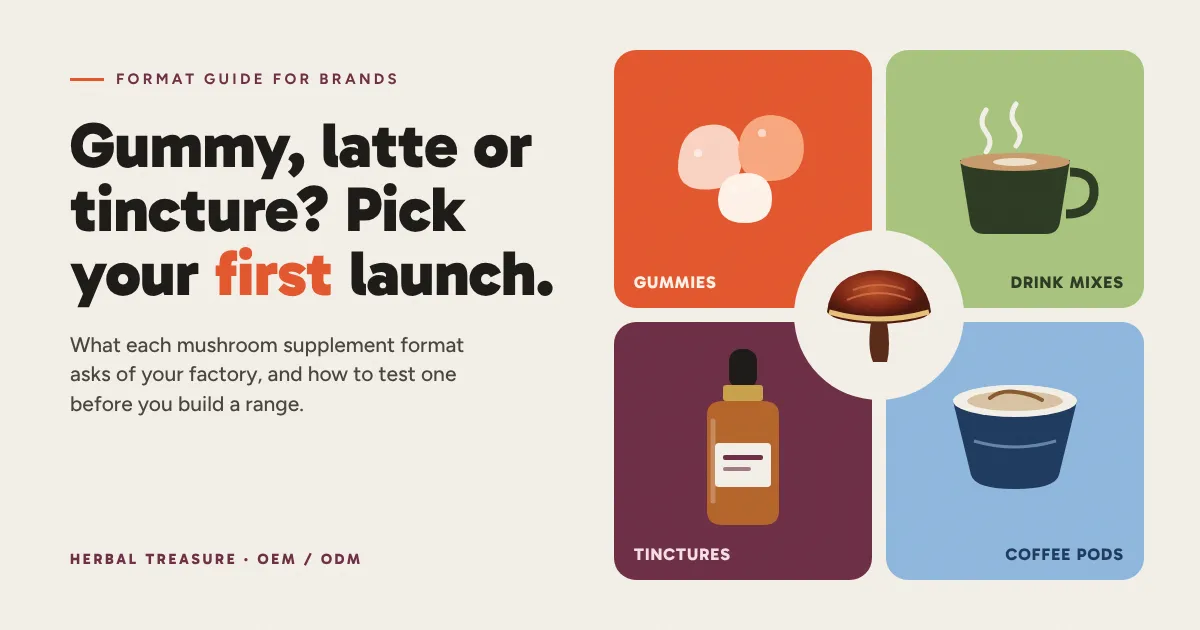
The mushroom supplement formats winning new customers today are gummies, drink mixes such as mushroom coffee and lattes, and liquid tinctures. Capsules and powders are still the foundation of the category, but these newer formats are easier for first-time buyers to try and easier to show on social media. Each one also brings its own manufacturing challenges, and those challenges decide which format suits your brand first.
This guide explains why these formats appeal to younger wellness shoppers, what makes each one hard to produce well, what to ask a manufacturer before you commit, and how to test the market without launching ten products at once.
Why New Mushroom Supplement Formats Are Growing
Hard capsules and loose powders remain the base of the market, and many loyal customers will keep buying them. The faster growth, though, is in gummies, functional drink mixes and tinctures, which now appear regularly among popular listings on Amazon and on brands’ own online stores. Three reasons stand out.
They Lower the Barrier for New Customers
A gummy tastes like a treat, which makes it an easy first step for younger shoppers who have never taken a mushroom supplement. A mushroom coffee or latte fits into a habit people already have. Instead of adding a new routine, the customer simply swaps their morning cup.
They Suit Direct-to-Consumer Content
Short videos sell what viewers can see. Stirring a latte, pouring a coffee or chewing a gummy makes a far more engaging clip than a capsule on a table. For brands that sell through their own website and social channels, a format that films well is a real advantage.
They Help a Product Stand Out
Single-mushroom capsules are a crowded shelf, and many look alike. A blended mushroom coffee or a themed gummy, such as a nighttime gummy, gives shoppers something specific to remember and gives your brand a clearer story to tell.
Mushroom Supplement Formats Compared
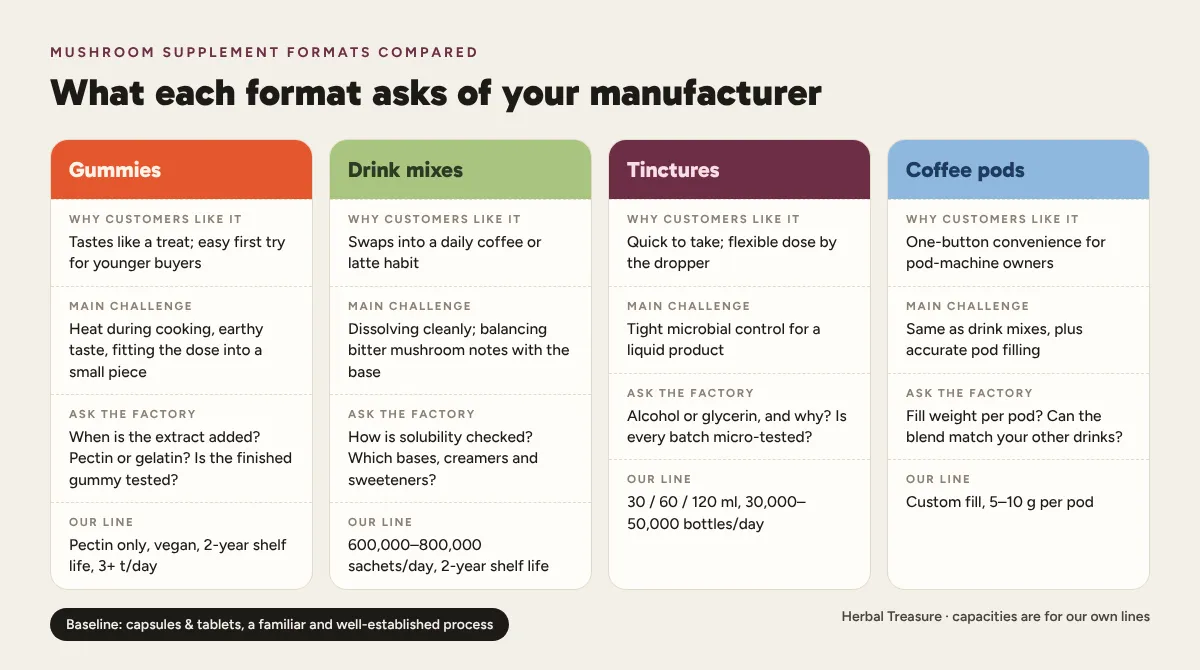
The table below sets the newer formats against the familiar capsule baseline. Capacity figures are for our own lines and are included to show the scale each format runs at.
| Format | Why customers like it | Main manufacturing challenge | Our daily capacity |
| Capsules and tablets | Familiar, precise dose, easy to travel with | Low; well-established process | 3 million capsules (4 lines); 2 million tablets |
| Gummies | Pleasant taste, feels like a treat | Heat during cooking; taste; fitting the dose into a small piece | More than 3 metric tons |
| Drink mixes (coffee, latte, cocoa) | Fits an existing daily habit | Dissolving well; masking earthy, bitter notes | 600,000–800,000 sachets |
| Tinctures | Fast to take, flexible dose | Strict microbial control for liquids | 30,000–50,000 bottles (automatic filling) |
| Coffee pods | Convenience for pod-machine users | Same as drink mixes, plus pod filling | Custom fill, 5–10 g per pod |
The Manufacturing Challenges Behind Each Format
Popular formats look simple on the shelf, but they are harder to make than capsules. Many traditional factories can only fill capsules and pack powders, so it is worth knowing where the difficulty lies before you choose a partner.
Mushroom Gummies: Managing Heat
Gummies are cooked, deposited into molds and set. Some active compounds in mushroom extracts are sensitive to prolonged high heat, so the stage at which the extract is added, and the temperature and time it is exposed to, need to be controlled. The way to confirm the result is to test the finished gummy, not just the extract that went into it.
Our gummies are made with pectin only. We do not make gelatin gummies, so every formula is plant-based and suitable for vegans, and pectin is less sensitive to heat than gelatin. Low-sugar and zero-sugar versions are possible, and our gummies have a two-year shelf life. Finished-product COAs can include polysaccharides or beta-glucan, so you can see what is in the gummy itself.
Taste and size are the other balancing act. Mushroom extracts can taste earthy, and a gummy is small, so the formula has to carry a meaningful amount of extract while still tasting good.
Mushroom Drink Mixes: Dissolving and Taste
A drink mix has two jobs: it must dissolve easily in a cup, and it must taste like something people want every day. Reishi in particular is naturally bitter, so the formula has to balance the mushroom with the coffee, cocoa or tea base rather than hide it completely. Flavor, color and instant solubility are all adjusted on our powder line.
Most of the choices are yours to make:
- Coffee base:instant or ground, arabica or robusta, decaf, or coffee-free blends built on cocoa or tea
- Non-coffee bases:matcha, chai, golden milk and hojicha
- Creamer:plant-based (mainly coconut or oat) or dairy
- Sweetness:regular or sugar-free, mainly with monk fruit or stevia
- Serving size:2–3.5 g for black coffee sticks, 5–15 g for drip bags, 8–30 g for lattes and other flavored drinks
Our main ready formula is a four-mushroom coffee with reishi, lion’s mane, cordyceps and chaga, and the mushroom blend can be changed to suit your product. Drink powders have a two-year shelf life, and finished drinks can be tested for polysaccharides and beta-glucan.
Mushroom Tinctures: Microbial Control
Liquids give microorganisms more chance to grow than dry powders, so tinctures demand tighter microbial control. That starts with the base: we make tinctures with either alcohol or glycerin, depending on your market and your customers, and glycerin is the base we use for Halal tinctures. Dual extraction (hot water followed by alcohol) is available.
Our in-house lab runs microbiological testing on every batch, and tinctures are filled on an automatic line. Standard bottle sizes are 30, 60 and 120 ml (about 1, 2 and 4 fl oz), and dark amber glass is recommended to protect the liquid from light.
How Herbal Treasure Started With Reishi Coffee
One of the first products that opened overseas markets for Herbal Treasure was a reishi coffee. At the time, few shoppers abroad knew much about reishi, and its bitterness was a real obstacle. Our team spent months adjusting the formula to balance the reishi extract against the coffee, then built a range of reishi latte, cappuccino and hot chocolate drinks around it. That range brought us our first overseas clients.
The lesson has stayed with us: a familiar format can introduce an unfamiliar ingredient. It is also why we went on to build gummy, powder and tincture workshops alongside our capsule lines, so brands can launch in the format their customers already enjoy.
Questions to Ask a Manufacturer About Each Format
Before you request a quote, ask questions that show whether a factory really makes the format or simply resells it.
- Gummies:At what stage is the extract added, and how is heat controlled? Is the gelling agent pectin or gelatin? Can the finished gummy be tested for polysaccharides or beta-glucan?
- Drink mixes:How is solubility tested? Can you match my preferred coffee base, creamer and sweetener? What is the shelf life of the finished powder?
- Tinctures:Alcohol or glycerin base, and why? Is every batch tested for microbiology? What bottle sizes and glass colors are available?
- All formats:Which of your certificates cover this workshop? What are your sample and production lead times?
Start With One or Two Formats
A new brand does not need a full product range on day one. Choose one or two formats, test them with real customers, and expand once you know what sells. Launching many SKUs at once ties up cash in stock and spreads your marketing budget thin.
A small first run keeps that test affordable:
- Ready formulas:more than 5,000 proven formulas, including 16 gummy and 8 tincture formulas added in September 2026
- Samples:free samples (you cover shipping), usually ready in 5–7 days for standard formulas and 7–14 days for custom work
- Minimum order:from 500 units per SKU
- Production:15–20 days for standard orders, 4–6 weeks for deeply customized products
Herbal Treasure is an NSF cGMP certified manufacturer that also holds ISO 22000, FSSC 22000, HACCP, EU Organic, USDA Organic and Canada Organic certifications. Our gummy, powder, tincture and capsule lines operate under one roof, so a brand can test one format now and add another later with the same partner.
Frequently Asked Questions
What are the most popular mushroom supplement formats?
Capsules and powders remain the base of the market. Gummies, drink mixes such as mushroom coffee and lattes, and tinctures are the faster-growing formats, because they are easy to try and fit into daily routines.
Which mushroom supplement format is best for a new brand?
It depends on your customers and sales channel. Drink mixes suit brands built around a daily ritual, gummies suit younger first-time buyers, and tinctures suit customers who want a flexible dose. Start with one or two formats and test them before expanding.
Do mushroom gummies contain gelatin?
Many gummies on the market do, but ours do not. We make mushroom gummies with pectin only, so they are plant-based and suitable for vegans. Pectin is also less sensitive to heat than gelatin.
How long do mushroom gummies and drink mixes last?
Our mushroom gummies and drink powders both have a two-year shelf life. The final shelf life on your label depends on the formula and packaging.