
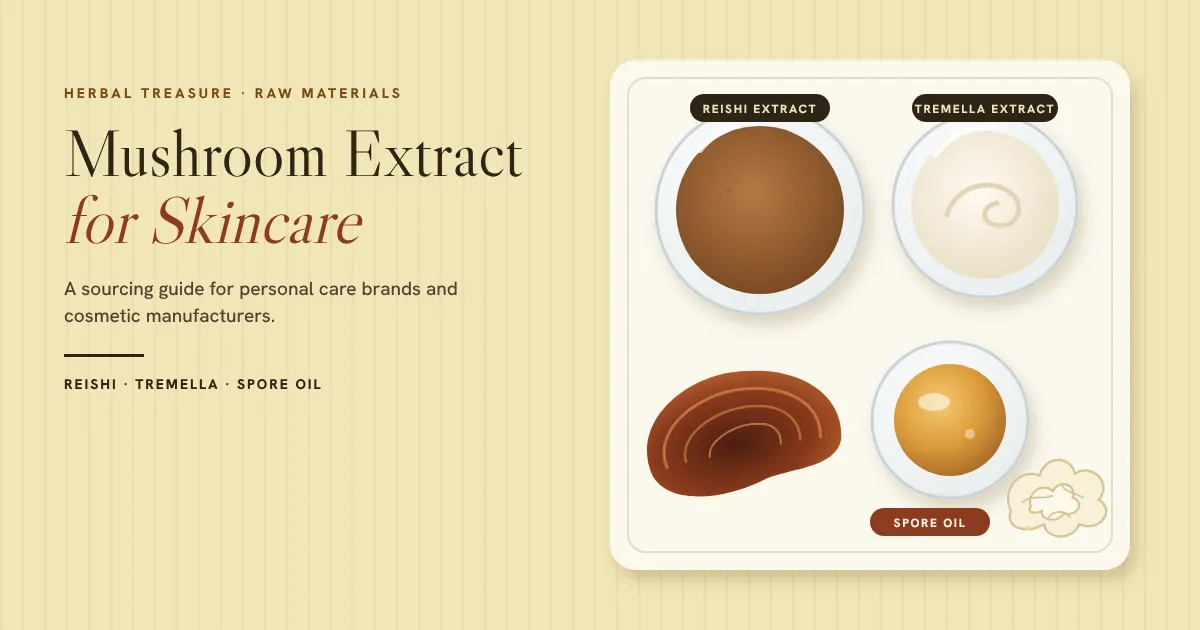
Mushroom extract for skincare: reishi extract powder, tremella extract and reishi spore oil in glass dishes, with a reishi mushroom and a tremella mushroom
Three ingredients, one source: reishi extract, tremella extract and reishi spore oil.
The mushroom extracts most used in skincare and personal care are reishi extract, tremella extract and reishi spore oil, with lion’s mane, cordyceps and chaga also available. To source them well, a personal care brand or cosmetic manufacturer should confirm the species and part used, the marker compound and test method, the contaminant limits, and the documents each batch comes with.
This guide walks through each ingredient, the questions to ask a supplier, and why buying from the source manufacturer makes life easier for your formulation and quality teams.
Why Personal Care Brands Are Adding Mushroom Extracts
Medicinal mushrooms are no longer limited to dietary supplements. Reishi and tremella extracts now appear in body lotion, shampoo, hand cream, soap and toothpaste, and mushroom personal care is one of the faster-moving corners of cross-border e-commerce.
For a personal care brand, a mushroom extract does two jobs:
- It gives the product a story.Reishi and tremella have long histories in East Asia, and shoppers who already buy mushroom supplements recognize the names.
- It plays a defined role in the formula.Tremella is used as a moisturizing-type ingredient in lotions and hand creams, while reishi spore oil can sit in the oil phase of a cream or lotion.
Both jobs depend on the same thing: an extract that is what the label says it is, batch after batch.
6 Mushroom Extracts for Skincare and Personal Care
The six mushroom ingredients below are the ones we use in our own personal care formulas. Each one suits a different part of a product range.
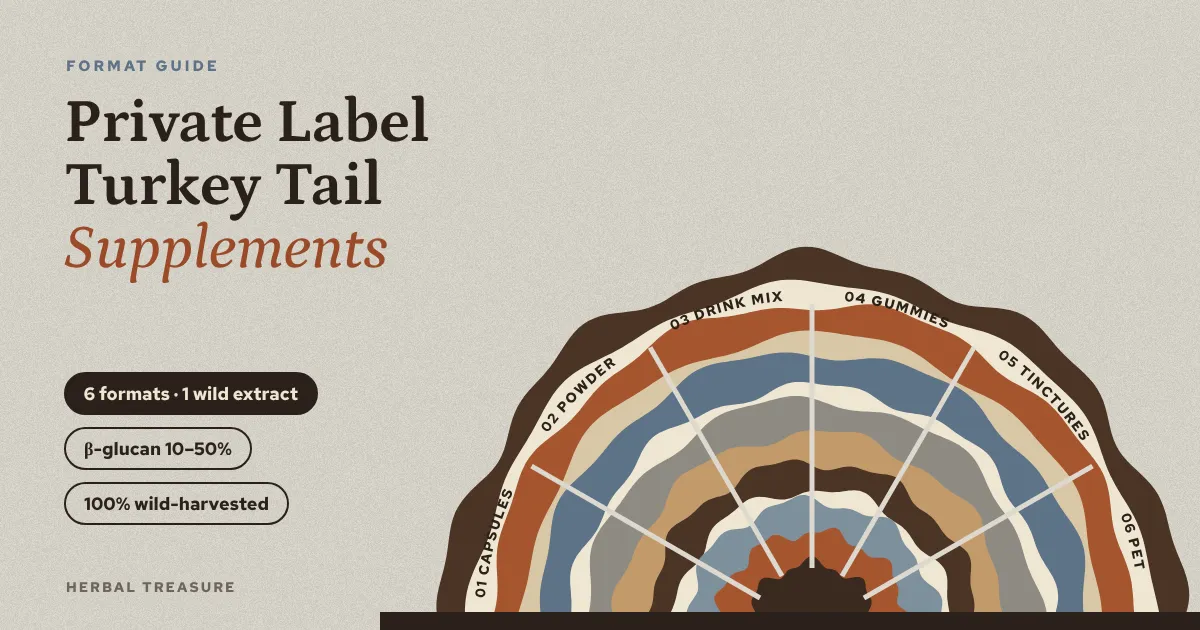
Reishi extract (ling zhi)
Reishi (Ganoderma lucidum, known in Chinese as ling zhi) is the best-known mushroom name on a personal care label. Reishi extract is specified by its polysaccharide and triterpene content. We offer reishi extract with polysaccharides from 20% to 50% and triterpenes from 4% to 10%, set to the spec you need.
Reishi spore oil
Reishi spore oil is extracted from broken-wall reishi spores, the fine powder a mature reishi releases. Because it is an oil, it suits the oil phase of creams, lotions and balms. Our spore oil is specified by total triterpenes, from 10% to 35%, customized per client, and comes from our log-grown forest base.
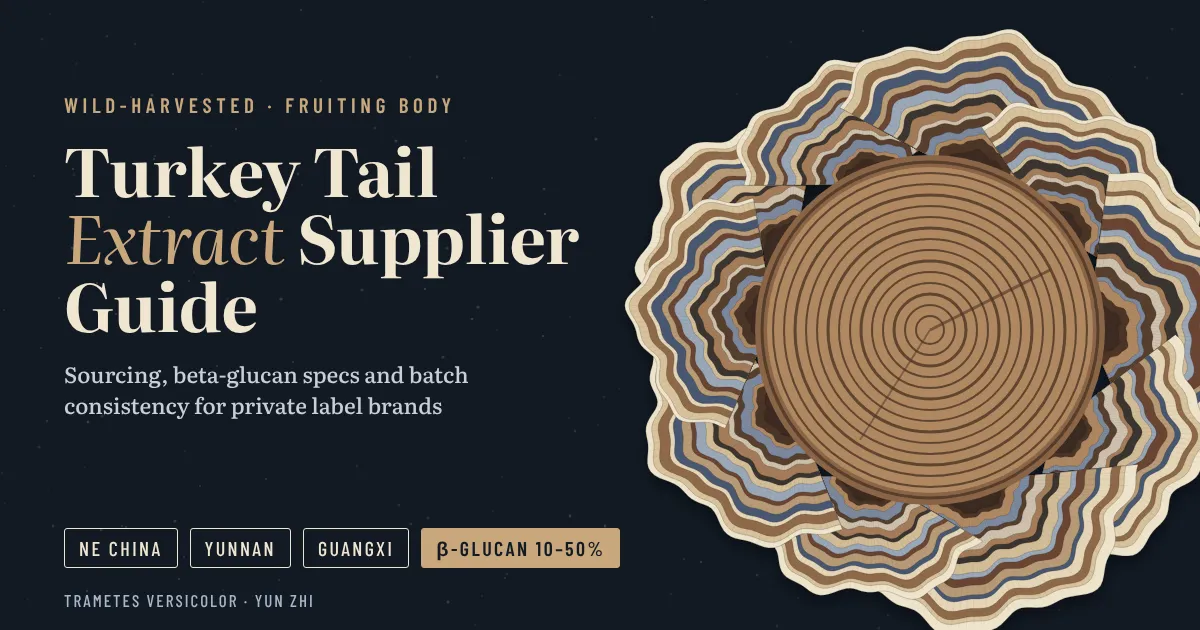
Tremella extract (yin er)
Tremella (Tremella fuciformis, known in Chinese as yin er and in English as snow fungus) is a pale, ruffled mushroom with a jelly-like texture. In personal care, tremella extract is used as a moisturizing-type ingredient in body lotions and hand creams. Its main marker is its polysaccharide content.
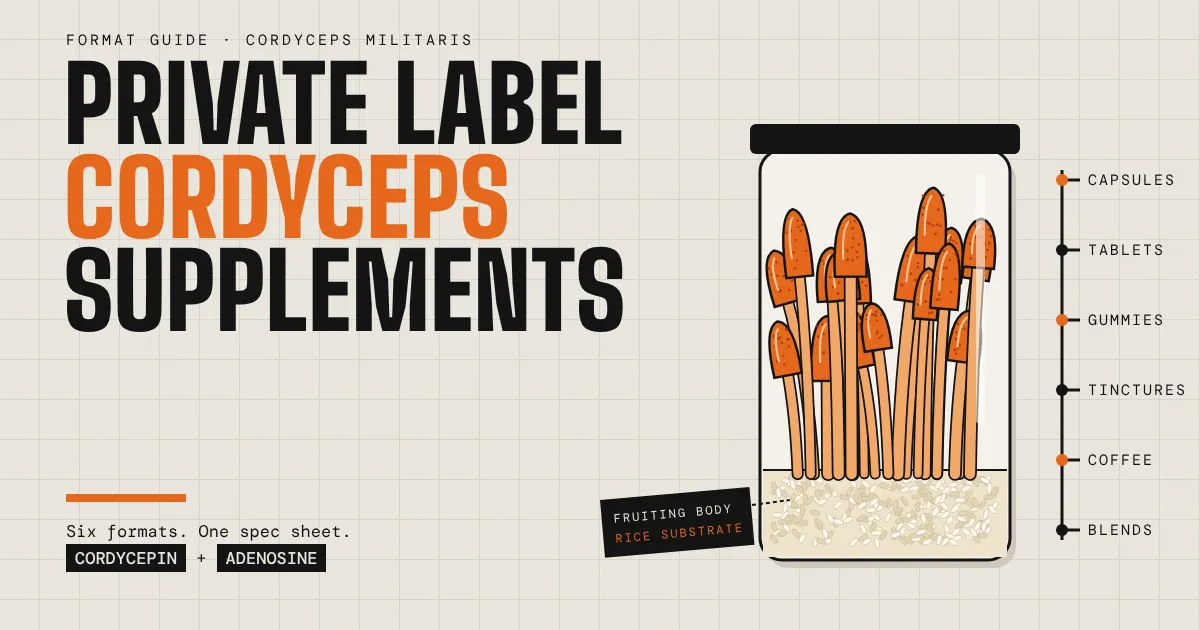
Lion’s mane, cordyceps and chaga extracts
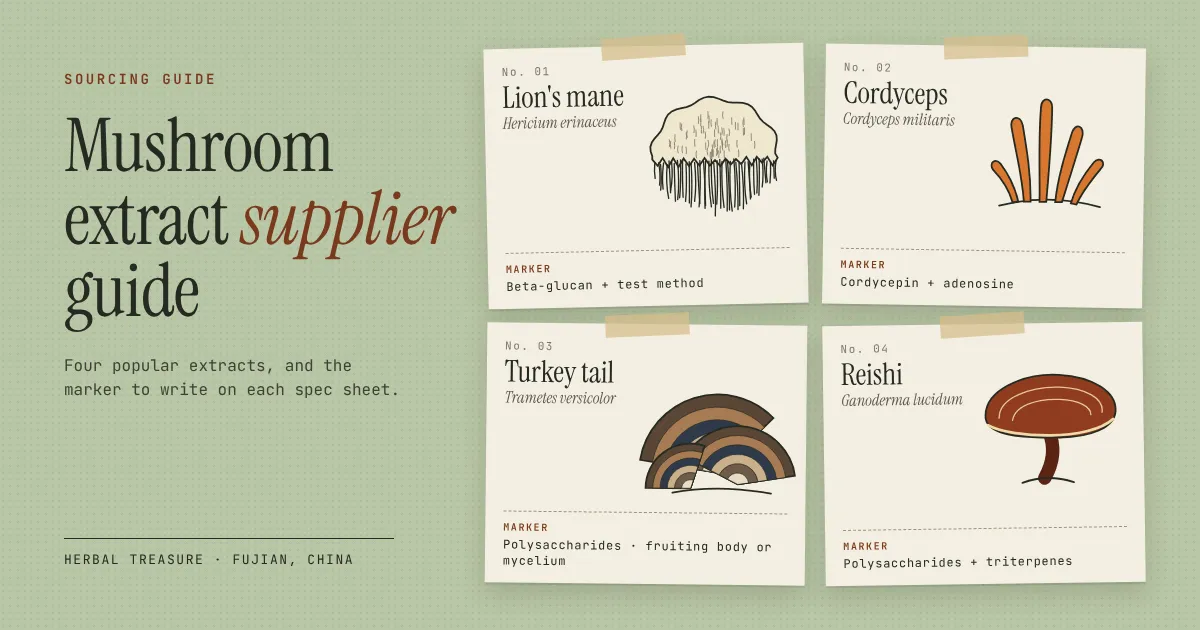
These three are best known as supplements, which is exactly why personal care brands use them: a lion’s mane body wash or a cordyceps shampoo can mirror a supplement a brand already sells. Lion’s mane is usually specified by beta-glucan, cordyceps militaris by cordycepin and adenosine, and chaga by polysaccharides.
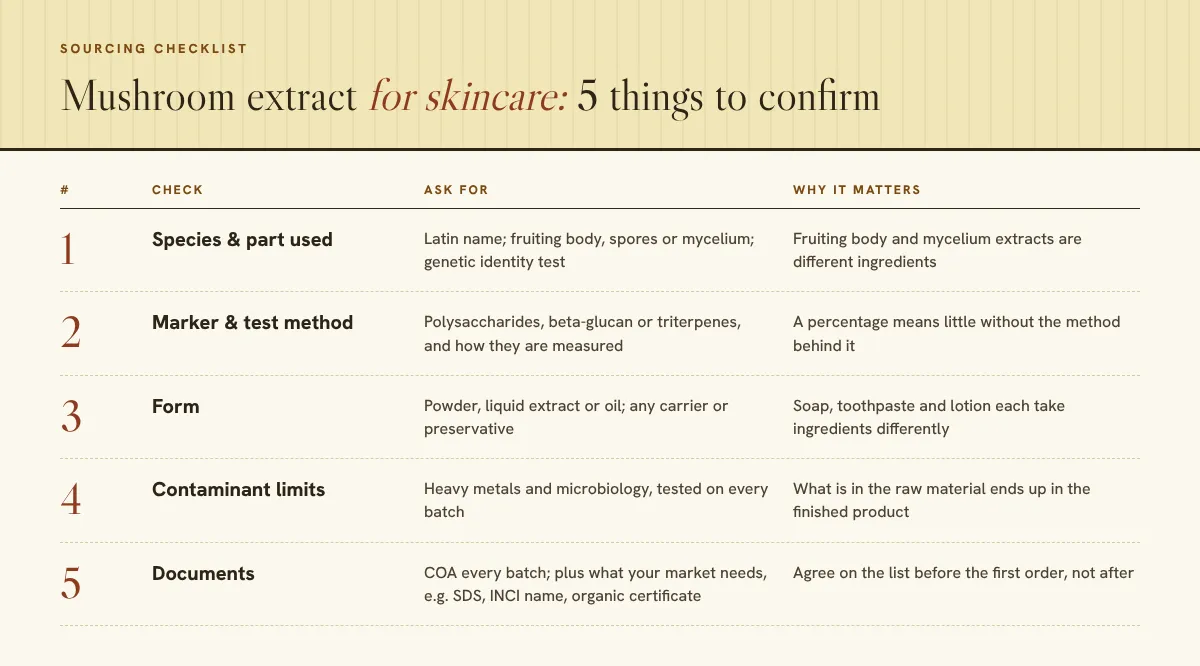
Mushroom extract for skincare sourcing checklist: species and part, marker and test method, form, contaminants and documents
Five things to confirm before you approve a mushroom extract for a personal care formula.
What to Ask a Mushroom Extract Supplier
Most problems with mushroom ingredients start with a loose specification. Before you approve an extract for a personal care formula, confirm these five points in writing.
1. Species and part used
Ask for the Latin name and the part of the mushroom: fruiting body, spores or mycelium. A reishi extract made from the fruiting body is a different ingredient from one made from mycelium grown on grain, even if both are sold as “reishi extract.” Genetic identity testing confirms the species.
2. Marker compound and test method
A percentage means little without the method behind it. Ask which compound is measured (polysaccharides, beta-glucan, triterpenes) and how. Polysaccharides and beta-glucan are not the same figure, and different test methods can give very different results for the same powder. Our guide to beta-glucan vs polysaccharides explains the difference.
3. Form and how it goes into your formula
Tell your supplier what you are making. A powdered extract, a liquid extract and an oil go into a formula in different ways, and a soap, a toothpaste and a lotion each need something different. If a liquid extract contains a carrier or a preservative, that ingredient must appear on your label too.
4. Contaminant limits
Ask for limits and results for heavy metals and microbiology on every batch. Cosmetic rules in the European Union, the United States and Canada all expect a product to be safe, and contaminants in a raw material end up in the finished product.
5. Documents for every batch
At minimum, each batch should come with a certificate of analysis (COA) that uses the same marker and method as your spec. Depending on your market, your regulatory team may also ask for a safety data sheet, the cosmetic ingredient (INCI) name, an origin statement and, for an organic claim, the organic certificate. Agree on the full list before your first order.
Supplement-Grade vs Personal Care Use: What Changes
Many mushroom extracts start life as supplement ingredients. The extract itself can be the same, but the paperwork around it changes when it goes into a cosmetic:
- Different rules.A personal care product is regulated as a cosmetic, not a food or dietary supplement. In the European Union that means Regulation (EC) No 1223/2009; in the United States, the Modernization of Cosmetics Regulation Act (MoCRA).
- Different label names.Supplement labels use common names. Cosmetic labels list ingredients by their INCI names, so confirm the correct INCI name with your supplier and regulatory adviser.
- Different claims.Supplement claims do not carry over. Keep personal care wording cosmetic, such as “moisturizes” or “leaves hair soft,” and avoid anything that suggests treating or healing.
Our mushroom extract supplier guide covers extract specs for supplements; this article focuses on the personal care side.
Why Source From the Manufacturer That Makes the Extract
Many brands buy a mushroom extract from one supplier and send it to a separate personal care factory. That route has two costs:
- More communication.Every spec change, sample and document request passes between companies that do not work together.
- Quality standards that don’t line up.The extract supplier and the personal care factory each run their own quality control, so it is hard to hold the whole product to one standard.
A source manufacturer that both extracts the mushrooms and develops personal care formulas removes that gap. You can buy the extract alone for your own formula, or have the same partner develop the finished product. Brands that want the finished-product route can read our guide to private label mushroom skincare.
How Herbal Treasure Supplies Mushroom Extracts for Personal Care
Herbal Treasure has worked with edible and medicinal mushrooms in Fujian, China, since 2003. For personal care brands and cosmetic manufacturers, that means:
- Our own reishi:organic reishi greenhouses and a log-grown forest base in Jiangle County, Sanming, in the southern Wuyi Mountains. Our log-grown reishi and reishi spore oil come from this base.
- Compliant sourcing for other mushrooms:other raw materials come from compliant cultivation and collection.
- In-house extraction:an NSF cGMP-certified extraction workshop of about 1,000 m² (roughly 10,800 sq ft).
- Testing on every batch:our in-house laboratory tests active content, heavy metals, microbiology and genetic identity. Third-party testing is available on request, paid by the client.
- Organic options:our certifications include USDA Organic, EU Organic and Canada Organic, so organic raw materials are available.
- Extracts and finished products:reishi extract, reishi spore oil, tremella extract and other mushroom extracts, plus personal care formula development for body wash, body lotion, hand cream, soap, shampoo, conditioner, toothpaste and mouthwash.
More than 1,000 brands in over 40 countries and regions work with us, and factory audits and visits are welcome.
Start With a Clear Spec
The right mushroom extract for skincare is the one you can describe precisely: species, part, marker, method, form, limits and documents. Write those down before you request samples, and ask for a COA that matches every batch.
Ready to source? Send us your product type, target market and the mushroom you want to use, and we will suggest an extract and spec to start from.
Frequently Asked Questions
Which mushroom extracts are used in skincare?
The most common are reishi extract, tremella extract and reishi spore oil. Lion’s mane, cordyceps and chaga extracts are also used, often by brands that want a personal care product to match a mushroom supplement they already sell.
What is the difference between reishi extract and reishi spore oil?
Reishi extract comes from the fruiting body and is specified by polysaccharides and triterpenes. Reishi spore oil is extracted from the spores, is specified by total triterpenes, and suits the oil phase of creams, lotions and balms.
Can a supplement-grade mushroom extract be used in personal care?
The extract can be the same, but the requirements change. A personal care product follows cosmetic rules, lists ingredients by INCI name and uses cosmetic claims only, so confirm the documents your market needs before you order.
Can you supply both the extract and the finished product?
Yes. We supply mushroom extracts as raw materials, and we also develop finished personal care products, including body wash, body lotion, hand cream, soap, shampoo, conditioner, toothpaste and mouthwash.