
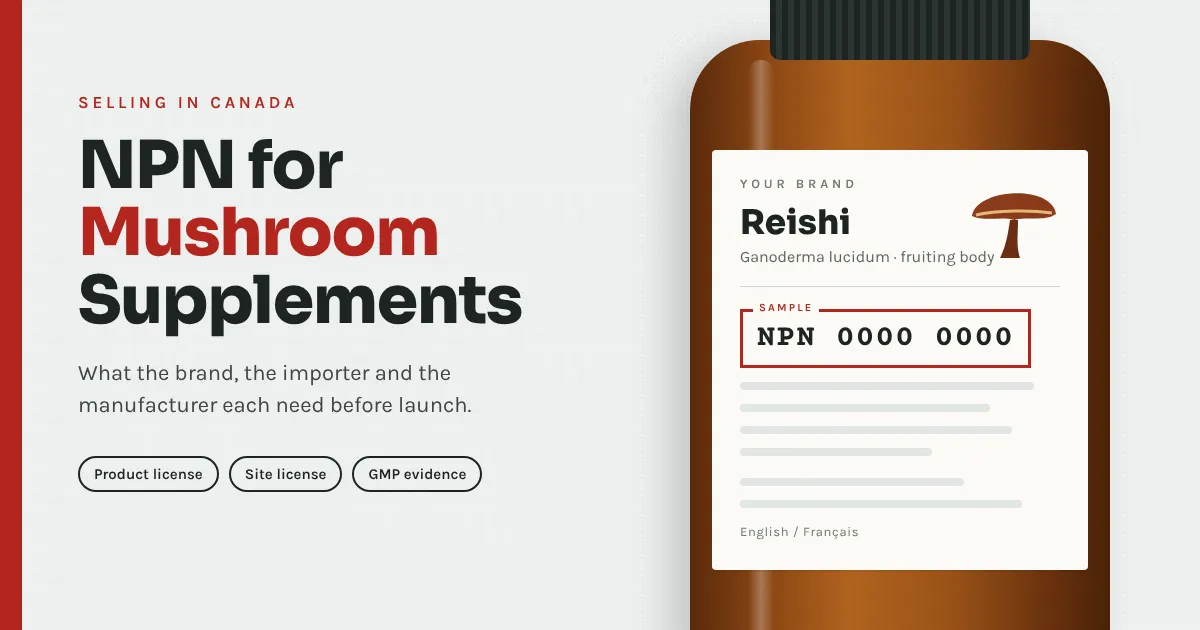
If you plan to sell reishi, lion’s mane or cordyceps supplements in Canada, you need an NPN for mushroom supplements before the first bottle goes on sale. Health Canada treats most mushroom supplements as natural health products (NHPs), and each one needs a product license, shown on the label as a Natural Product Number (NPN). This is a pre-market approval, not a simple registration.
The license is only one piece. A Canadian importer needs a site license, and the factory that makes your product must show it follows Canadian good manufacturing practices (GMP). This guide explains who is responsible for what, how long a review takes, and how your choice of mushroom ingredient shapes the application.
What Is an NPN, and Why Do Mushroom Supplements Need One?
What is an NPN? An NPN, or Natural Product Number, is the number Health Canada assigns when it approves a product license for a natural health product. It confirms that the product’s ingredients, dose, claims and quality have been reviewed. The label must show it with the prefix “NPN.”
This is where Canada differs most from the United States. In the US, dietary supplements do not need FDA approval before they are sold. In Canada, all NHPs go through a pre-market review, whether they are made in Canada or abroad. Selling first and filing later is not an option.
Who Needs What: Brand, Importer and Manufacturer
Canadian NHP rules split responsibility between three parties. Mixing them up is one of the most common reasons a launch stalls.
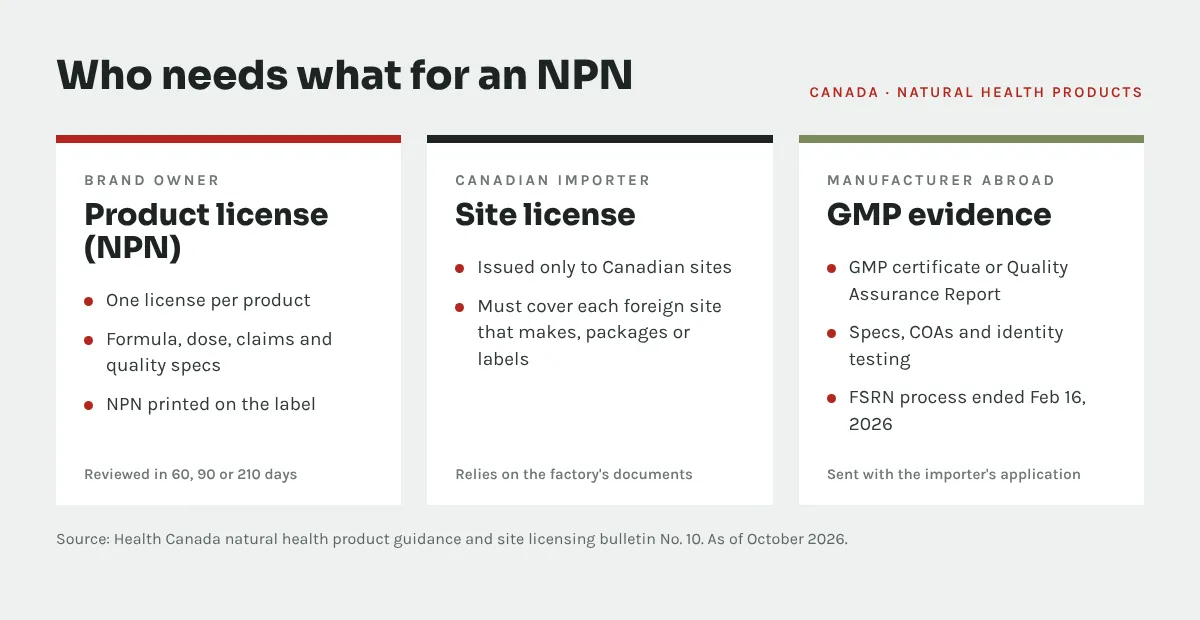
| Party | What it needs | What it involves |
| Brand owner | Product license (NPN) | Applies to Health Canada for each product, with its formula, dose, claims and quality specifications |
| Canadian importer | Site license | Site licenses are issued only to Canadian sites. The importer’s license must cover each foreign site that makes, packages or labels the product |
| Manufacturer abroad | GMP evidence | Supplies proof of GMP compliance, such as a GMP certificate or a Quality Assurance Report (QAR), for the importer’s site license application |
In other words, a factory outside Canada cannot hold a Canadian site license and cannot ship NHPs into Canada on its own. Every product needs a Canadian importer with a site license, and that importer depends on the factory’s documents.
The 2026 Change: FSRN Is No Longer Used
For years, foreign factories could apply for a Foreign Site Reference Number (FSRN), and importers could point to it as GMP evidence. On February 16, 2026, Health Canada ended the FSRN process. It no longer accepts new FSRN requests, and existing FSRNs are listed as “discontinued.”
Foreign sites now provide their GMP evidence through each importer’s site license application. For brands, the practical effect is simple: when you choose a manufacturer, ask how quickly it can prepare a complete GMP evidence package for your importer. An FSRN number alone no longer answers that question.
NPN Application Classes and Review Times
How long does NPN approval take? Health Canada sorts product license applications into three classes. Its service standards are 60 calendar days for Class I, 90 days for Class II and 210 days for Class III. The class depends on how closely your product matches evidence Health Canada has already reviewed.
| Class | Typical fit | Service standard |
| Class I | The product meets every parameter of a single Health Canada monograph | 60 days |
| Class II | The product is supported by evidence Health Canada has already assessed, but does not fit one monograph exactly | 90 days |
| Class III | The product needs a full review of its safety and efficacy evidence, for example a claim outside any monograph | 210 days (30 days screening, then 180 days assessment) |
These are Health Canada’s targets, not guarantees. Missing or inconsistent information can lead to requests for more data or a refused application, which costs far more time than any review queue. A product that drifts outside a monograph, for example by adding a new claim, can also move from Class II to Class III.
How Your Mushroom Ingredient Shapes the Application
The fastest route for most mushroom supplements is Health Canada’s Mushrooms monograph (current version dated October 25, 2024). It covers 15 species in one document, including reishi (Ganoderma lucidum), lion’s mane (Hericium erinaceus), Cordyceps militaris, chaga (Inonotus obliquus), turkey tail (Trametes versicolor) and tremella (Tremella fuciformis).
The monograph is detailed. Small choices in your specification decide whether your product fits it.
Fruiting Body or Mycelium
The part of the mushroom you use matters, and the rules change with the claim. For reishi, the monograph accepts fruiting body or mycelium for its antioxidant and polysaccharide claims. Its Traditional Chinese Medicine (TCM) claims, however, require the fruiting body only. The same applies to turkey tail.
So the raw material your manufacturer supplies has a direct effect on which claims you can make, and on how fast you can file. Make sure your specification names the species, the part used and how it was grown.
Water Extract, Alcohol Extract or Plain Powder
The monograph also separates preparation methods:
- Powderedmeans dried and ground, with no extraction.
- Aqueous (water) extractscan support the polysaccharide claims. Standardized water extracts in the monograph are capped at 40% polysaccharides.
- Ethanolic (alcohol) extractsare generally limited to the antioxidant claim. The monograph does not allow them for the polysaccharide or herbal immune-support claims.
If your product is a tincture or a high-polysaccharide extract, check these points before you settle the formula, not after.
Claims Come From the Monograph Wording
Monograph claims are set phrases. Examples include “Source of antioxidants,” “Source of fungal polysaccharides with immunomodulating properties” and “Used in Herbal Medicine to support the immune system.” Using the exact wording, with the matching ingredient and dose, keeps a product in Class I. Writing your own version of a claim can push it into a longer review.
Ingredients the Monograph Does Not Cover
Reishi spore powder and spore oil are not listed in the Mushrooms monograph. A product built around them will need another route, usually with more evidence and a longer timeline. Plan for that from the start.
Label Requirements to Plan For
Your NPN appears on the label, but so does much more. Health Canada requires certain label information in both English and French, along with the product name, license number, quantity, medicinal and non-medicinal ingredients, recommended use, dose and any cautions.
Health Canada’s updated labeling rules, which include a standardized Product Facts table, are being phased in, with a compliance deadline of June 22, 2028. Check the current labeling guidance before you finalize artwork, so you print once.
Documents to Request From Your Manufacturer
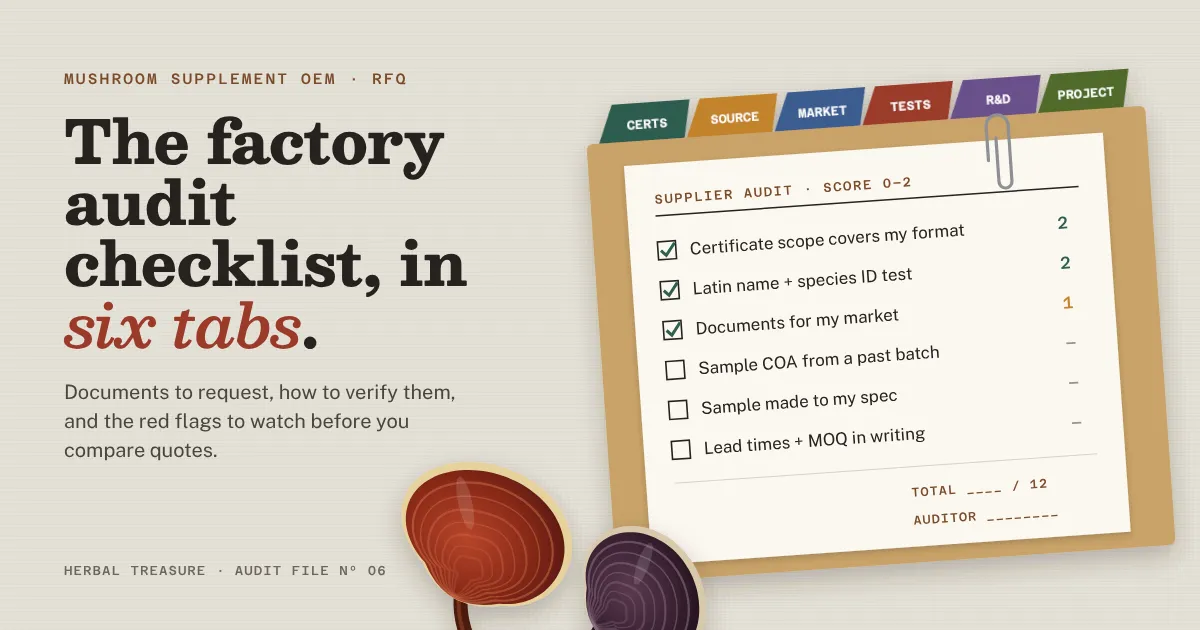
Your license application and your importer’s site license both draw on the factory’s paperwork. Before you sign, ask whether your manufacturer can provide:
- GMP evidencefor your importer, such as GMP certificates and the information needed for a Quality Assurance Report.
- Raw material specificationsthat name the species, the part used (fruiting body or mycelium) and the growing method.
- Batch certificates of analysis (COAs)covering active content, heavy metals and microbiology.
- Identity testing, to confirm the species.
- Finished product specificationsthat match the dose and claims in your application.
- Consistent documents across batches, so your license stays accurate after launch.
How Herbal Treasure Supports NPN Projects for Canada
Herbal Treasure has worked with the Canadian market for years, and products we manufacture have received more than 50 NPNs. We know the NHP document requirements and prepare the manufacturing-side compliance package that brands and their importers need, so your application can move faster.
What we bring to a Canadian project:
- GMP evidence for your importer.Our site was previously assessed under Health Canada’s FSRN process. Since that process ended, we supply GMP evidence directly for each importer’s site license application. Our facility holds NSF cGMP certification, along with ISO 22000, FSSC 22000 and HACCP.
- Clear raw material sourcing.Reishi from our own forest base in Jiangle County, Sanming, Fujian. Cordyceps militaris and wild-harvested turkey tail are fruiting body materials, which matters when a claim depends on the part used.
- Batch testing.Our in-house lab tests every batch for active content, heavy metals, microbiology and species identity (genetic ID testing). Third-party testing is available on request, at the client’s cost.
- Organic options.We hold Canada Organic, USDA Organic and EU Organic certification.
- Flexible starting point.OEM with your formula, or ODM from more than 5,000 proven formulas, with a minimum order of 500 units per SKU.
Factory visits and audits, by you, your importer or a third party, are always welcome.
The Bottom Line
An NPN for mushroom supplements is a pre-market approval, and it rests on three parties: the brand that holds the license, the importer that holds the site license and the manufacturer that proves its GMP. Choose your ingredient with the Mushrooms monograph in mind, and choose a manufacturer that can document every step.
Tell us which mushroom, format and claims you have in mind, and we will tell you which documents to prepare first.
Frequently Asked Questions
What is an NPN for mushroom supplements?
An NPN (Natural Product Number) is the number Health Canada assigns when it licenses a natural health product. Most mushroom supplements are NHPs, so each product needs its own license and NPN before it can be sold in Canada. The number must appear on the label with the prefix “NPN.”
How long does it take to get an NPN?
Health Canada’s service standards are 60 days for Class I, 90 days for Class II and 210 days for Class III applications. A product that matches the Mushrooms monograph exactly can qualify for Class I. Incomplete applications can take longer or be refused.
Can a manufacturer in China get a Canadian site license?
No. Health Canada issues site licenses only to Canadian sites. A foreign manufacturer supplies GMP evidence for its Canadian importer’s site license application, and the importer brings the product into Canada.
Is an FSRN still required for natural health products?
No. Health Canada ended the Foreign Site Reference Number (FSRN) process on February 16, 2026. Foreign manufacturers now provide GMP evidence through each importer’s site license application instead.
This article reflects Health Canada requirements as of October 2026 and is general information, not legal or regulatory advice. Rules change, so confirm current requirements with Health Canada or a qualified regulatory consultant before you apply.
Official Sources
- Health Canada: Natural Health Products Management of Applications Policy (review classes and service standards)
- Health Canada: Mushrooms monograph, Natural Health Products Ingredients Database
- Health Canada: Ending Foreign Site Reference Number process and foreign warehouses (site licensing bulletin, February 16, 2026)
- Health Canada: Guidance document, Labelling of natural health products
Health Canada: Improved natural health product labelling