
Planning private label reishi supplements for Amazon or your own store? Start with the format, because the format decides what you are really buying. Cracked-wall spore powder, spore oil and fruiting body extract come from different parts of the reishi mushroom, and each one is judged by a different number on the spec sheet.
This guide walks through the six reishi formats brands ask us about most, what to specify for each, and what Amazon expects to see before a supplement listing goes live.
Why Reishi Formats Matter for Amazon and DTC Brands
Reishi (ling zhi, Ganoderma lucidum) is one of the best-known medicinal mushrooms in the world. On cross-border platforms, shoppers no longer look only for plain reishi capsules. Demand is strong for reishi spore powder, spore oil, reishi coffee and reishi gummies, and some brands extend the line into personal care.
That variety is an opportunity, but it also creates confusion. Two products can both say “reishi” on the front and contain very different raw materials. If your spec sheet does not name the raw material and the quality marker, you have no reliable way to compare quotes, and no way to prove what is in the bottle.
Reishi Fruiting Body, Spores and Spore Oil: What Is the Difference?
Reishi fruiting body extract is made from the mushroom itself, the cap and stem. Reishi spores are the tiny reproductive cells the mushroom releases from the underside of its cap. Reishi spore oil is oil obtained from those spores. Because they are different raw materials, each is specified by a different quality marker.
- Fruiting body extract:judged mainly by polysaccharides and triterpenes.
- Spore powder:spores have a tough outer wall, so the key figure is the cracking rate, the share of spores whose wall has been broken open. This is what “cracked-wall” or “broken-wall” spore powder means.
- Spore oil:judged mainly by total triterpenes.
A fourth material, mycelium, also appears on the market. It is the root-like network that grows inside the substrate, not the mushroom or its spores, and it should always be labeled as mycelium. We cover that difference in our guide to log-grown reishi extract.
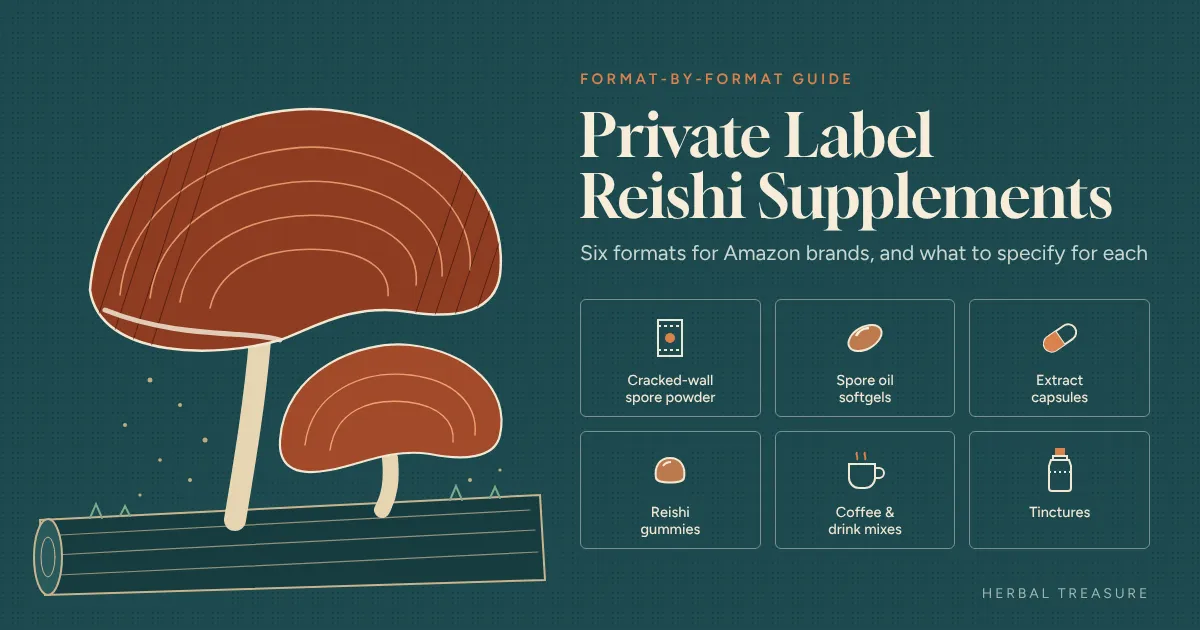
6 Private Label Reishi Supplement Formats, and What to Specify
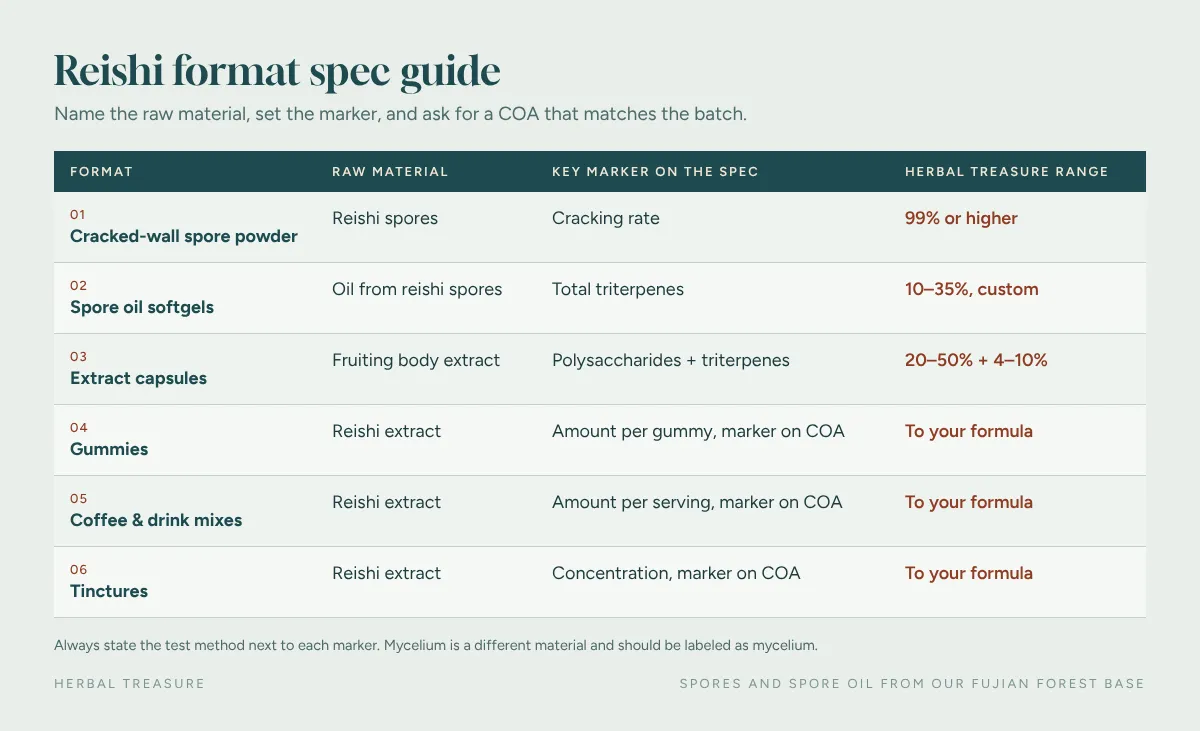
1. Cracked-Wall Reishi Spore Powder
Spore powder suits brands that want a single-ingredient, premium reishi product. Because the spore wall is tough, the number that matters most is the cracking rate.
- Specify:spores as the raw material, the minimum cracking rate, and where the spores were grown.
- Herbal Treasure range:cracking rate of 99% or higher, from reishi grown at our own forest base.
- Common packaging:bottles, pouches or single-serve sachets.
2. Reishi Spore Oil Softgels
Spore oil is a concentrated format, so buyers focus on one figure: total triterpenes. Ask for it on the specification and on every batch test report.
- Specify:spore oil as the raw material, total triterpene content, and the test method.
- Herbal Treasure range:total triterpenes customized between 10% and 35%, to your requirements.
- Raw material source:spores from our forest base, the same base that grows our log-grown reishi.
3. Reishi Extract Capsules
Capsules remain the most familiar way to take reishi, and they are easy for shoppers to compare. For a fruiting body extract, put both main markers on the spec.
- Specify:fruiting body as the raw material, polysaccharide and triterpene levels, and the test method for each.
- Herbal Treasure range:polysaccharides 20–50% and triterpenes 4–10%, customized to your formula.
- Capacity:four capsule lines with a combined output of up to 3 million capsules a day.
4. Reishi Gummies
Gummies appeal to shoppers who want something easier than a capsule. A gummy has limited room for active ingredients, so the strength of the extract you put in it matters.
- Specify:the reishi extract used, the amount per gummy, and the marker you want reported on the certificate of analysis (COA).
- Capacity:more than 3 metric tons (about 6,600 lb) of gummies a day.
5. Reishi Coffee and Drink Mixes
Reishi coffee and powdered drink mixes fit naturally into a morning routine, which makes them popular with direct-to-consumer brands. They are usually packed in stick packs or pouches.
- Specify:the reishi extract and its marker, the amount per serving, and the coffee or drink base.
- Capacity:600,000–800,000 powder sachets a day, with packaging design available for stick packs, pouches and gift boxes.
6. Reishi Tinctures
Tinctures give shoppers a liquid option they can add to water or take by the dropper. As with every format, ask for the reishi extract and its marker on the spec and the COA.
- Specify:the reishi extract, its concentration and marker, and bottle size.
- Capacity:automatic filling lines that fill 30,000–50,000 bottles a day.
Beyond Supplements: Reishi Personal Care
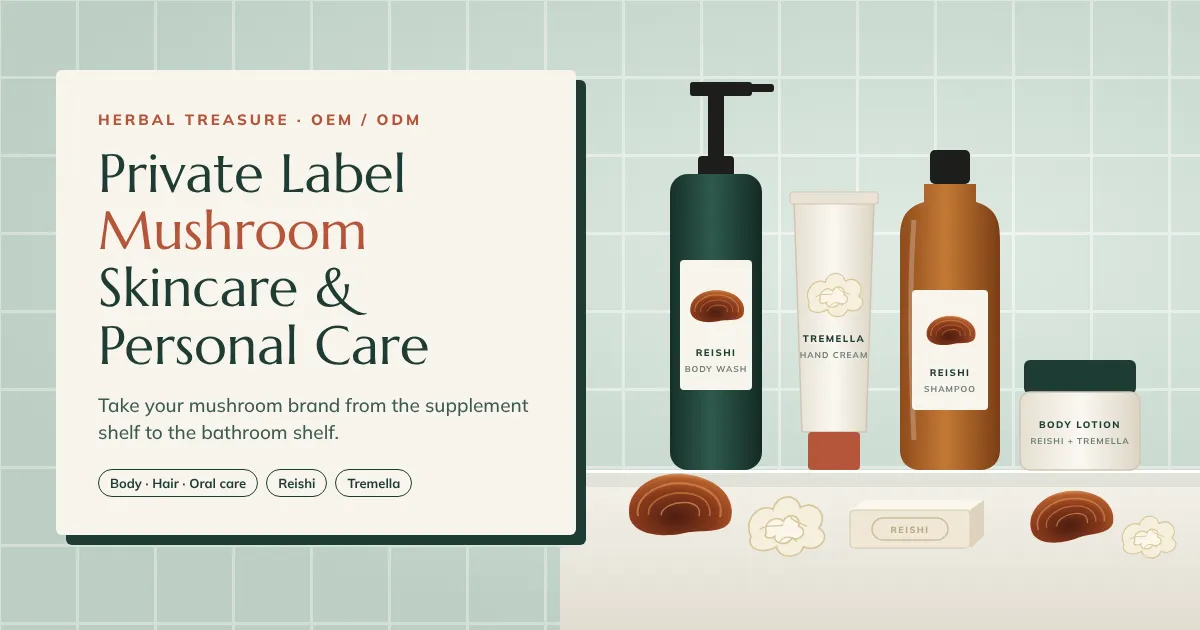
Some brands extend a reishi line beyond supplements. We also develop reishi-based personal care products, including soap, toothpaste, mouthwash, shampoo, conditioner, body wash, body lotion and hand cream, as well as skincare that combines reishi with tremella (yin er) extract.
What Amazon Expects From Reishi Supplement Listings
In Amazon’s US store, dietary supplements must be verified by an approved third-party testing, inspection and certification (TIC) organization before they can be sold. The lab tests the product, reviews the label and sends the results to Amazon directly. Amazon no longer accepts COAs submitted by sellers themselves.
According to testing bodies that run this verification, such as SGS, the process typically covers:
- Identity and potency: labeled ingredients are present at the claimed amounts
- Contaminants: heavy metals and microbials
- Adulterants: undeclared pharmaceutical ingredients
- A label review against Amazon’s requirements
- Manufacture in an FDA cGMP-compliant facility
Sellers are usually asked for label files, the manufacturing facility’s GMP certificate, a product specification or COA, and product samples. Verification is renewed every year for each listing. Amazon updates these rules from time to time (NutraIngredients-USA reported the 2024 changes), so always confirm the current requirements in Seller Central before you launch.
For your manufacturer, this means the spec sheet, the label and the finished product all have to match. A clear spec for each format is the best preparation for third-party testing.
Two Reishi Sourcing Traps to Avoid
Cross-border sellers run into the same two problems again and again:
- Mycelium sold as fruiting body extract.The two are different materials at different prices. Your spec sheet should state which one you are buying.
- Overstated triterpene content.A high number on a quote means little without a test method and a batch report to back it up.
The fix is simple: write the raw material, the marker and the test method into the specification, and ask for a test report that matches the batch you receive. For more on reading these numbers, see beta-glucan vs polysaccharides.
How Herbal Treasure Makes Private Label Reishi Supplements
Herbal Treasure is based in Jiangle County, Sanming, in the southern foothills of Fujian’s Wuyi Mountains, a heavily forested area well suited to growing reishi under the forest canopy. Here is how we support reishi brands:
- Cultivation:a forest base of more than 200 mu (about 13 hectares, or 33 acres), where reishi is log-grown on oak and maple logs under conditions close to the wild, alongside our organic reishi greenhouses. Our spore powder and spore oil come from this forest base.
- Extraction and testing:an in-house extraction workshop and laboratory testing for active content, heavy metals, microbiology and species identity, with a COA for every batch.
- Certifications:NSF cGMP, USDA Organic, EU Organic, Canada Organic, FSSC 22000, ISO 22000, HACCP, Halal and Kosher. Our facility is FDA-registered and holds a Health Canada Foreign Site Reference Number (FSRN).
- Formulas:bring your own formula (OEM), or start from more than 5,000 proven formulas (ODM).
- Orders:minimum order from 500 units per product; samples in 5–7 days for standard products or 7–14 days for custom formulas; production in 15–20 days for standard orders or 4–6 weeks for deep customization.
Our reishi raw materials and private label products already reach brands in more than 40 countries and regions, many of them selling on Amazon and on their own websites.
Choosing Your First Reishi Format
The right first product depends on your customer. Spore powder and spore oil suit buyers who want a premium, single-ingredient product. Capsules are the easiest to compare and reorder. Gummies, coffee and tinctures reach shoppers who prefer a daily ritual over a pill. Whatever you choose, name the raw material, set the marker, and ask for a matching COA.
Ready to plan your reishi line? Request a manufacturing quote and tell us your market, format and target specification.
Frequently Asked Questions
What is the difference between reishi spore powder and reishi extract?
Reishi extract is made from the fruiting body, the mushroom’s cap and stem, and is usually specified by polysaccharides and triterpenes. Spore powder is made from the tiny spores the mushroom releases, and its key figure is the cracking rate.
What does cracked-wall reishi spore powder mean?
Reishi spores have a tough outer wall. Cracked-wall, or broken-wall, spore powder has been processed to break that wall open. The cracking rate tells you what share of spores are opened; Herbal Treasure’s is 99% or higher.
What is the minimum order for private label reishi supplements?
At Herbal Treasure, minimum orders start from 500 units per product. The exact quantity depends on the format, formula and packaging you choose.
What does Amazon require for reishi supplements?
In Amazon’s US store, dietary supplements must pass verification by an approved third-party testing organization. Testing typically covers identity, potency, contaminants and label accuracy, and products must be made in a cGMP-compliant facility. Check Seller Central for current rules.