
Graphic for how to verify a supplement manufacturer: a magnifying glass over a reishi mushroom on a red background, with the title Factory or trading company?
Before you compare prices, check who actually makes your product.
To verify a supplement manufacturer, ask for proof instead of promises: photos and ownership documents for the cultivation base, a live look at the extraction workshop, certificates issued in the factory’s own name, and a batch COA that states its test methods. A real source factory can show you all of this. A middleman usually can’t.
Search for “lion’s mane powder OEM” or “cordyceps ODM” and you will find hundreds of suppliers calling themselves the source. Some are. Others are trading companies that buy ingredients from several plants, repack them and resell them under their own name. Trading companies are a legitimate business, and some buyers are happy to work with them. But if you are building a brand that depends on consistent quality and clean export paperwork, you need to know exactly who stands behind each batch.
This guide gives you eight checks, the evidence to ask for at each step, and the warning signs that tell you to dig deeper.
Why It Matters Whether Your Supplier Is a Factory or a Trading Company
A trading company sits between you and the people who grow, extract and test your mushrooms. That gap is where most sourcing problems start.
- Batch-to-batch variation.If your supplier buys from whichever plant has stock, the raw material, extraction method and active content can change from one order to the next.
- Borrowed credentials.Certificates shown to you may belong to another company, so they may not cover the site that actually made your product.
- Paperwork that doesn’t match.When the manufacturer on the documents differs from the one on your label or shipping papers, customs and marketplace reviews can hold up your goods.
None of this means every reseller is a risk. It means you should check what you are told, the same way you would check a new partner in any other industry.
How to Verify a Supplement Manufacturer: 8 Checks
Each check below covers one link of the supply chain, from the mushroom itself to after-sales support. Work through them in order on your first calls with a supplier, and ask for documents or a live video at every step. A real manufacturer will treat these questions as normal.
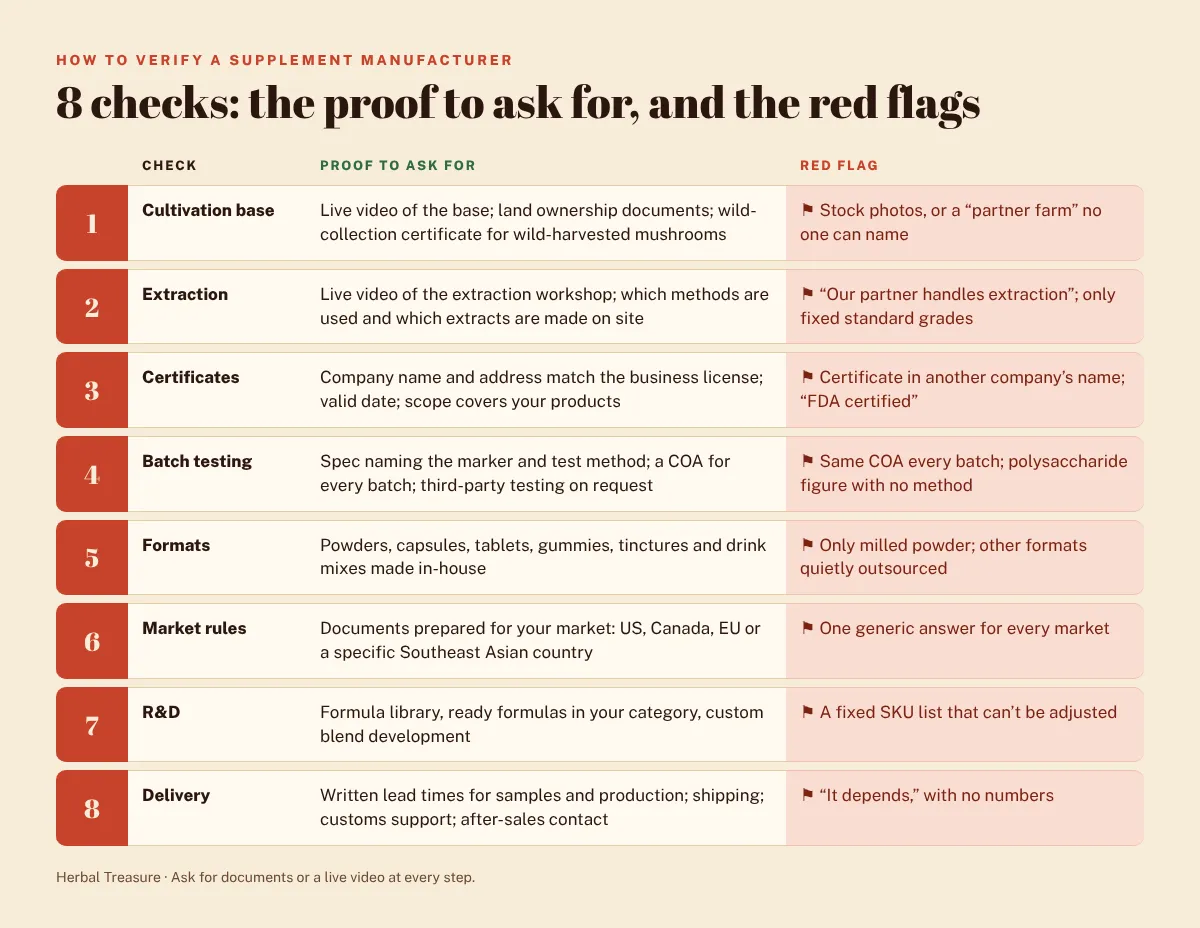
Table of 8 checks to verify a mushroom supplement manufacturer, listing the proof to ask for and the red flags for each
The eight checks at a glance: what a source factory can show you, and the answers that should make you look closer.
1. Does the Manufacturer Own Its Cultivation Base?
Ask for: recent photos or a live video of the cultivation base, and documents that show who owns the land. For wild-harvested mushrooms such as turkey tail (yun zhi), ask for the wild-collection certificate. It is a required document for organic certification of wild-harvested raw materials.
Red flag: stock photos, a “partner farm” that can’t be named, or a base that no one can show you on camera.
2. Does It Run Its Own Extraction Workshop?
Ask for: a live video of the extraction workshop and a short explanation of the methods used, such as hot-water extraction, alcohol extraction and low-temperature cell-wall breaking. Ask which extracts are made on site and which are bought in.
Red flag: “Our partner handles extraction,” or a supplier that can only offer a few standard grades and can’t adjust the process for you. A company that buys finished extracts and simply blends or repacks them has limited control over what is inside.
3. Are the Certificates Held by the Factory Itself?
Ask for: copies of each certificate, then check three things: the company name and address match the factory’s business license, the certificate is still valid, and its scope covers the products you are buying. Many certification bodies let you look certificates up online; the USDA Organic Integrity Database is one example.
Red flag: a certificate issued to a different company name, or the phrase “FDA certified.” The FDA does not certify supplement factories. Facilities register with the FDA, so the correct term is “FDA-registered facility.”
4. Can It Standardize Active Compounds and Prove Each Batch?
Ask for: a specification that names the marker compound and its target level, a COA for every production batch, and the test method behind each number. For mushroom extracts, make sure the COA tells you whether it measures total polysaccharides or beta-glucan, because the two numbers are not interchangeable. Our guide to beta-glucan vs polysaccharides explains the difference.
Red flag: the same COA for every batch, a high polysaccharide figure with no method stated, or reluctance when you ask for third-party testing.
5. Can It Make Every Format You Plan to Sell?
Ask for: a list of the dosage forms made in-house, such as powders, capsules, tablets, gummies, tinctures and mushroom coffee or drink mixes, and a video of the line for the format you need first.
Red flag: a supplier that can only mill dried mushrooms into simple powder, or that sends gummies and tinctures out to another plant without telling you.
6. Does It Understand the Rules in Your Market?
Ask for: examples of the documents it has prepared for clients in your market, whether that is the United States, Canada, the European Union or a country in Southeast Asia. Requirements differ between markets, and in Southeast Asia they differ from country to country.
Red flag: one generic answer for every market, or no experience with the market you plan to enter. Our mushroom supplement compliance guide covers what the US, Canada and the EU expect.
7. Does It Have Real R&D Behind Its Formulas?
Ask for: the size of the formula library, examples of ready formulas in your category, and how custom blends are developed and tested.
Red flag: a fixed list of SKUs and no way to adjust a formula. That often means the products are sourced, not developed.
8. Is the Delivery Chain Clear From Sample to Shelf?
Ask for: written lead times for samples and production, the shipping options, the support offered for customs clearance, and who answers technical questions after delivery.
Red flag: “It depends” with no numbers, or no one who can explain what happens after the goods leave the factory. Our supplement manufacturing timeline shows what each stage normally takes.
What to Look For on a Video Factory Tour
A short video tour is one of the fastest ways to verify a supplement manufacturer. Ask the supplier to walk you through the site live, not with a prepared clip, and to point the camera where you ask. Five minutes is often enough to see whether the answers above hold up.
- The extraction workshop.Is it running, and does it match what you were told about the methods?
- The lab.Are there instruments for testing active content, heavy metals and microbiology?
- The production line for your format.Capsule, gummy or tincture lines should be on site, not “at our partner.”
- Raw material storage.Are materials labeled with batch numbers that can be traced back to a source?
If a supplier refuses a live tour or keeps rescheduling, treat it as an answer in itself.
When a Quote Looks Too Low: 4 Questions to Ask
A low price is not a problem on its own, but it is a reason to look at what you are being quoted for. Before you compare two offers, make sure they describe the same product.
- Which marker compound is specified, and at what level?
- Which test method is used to measure it?
- Is the material made from the fruiting body or from mycelium?
- Will the COA come from your batch, and can you send a sample to a third-party lab?
If one supplier can’t answer these clearly, the two quotes are not comparable.
How Herbal Treasure Answers These 8 Checks
We are a manufacturer, so we are not a neutral judge. Here are our own answers to the eight checks, so you can hold us to the same standard.
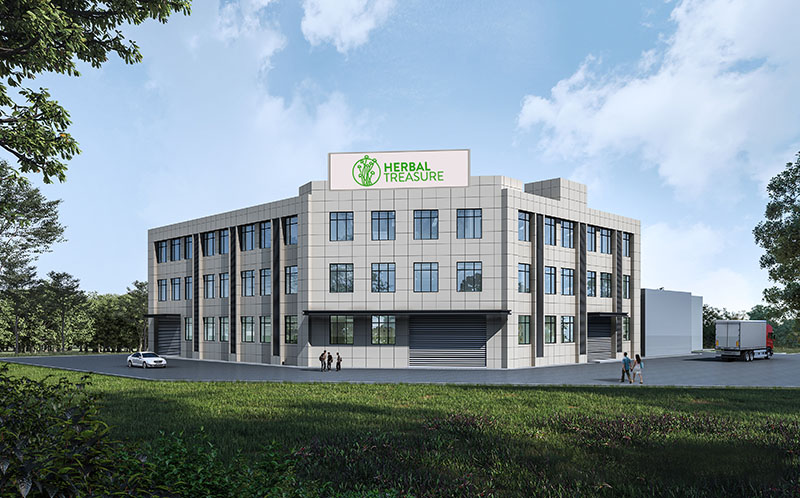
- Cultivation base:our forest-grown base covers more than 200 mu (about 13 hectares, or 33 acres) in Jiangle County, Sanming, in the southern Wuyi Mountains of Fujian. The land was purchased by the company and our facilities were built with our own funds. Ownership documents can be provided on request. Wild-harvested raw materials such as turkey tail come with wild-collection certificates.
- Extraction:a 1,000 m² (about 10,800 sq ft) extraction workshop, using hot-water extraction, alcohol extraction and proprietary low-temperature cell-wall breaking.
- Certificates:NSF cGMP, ISO 22000, FSSC 22000, HACCP, EU Organic, USDA Organic, Canada Organic, Halal and Kosher. Our facility is FDA-registered and holds a Health Canada Foreign Site Reference Number (FSRN).
- Testing:our in-house lab tests every batch for active content, heavy metals, microbiology and species identity, and each batch ships with a COA. Third-party testing can be arranged on request, with the lab fee paid by the client.
- Formats:more than 10,000 m² (about 108,000 sq ft) of facilities, including 8,000 m² of cGMP workshops, for powders, capsules, tablets, gummies, tinctures, and mushroom coffee and drink mixes.
- Markets:we prepare documents for clients in the US, Canada and the EU. Southeast Asian requirements vary by country, and we work to supply what each market asks for.
- R&D:an R&D team of more than 100 people and more than 5,000 proven formulas, for both OEM and ODM projects.
- Delivery:samples in 5–7 days for standard formulas and 7–14 days for custom ones; production in 15–20 days, or 4–6 weeks for deep customization; international delivery by air or express in 7–14 days, with customs clearance support. Orders start from 500 units per product.
Video tours, factory visits and audits by clients or third parties are all welcome.
Verify First, Then Compare Prices
A low quote is only good value if the product behind it is consistent, documented and legal to sell in your market. Check the supply chain first, and compare prices only between suppliers who pass. For a broader look at choosing a partner, see our guide on how to choose a mushroom supplement manufacturer.
If you would like to put these eight checks to us, book a video factory tour or request a quote.
Frequently Asked Questions
How can I tell if a supplier is a real factory or a trading company?
Ask for a live video of the extraction workshop and production line, and check that the company name on each certificate matches the factory’s business license. A real factory can show its own base, workshop and lab on camera and explain its methods in detail. A trading company usually can’t.
What does “FDA registered” mean for a supplement manufacturer?
It means the facility is registered with the US Food and Drug Administration. The FDA does not certify facilities or approve dietary supplements before they are sold, so a supplier claiming to be “FDA certified” or “FDA approved” is using the wrong term.
Should every batch of mushroom extract come with a COA?
Yes. Each production batch should have its own COA showing the active marker, heavy metals and microbiology, with the test method for each result. At Herbal Treasure, every batch is tested in our in-house lab, and third-party testing can be arranged on request.
Can I visit or audit a mushroom supplement manufacturer in China?
Many manufacturers accept visits, and you should ask before you place an order. Herbal Treasure welcomes video tours, on-site visits and audits by clients or third parties.