

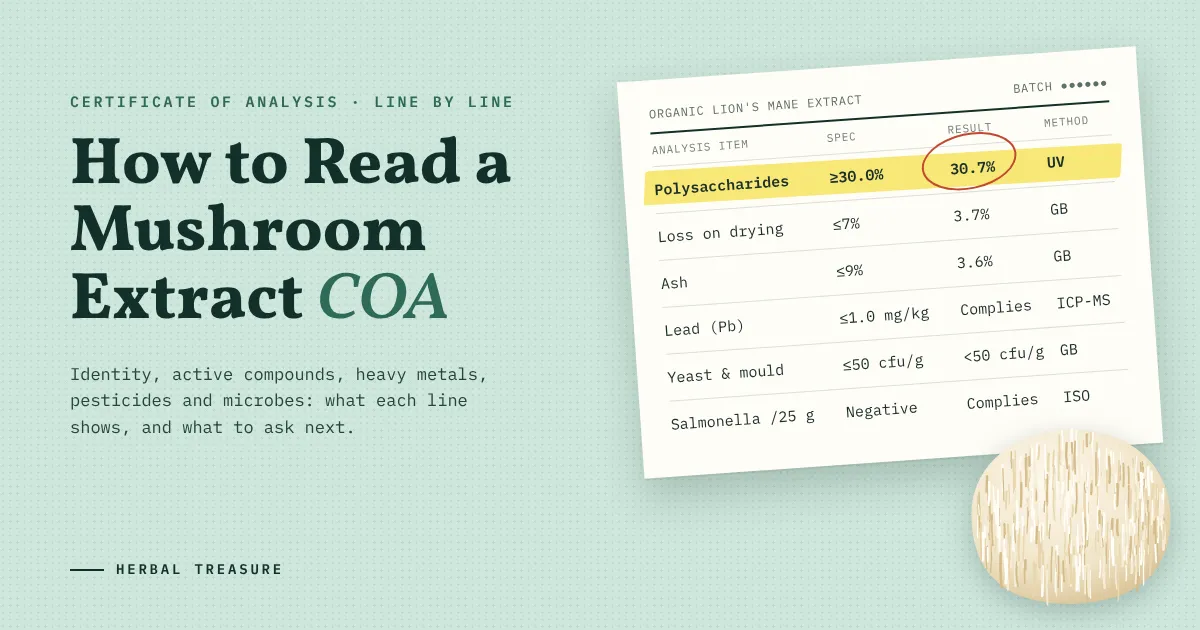
Mushroom extract COA: a highlighted certificate of analysis line showing polysaccharides of 30.7% against a 30% specification, next to a lion’s mane mushroom
A COA tells you a lot, and leaves some questions open. Here is how to read one line by line.
A mushroom extract COA (certificate of analysis) is the lab report for one production batch. To read it, work through four questions: does the header identify exactly what you ordered, does the active compound result meet your specification with a named method, what do the purity tests (heavy metals, pesticides, microbes) actually report, and does every line match the specification you agreed in writing?
Below, we walk through an example COA for an organic lion’s mane extract specified at 30% polysaccharides. For each section: what the report says, what that shows, and what you still need to ask. The aim is to help you spot information and gaps on any supplier’s COA, including ours.
What Is a Mushroom Extract COA?
A mushroom extract COA is a batch-specific document from the manufacturer’s quality control lab or an independent lab. It lists each test, the specification (the agreed limit), the result and the method, as evidence about one batch identified by its batch number.
Two columns matter most: Specification and Test Results. The specification is your contract in numbers. The result is what the lab reported for this batch. Read the two side by side, and check that the specification column matches the one you signed off on.
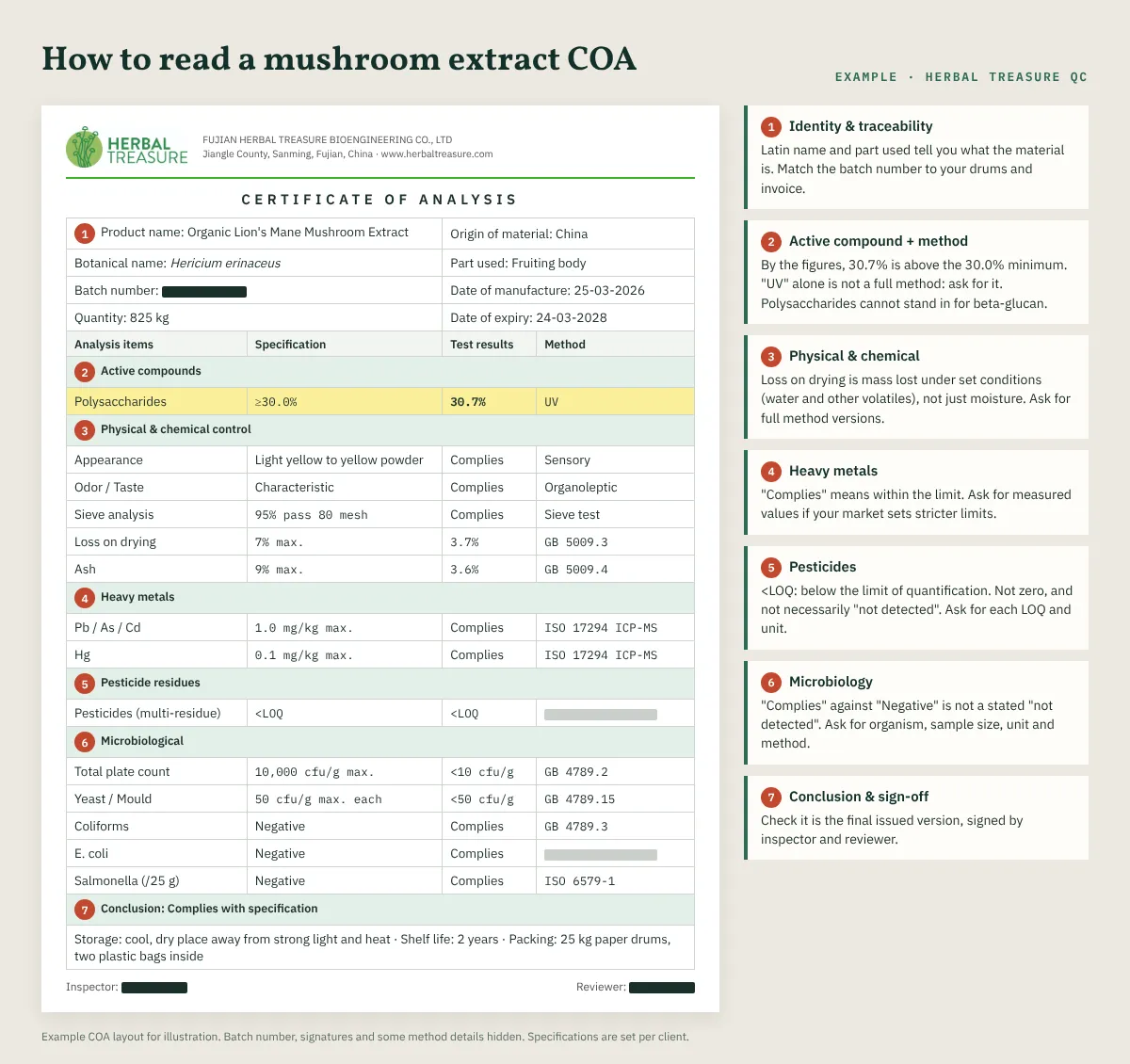
Mushroom extract COA example: an annotated certificate of analysis for organic lion’s mane extract with seven numbered sections, from batch header to packing details
An example COA layout for lion’s mane extract. Batch number, signatures and some method details are hidden.
How to Read a Mushroom Extract COA, Section by Section
The numbers below match the annotated example. Layouts differ, but a complete COA covers the same ground.
1. The Header: Identity and Traceability
On the report: product name (Organic Lion’s Mane Mushroom Extract), botanical name (Hericium erinaceus), part used (fruiting body), origin, batch number, quantity, and dates of manufacture and expiry.
What it shows: what the supplier says the material is, and which batch the results belong to.
What to ask: “mushroom extract” can come from the fruiting body or from mycelium, so check the part used, and ask how the material was grown and what the raw material consists of. Then confirm that the batch number matches the drums, the packing list and the invoice. Without that link, the report cannot be tied to the goods you received.
2. Active Compounds: The Result and the Method
On the report:
| Analysis item | Specification | Test result | Method |
| Polysaccharides | ≥30.0% | 30.7% | UV |
What it shows: by the figures on the report, 30.7% is above the minimum specification of 30.0%.
What to ask: the method column says “UV”, which on its own does not tell you the sample preparation, what exactly is measured or how the result is calculated. Ask for the full method or the lab’s internal method number, the basis of the result (for example, as-is or dry basis) and the decision rule used to judge compliance. Different methods can give different numbers from the same powder.
This line reports total polysaccharides, and a polysaccharide result cannot stand in for a beta-glucan result. If your label or marketing refers to beta-glucan, add it to your specification as a separate line with its own method. Our guide to beta-glucan vs polysaccharides explains the difference. The same applies to other markers, such as triterpenes for reishi (ling zhi), or cordycepin and adenosine for cordyceps militaris (yong chong cao).
3. Physical and Chemical Tests
On the report: appearance and odor (light yellow to yellow powder, characteristic), sieve analysis (95% passing 80 mesh), loss on drying (maximum 7%, result 3.7%) and ash (maximum 9%, result 3.6%), with GB 5009.3 and GB 5009.4 given as methods.
What it shows: whether the powder matches its physical description. Particle size affects capsule filling and how a powder disperses in drinks. Loss on drying is the mass lost under defined drying conditions, which can include water and other volatile substances, so it is not simply moisture. Ash is the inorganic residue left after burning.
What to ask: a standard number alone is not enough to repeat a test. Ask for the full version, the specific method option used and any key operating conditions. If you plan a drink mix or a fine powder, agree the mesh size in your specification.
4. Heavy Metals
On the report: limits of 1.0 mg/kg for lead (Pb), arsenic (As) and cadmium (Cd), and 0.1 mg/kg for mercury (Hg), by ICP-MS (ISO 17294), with each result reported as “Complies”.
What it shows: the lab judged each result to be within its limit.
What to ask: “Complies” is a conclusion, not a number. If your market, retailer or own policy sets its own limits, ask for the measured values, and check that the limits on the COA are at least as strict as yours.
5. Pesticide Residues
On the report: a multi-residue pesticide screen, with the specification and result both given as “<LOQ”.
What it shows: for the compounds covered, the results were below the method’s limit of quantification (LOQ). That means they could not be reliably quantified under the method’s stated performance requirements. It does not mean zero, and it does not necessarily mean “not detected”.
What to ask: the list of compounds tested, the LOQ and unit for each one, the full method references and the linked lab report. If a COA states a number of compounds, the detailed list should back it up. For organic products, the organic certificate covers how the material is grown and handled; the COA reports what was measured in one batch.
6. Microbiology
On the report: total plate count (maximum 10,000 cfu/g, result <10 cfu/g), yeast and mould (maximum 50 cfu/g each, results <50 cfu/g), and pathogen tests whose specification reads “Negative” and whose result reads “Complies”.
What it shows: “cfu/g” means colony-forming units per gram, a count of live microorganisms. For the pathogen lines, the report states that the result met the specification.
What to ask: “Complies” against a “Negative” specification is not the same as a stated “not detected in 25 g”. Ask for the exact organism for each test (for example, whether a Staphylococcus test means Staphylococcus aureus), the sample size, the reporting unit and the full method. A COA that lists only a total plate count is incomplete.
7. Conclusion, Storage, Shelf Life and Packing
On the report: an overall conclusion (“Complies with specification”), storage conditions (cool, dry, away from strong light and heat), shelf life (2 years when properly stored), packing (25 kg paper drums with two plastic bags inside), and inspector and reviewer sign-off.
What to ask: check that the report is the final issued version, signed by the people responsible, and that the shelf life and storage conditions match your own product plans.
Standardized Extract vs Ratio Extract: What Should the COA Show?
A standardized extract is specified to contain a minimum level of a measured compound, such as 30% polysaccharides. A ratio extract, such as 10:1, tells you how much raw mushroom went into each unit of extract. A ratio describes the process, not the active content.
We make both types. Either way, ask for measured marker values and their methods, not only the ratio: two 10:1 extracts can differ widely in polysaccharides or beta-glucan.
6 Gaps to Check on a Mushroom Extract COA
- No batch number, or one that does not match your shipment.The report cannot be tied to your goods.
- Results without full methods.You cannot compare the number with another lab’s result.
- A specification column that differs from your agreed spec.Check limits line by line.
- No botanical name or part used.You cannot confirm what the material is.
- Only “Complies” where you need numbers.Ask for measured values when your market or retailer requires them.
- An issuer you cannot connect to the batch.A report issued by a company other than your supplier is not a problem in itself: it may come from a third-party lab or another legitimate supply arrangement. Check the relationship between the issuer, the party that submitted the sample and the manufacturer, and how the report traces to your delivered batch. Our guide on how to verify a supplement manufacturer covers what to check next.
For extra assurance, send a sample from the same batch to an independent lab and compare the results. One comparison adds confidence in the results for that sample. Keep checking batch documents afterwards, and schedule further checks according to risk.
How Herbal Treasure Issues COAs for Mushroom Extracts
Herbal Treasure has worked with medicinal mushrooms in Fujian, China, since 2003, and every batch can be shipped with a COA from our quality control lab.
- In-house testing of every batchfor active content, heavy metals, microbiology and genetic identity, which confirms the species
- Third-party testing on request, with the lab fee paid by the client
- Specifications set to your product:polysaccharides from 20% to 50%, triterpenes from 4% to 10%, beta-glucan, cordycepin and adenosine
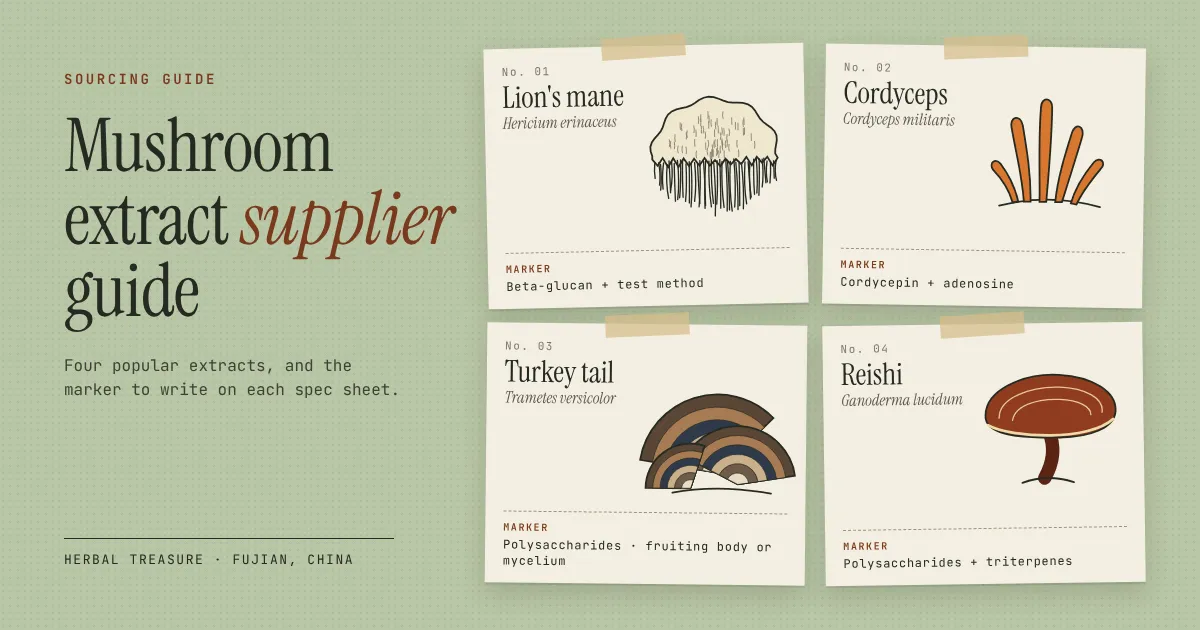
- Standardized and ratio extracts, from lion’s mane, reishi, cordyceps militaris, turkey tail, chaga and more, including organic options
- Certifications:NSF cGMP, ISO 22000, FSSC 22000, HACCP, USDA Organic, EU Organic and Canada Organic, Halal and Kosher
Send us your target specification and we will send a sample COA. Our mushroom extract supplier guide explains how to build that specification. Request a manufacturing quote.
Frequently Asked Questions
What should a mushroom extract COA include?
The product and Latin name, part used, batch number and dates; each active compound result with its full method; physical tests such as loss on drying, ash and mesh size; heavy metals; pesticide residues; microbiology; and storage, shelf life and packing details, with sign-off on the final issued report.
Is a manufacturer’s COA enough, or do I need third-party testing?
A manufacturer’s COA is the standard batch document. Many brands also have a sample tested by an independent lab, especially for a first order. One comparison adds confidence in that sample’s results, so keep checking batch documents and arrange further checks according to risk. At Herbal Treasure, third-party testing can be arranged on request, paid by the client.
What does “<LOQ” mean on a COA?
It means the result was below the method’s limit of quantification, so it could not be reliably quantified under the method’s stated performance requirements. It does not mean zero, and it does not necessarily mean not detected. Check the LOQ value and unit for each item.
Does a polysaccharide result tell me the beta-glucan content?
No. A total polysaccharide result cannot stand in for a beta-glucan result. If beta-glucan matters for your product, add it to your specification as a separate line with its own test method.