
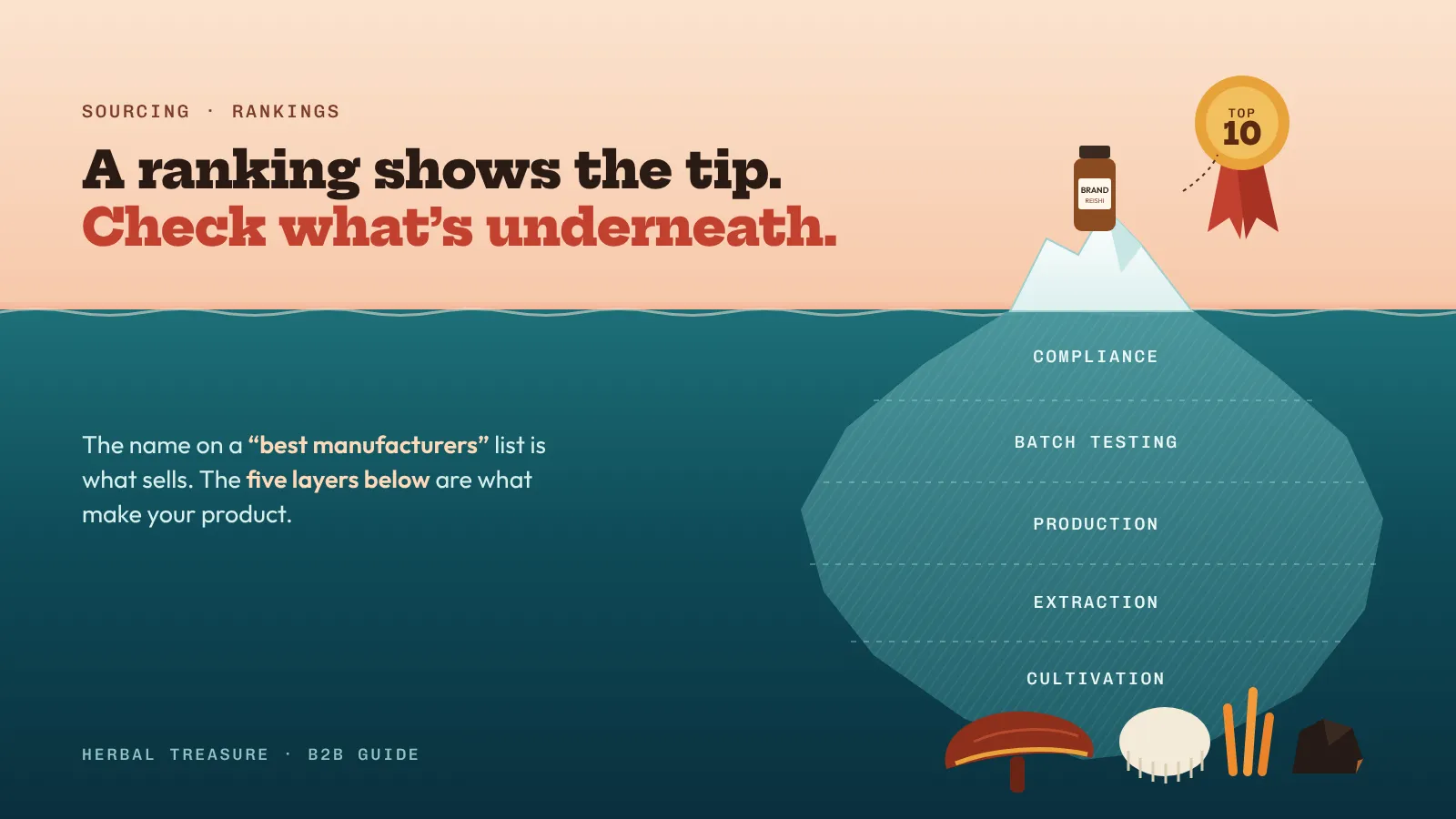
Search for the best mushroom supplement manufacturers and you will find plenty of “top 10” lists. They can be a useful starting point, but many of the names on them are consumer brands that don’t own a factory, and a list rarely tells you who actually grows, extracts and makes the product. For a B2B buyer, the better test is supply-chain evidence you can verify yourself.
This guide explains what those rankings measure, how to tell a brand from a manufacturer, and how to turn any list into a shortlist backed by documents and factory visits.
What Do “Best Mushroom Supplement Manufacturers” Lists Actually Measure?
Most rankings are built from signals you can see from the outside: product reviews, search visibility, social media presence and marketing reach. Those signals describe how well a name sells to consumers. They say little about who controls the mushrooms, the extraction, the production line and the batch testing behind the product.
That is not a flaw in the lists themselves. A consumer list is answering a consumer question: which product should I buy? A brand owner sourcing a manufacturing partner is asking something else: who can make my product the same way, batch after batch, and prove it? The two questions overlap far less than the word “best” suggests.
Brand vs Manufacturer: Why the Difference Matters for Buyers
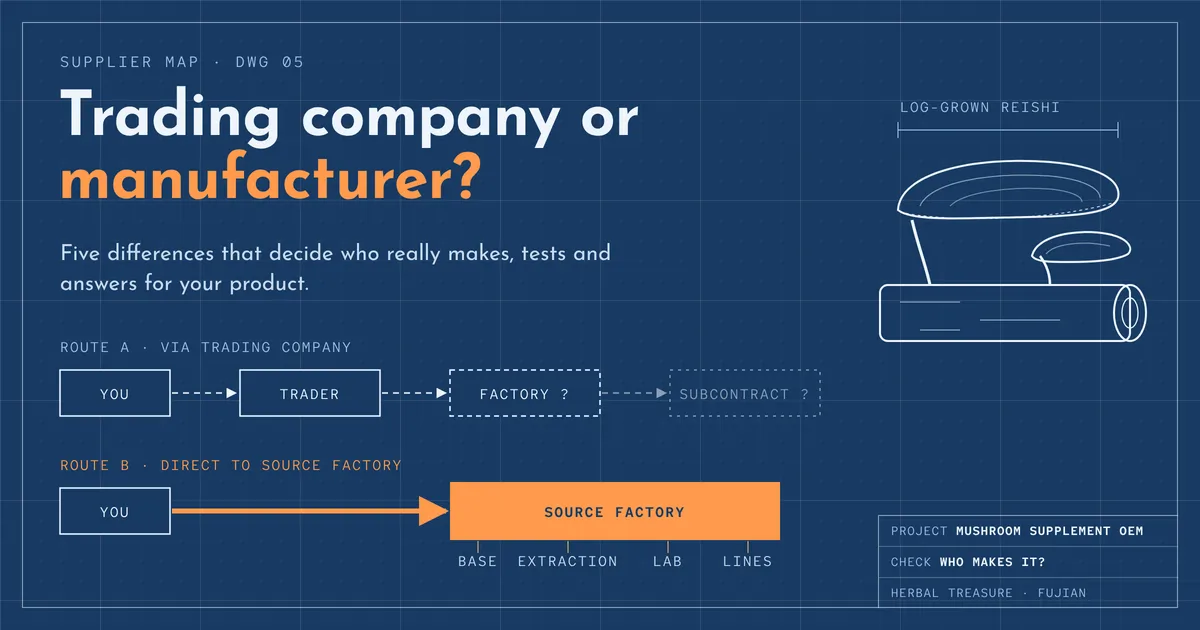
A brand designs, markets and sells a product under its own name. A manufacturer makes it. Some companies do both, but many well-known supplement brands work with OEM or ODM manufacturers further up the chain. That is a normal and legitimate way to build a brand.
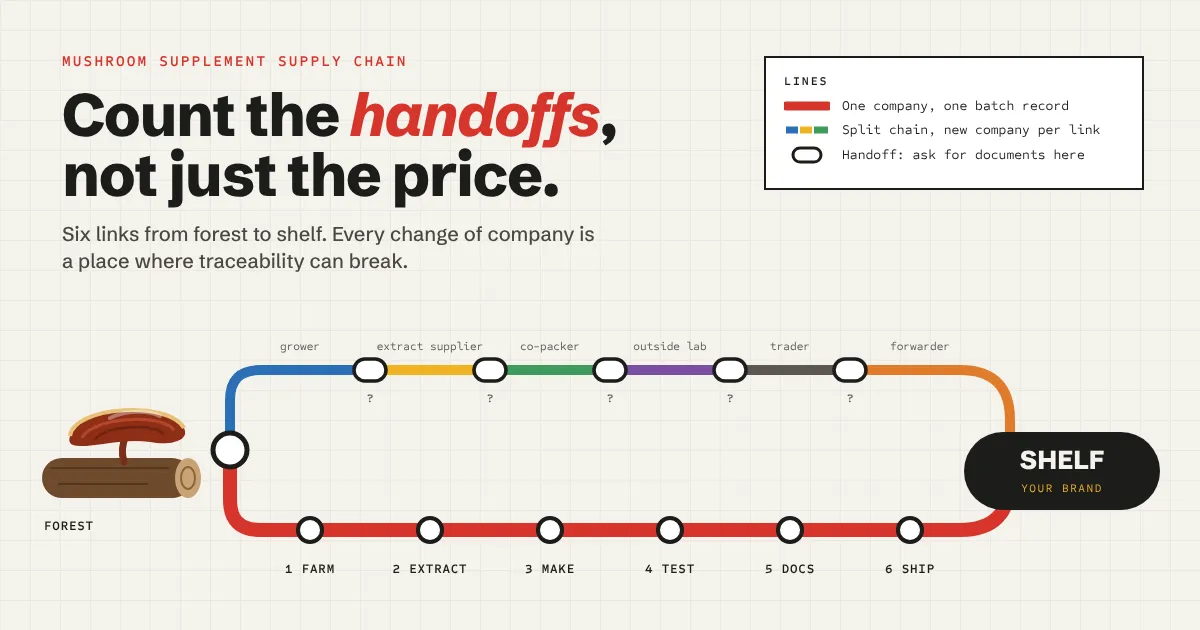
For a buyer, the point is simple: batch consistency and raw-material authenticity are decided upstream, at the factory. If you choose a supplier because its name appears on a list, you may end up dealing with a brand or a reseller that places your order elsewhere. You then have one more company between you and the people who can answer a question about a batch.
So the useful question is not “is this name on a ranking?” It is “who makes the product, and can they show me?”
Who Makes Mushroom Supplements? 3 Ways to Find Out
The quickest way to find out who makes a mushroom supplement is to read the label, ask the company directly, and check that its certificates and test reports are issued in its own factory’s name. Together, these three steps usually show within a day whether you are talking to the maker.
1. Read the label
In the US, a dietary supplement label must name the manufacturer, packer or distributor. When the named company is not the manufacturer, the name is usually qualified with wording such as “Manufactured for” or “Distributed by.” Those phrases tell you the product was made by someone else. Labeling rules differ in other markets, so treat this as a US clue rather than a universal one.
2. Ask three direct questions
- Do you own the factory where this product is made, and can I visit or join a live video tour?
- Where are the mushrooms grown, and do you control that growing base?
- Who runs the extraction and the batch testing: your own team or a partner?
A manufacturer answers these with specifics: an address, a site, a workshop, a lab. Vague answers are a signal to dig further.
3. Check whose name is on the documents
Certificates, facility registrations and certificates of analysis (COAs) should link back to the site that makes your product. A different issuer name on a COA is not automatically a problem, since an independent lab may have issued it. But you should be able to trace each document to the factory and the batch.
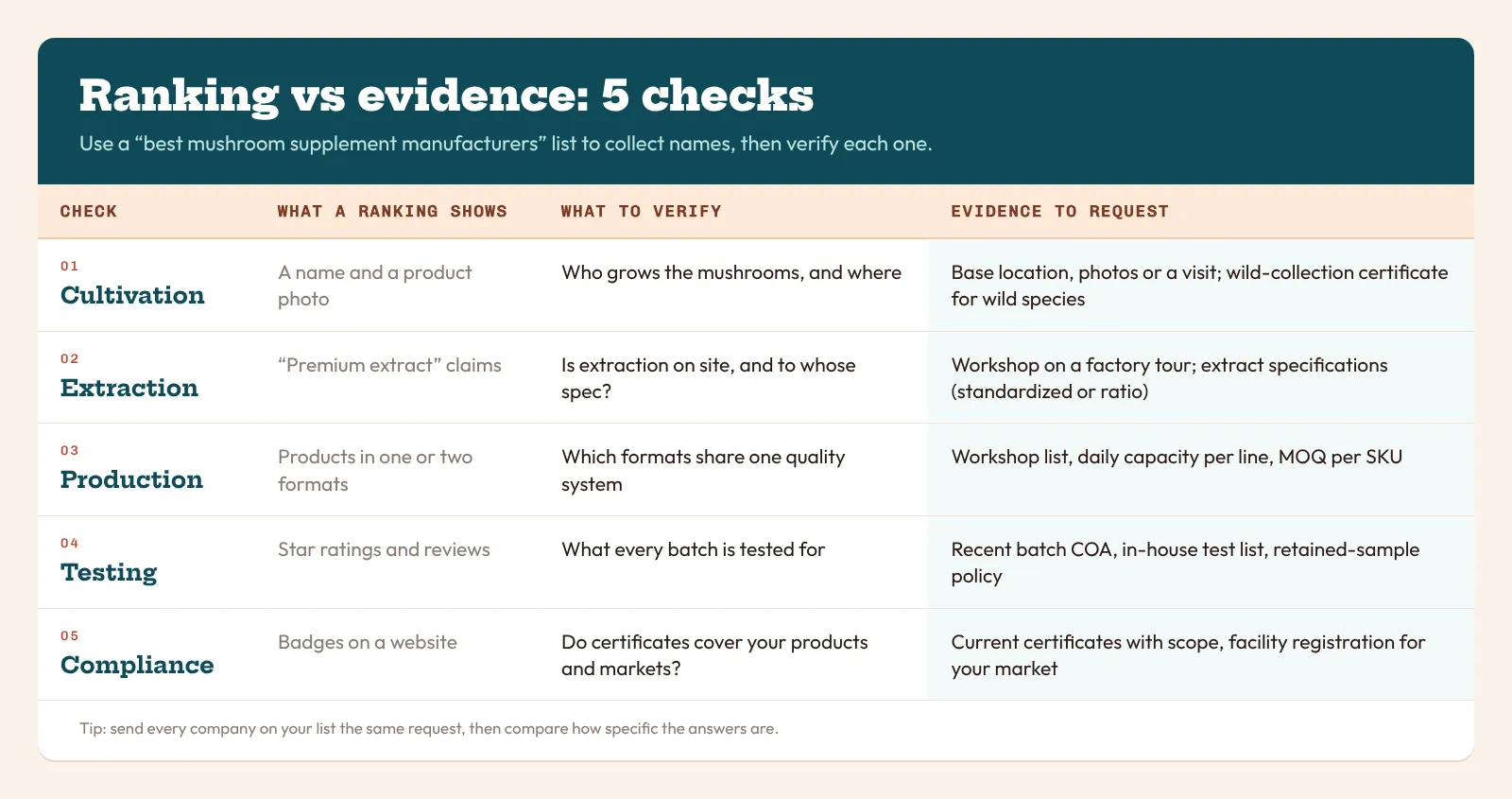
5 Supply-Chain Checks That Replace a Ranking
A ranking gives you a name. These five checks tell you what that name can actually do. For each one, ask for evidence you can hold in your hand or see on site.
Cultivation: Can they show where the mushrooms grow?
Ask whether the manufacturer runs its own growing base or buys raw material on the open market. Request the base location, photos or a visit, and for wild-harvested species, a wild-collection certificate. Organic certification for wild materials depends on that document.
Extraction: Do they run their own extraction?
Extraction decides much of what ends up in the capsule or powder. Ask whether the extraction workshop is on site, which methods it uses, and whether the factory can deliver both standardized and ratio extracts to your specification.
Production: Can they make every format you plan to sell?
If you plan capsules now and gummies or coffee later, check that the same quality system covers each format. Ask which workshops exist, what daily capacity each line has, and what the minimum order is per SKU.
Testing: What does every batch go through?
Ask which tests are run in house on each batch: typically identity, active content, heavy metals and microbiology. Then ask how long retained samples are kept and whether third-party testing is available. Read each COA for what it says and what it leaves out, rather than accepting it as a pass.
Compliance: Do the certificates match your markets?
The certificates you need depend on where you sell. Ask for current certificates and check that their scope covers the products you plan to buy.
How to Turn a List Into a Shortlist in One Afternoon
You don’t have to ignore rankings. You can use them as raw input:
- Collect the namesfrom two or three lists and remove duplicates.
- Split brands from manufacturers.Check each company’s website and product labels. Anyone selling mainly under its own consumer brand goes into a separate column.
- Send the same short request to the rest:factory address, certificate copies, a recent COA for a product like yours, and a date for a video tour.
- Score the replieson how complete and specific they are, not on how polished they look.
- Visit or audit the top two or threebefore placing a trial order.
Most lists shrink quickly at step 2. What is left is a shortlist built on evidence rather than visibility.
How Herbal Treasure Fits This Picture
We are a B2B manufacturing partner. We don’t compete with our clients on the shelf. Our role is making products for brands, and everything below can be checked by document or on site:
- Cultivation:our own forest base of more than 200 mu (about 13 hectares, or 33 acres) in Jiangle County, on the southern slopes of the Wuyi Mountains in Fujian, where we grow log-cultivated red reishi (Ganoderma lucidum) and purple reishi (Ganoderma sinense). The land is company-owned and the buildings were built with our own funds. Ownership documents can be shared on request after internal approval.
- Extraction:our own 1,000 m² (about 10,800 sq ft) extraction workshop, producing standardized and ratio extracts.
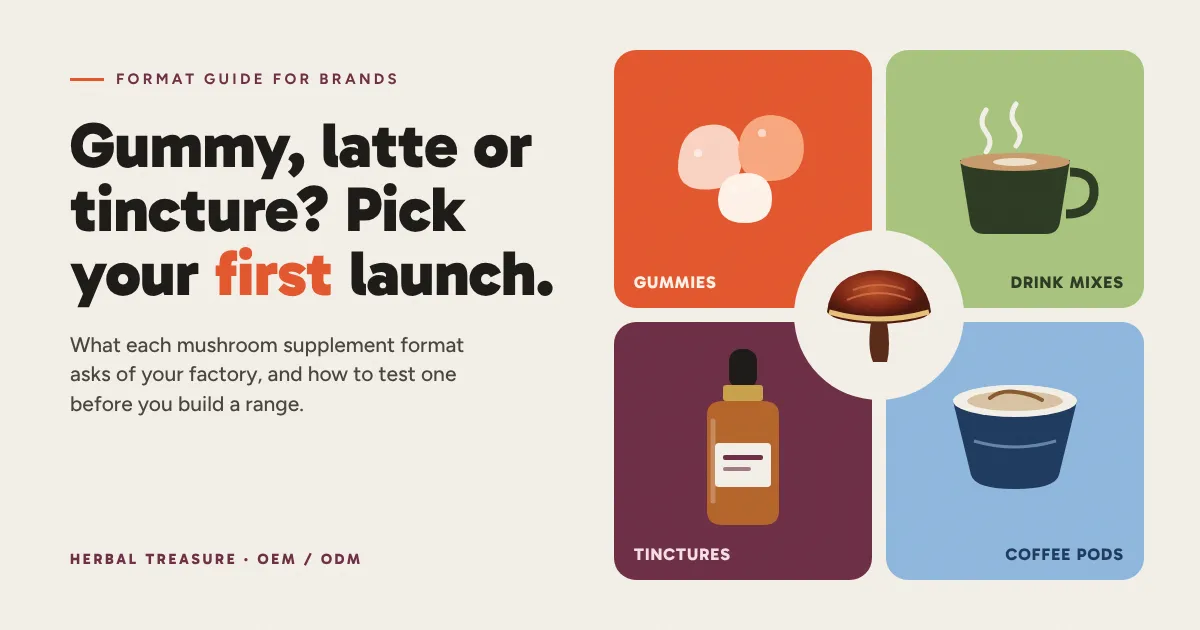
- Production:a facility of more than 10,000 m², including over 8,000 m² of cGMP workshops for capsules, tablets, powders and drinks, gummies and liquids. MOQ starts at 500 units per SKU.
- Testing:an in-house lab that tests every batch for species identity, active content, heavy metals and microbiology. A retained sample of each batch is kept for two years, and third-party testing is available on request.
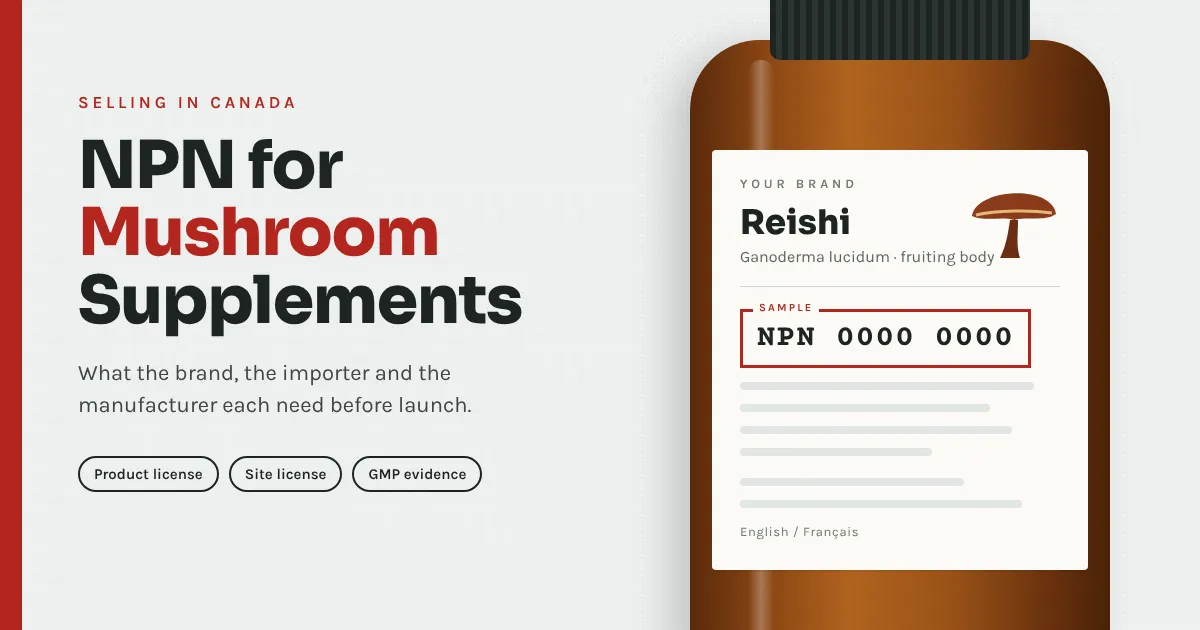
- Compliance:NSF cGMP, ISO 22000, FSSC 22000, HACCP, EU Organic, USDA Organic, Canada Organic, Halal and Kosher certifications, an FDA-registered facility since 2018, and more than 50 NPNs received for products we manufacture.
We have worked with more than 1,000 brand clients, and client visits, third-party audits and video tours are welcome. Herbal Treasure grew out of a family business growing reishi and was formally registered in 2018.
If you are comparing manufacturers from a list, send us the same questions you send everyone else. We would rather be judged on the answers.
Frequently Asked Questions
How do I find the best mushroom supplement manufacturer for my brand?
Use rankings only to collect names. Then separate consumer brands from manufacturers, ask each manufacturer for its factory address, certificates, a recent COA and a factory tour, and compare how specific the answers are. Audit your top two or three before a trial order.
Do well-known supplement brands make their own products?
Some do, but many work with OEM or ODM manufacturers. That is a normal way to run a brand. In the US, wording like “Manufactured for” or “Distributed by” on the label usually means another company made the product.
What is the difference between a supplement brand and a manufacturer?
A brand designs, markets and sells products under its own name. A manufacturer grows or sources the raw materials, extracts, produces, tests and packs them. One company can do both, but for sourcing you need to know which one you are dealing with.
What documents should a mushroom supplement manufacturer provide?
Ask for current certificates with their scope, facility registrations for your market, a recent batch COA for a similar product, raw-material origin details and, for wild-harvested mushrooms, a wild-collection certificate. Check that each document traces back to the factory and batch.