
When you compare a trading company vs a manufacturer, the core difference is simple. A manufacturer makes your product in its own facilities, while a trading company takes your order and places it with someone else’s factory. Both can send you a quote, but they differ on who controls production, quality, timing and documents, and on who fixes things when something goes wrong.
That difference rarely shows on the first quote. Buyers sourcing the same reishi spore powder to the same specification often receive prices that are far apart, and the price alone will not tell you which kind of supplier you are talking to. This guide compares the two across five areas, explains what each one means for a private label order, and gives you four quick ways to find out who is really behind the quote.
Trading Company vs Manufacturer: What Is the Difference?
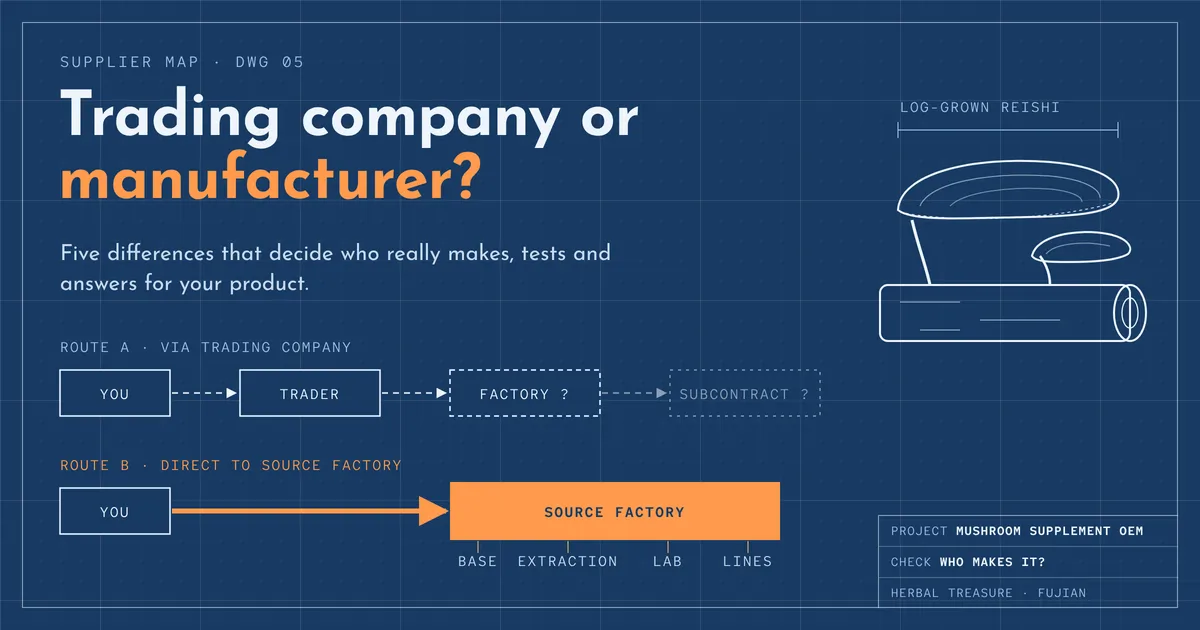
A manufacturer owns the facilities that do the core work: growing or sourcing raw materials, extraction, making the finished product and testing it. A trading company has no production lines of its own and outsources all of that to third-party factories. Most of the practical differences below follow from that one fact.
Both models exist across the supplement industry, and on a website or a trade show stand they can look very similar. The differences show up later, in your samples, your delivery dates, your document folder and, if something goes wrong, your inbox.
The 5 Differences Between a Trading Company and a Manufacturer
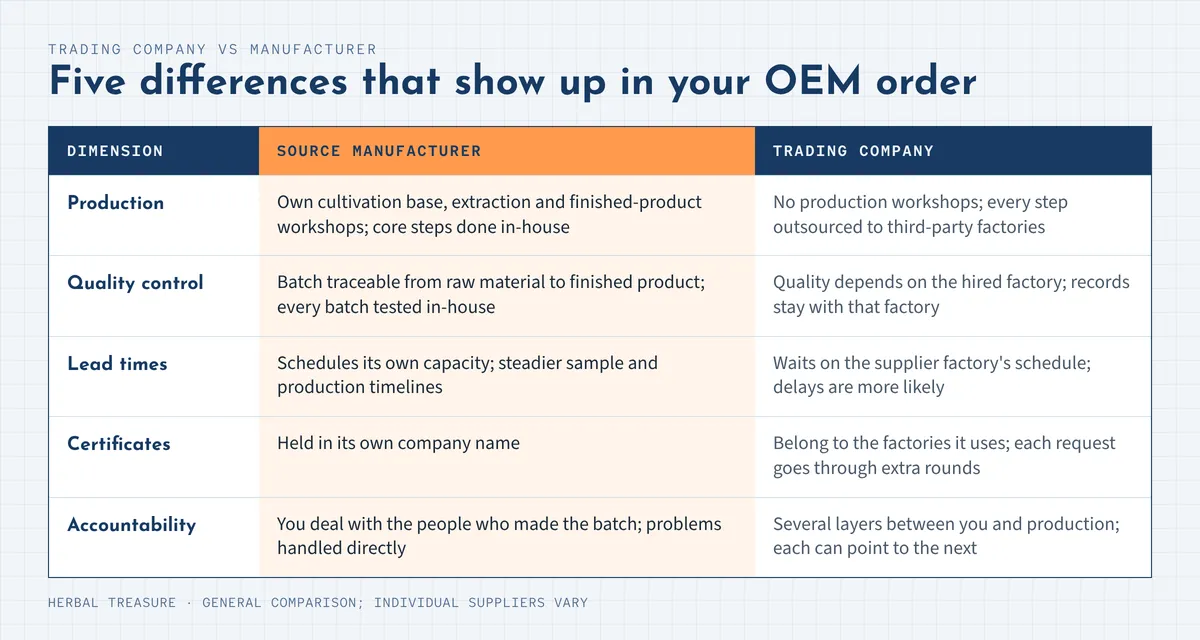
1. Production: Own Workshops or Outsourced Lines
A source manufacturer runs the key stages itself. For mushroom supplements, that means a cultivation base or controlled raw material supply, an extraction workshop, and finished-product workshops for capsules, powders, gummies or tinctures. The core processes happen in facilities it owns.
A trading company has no production workshops. Every step is outsourced to a third-party factory, sometimes to different factories for different products. The company you negotiate with is not the company that makes your product, and you may not know which factory does.
2. Quality Control: Full Traceability or a Black Box
A manufacturer can trace a batch from raw material to finished product because it holds the records for every stage. Testing happens in its own lab, batch by batch, and the people answering your questions can pull those records directly.
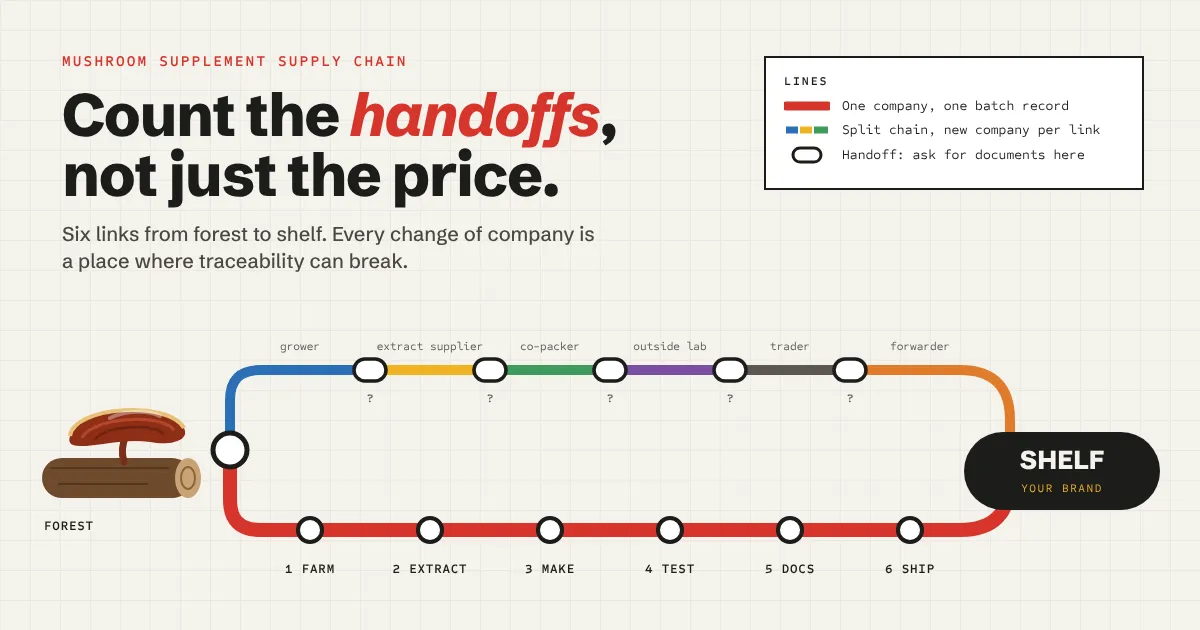
With a trading company, quality depends on whichever factory it has hired. Batch records, test data and process details stay with that factory, so the information you receive is secondhand at best. If the trader switches factories between orders, your second batch may not come from the same place as your first.
3. Lead Times: Your Own Capacity or Someone Else’s Schedule
A manufacturer schedules its own capacity, so sample and production lead times are steadier and easier to commit to in writing.
A trading company has to fit your order into its supplier’s schedule. When that factory is busy with its own customers, your order waits, and the trader may hear about the delay no sooner than you do. If your launch date is tied to a marketplace listing or a retail slot, that uncertainty is a real cost.
4. Compliance Documents: Certificates in Its Own Name or Borrowed Ones
A manufacturer holds its certificates in its own company name, so the GMP, food safety and organic certificates on file match the site that makes your product.
A trading company’s certificates belong to the factories it uses. Getting a copy means asking the trader, who then asks the factory, and the name on the certificate will not match the company on your invoice. Every document request adds a round of back-and-forth, which slows down a brand preparing a regulatory file or answering a retailer’s questions.
5. Accountability: One Point of Contact or Finger-Pointing
When a manufacturer’s batch has a problem, you are already speaking to the people who made it. Retained samples, batch records and the production team are in one place, so the investigation can start straight away.
With a trading company, a problem passes through several layers: you, the trader, the factory, and sometimes the factory’s own subcontractor. Each layer can point to the next, and resolving the issue takes longer.
What Happens When a Batch Has a Problem? An Example
The scenario below is an illustration, not a real case. Suppose a delivered batch of mushroom capsules shows a test result that does not match the agreed specification.
- Buying from a manufacturer:you send the batch number. The factory pulls its retained sample and batch records, retests, and reports what it found. One company holds all the evidence.
- Buying through a trading company:you send the batch number to the trader, who forwards it to the factory. That factory may have bought the extract from another supplier. Records travel back up the chain, and each party may see the cause as someone else’s.
The second route may still reach an answer. It simply takes longer, and you see less at every step.
Is a Trading Company Ever the Right Choice?
Sometimes. A trading company can be convenient for buyers who purchase many unrelated, standard items in small quantities and want a single contact for all of them. For OEM work, where you need a custom formula, a fixed specification and batch-level documents, you are usually better served by a factory you can deal with directly.
Watch for the Half-Factory, Half-Trader Supplier
The line is not always clean. Some suppliers do have a real workshop, for example for capsule filling or packing, but buy in their extracts or outsource other key steps. They are genuine manufacturers for part of the process and traders for the rest.
So the most useful question is not “Are you a factory?” but “Which steps do you do yourselves?” Ask the supplier to list every stage, from raw material to finished product, and to say which ones happen in its own facilities.
How to Tell a Trading Company From a Manufacturer: 4 Quick Checks
- Check the certificates.Ask for copies and compare the company name and address on each one with the company you are dealing with.
- Ask to see the extraction workshop and cultivation base.Recent photos and videos, or a live video tour, show whether the facilities exist and belong to the supplier.
- Ask whether core processes are outsourced.For mushroom ingredients this includes extraction and, for reishi spore powder, wall-breaking. Get the answer in writing.
- Ask about export experience in your category.A supplier that has shipped the same type of product to your market should be able to describe what those buyers needed. Client names are often confidential, so expect some discretion.
Why Herbal Treasure Built Its Own Factory
Our decision to build the whole chain in-house came from experience. In our early years, before we had our own finished-product lines, we relied on a partner factory. Once, with an urgent order due, we were held up by that factory’s production schedule, and our team stayed up all night to finish the packing ourselves.
That night convinced us to build a complete factory of our own. Today cultivation, extraction, manufacturing and testing are all done in-house, no core process is outsourced, and every project stays under our control from the first sample to bulk production.
How Herbal Treasure Measures Up on the Five Differences
We are a manufacturer, so treat this as our own account, and check it the same way you would check any other supplier.
- Production:a forest base of more than 200 mu (about 13 hectares, or 33 acres) in Jiangle County, Sanming, in the southern Wuyi Mountains of Fujian, on land the company purchased. A 1,000 m² (about 10,800 sq ft) extraction workshop, and more than 10,000 m² (about 108,000 sq ft) of facilities, including 8,000 m² of cGMP workshops for capsules, tablets, powders, gummies and tinctures. Reishi spore powder is wall-broken in-house using low-temperature jet wall-breaking.
- Quality control:our in-house lab tests every batch for active content, heavy metals, microbiology and species identity, and each batch ships with a COA. Third-party testing can be arranged on request, with the lab fee paid by the client. A retained sample of every batch is kept for two years.
- Lead times:samples in 5–7 days for standard formulas and 7–14 days for custom ones; production in 15–20 days, or 4–6 weeks for deep customization. Orders start from 500 units per product.
- Compliance documents:certificates held in our own company name, including NSF cGMP, ISO 22000, FSSC 22000, HACCP, EU Organic, USDA Organic, Canada Organic, Halal and Kosher. Our facility is FDA-registered. Land ownership documents can be provided on request.
- Accountability:you work directly with the factory that makes your product. Video tours, site visits and audits by clients or third parties are all welcome.
The Bottom Line
In the trading company vs manufacturer question, price is the wrong place to start. First find out who makes the product, who tests it, whose name is on the certificates and who answers when something goes wrong. Then compare quotes only between suppliers whose answers you can verify.
If you would like to see our facilities for yourself, book a video factory tour or request a quote.
Frequently Asked Questions
What is the difference between a trading company and a manufacturer?
A manufacturer makes products in its own facilities and controls production, testing and scheduling. A trading company takes orders and outsources production to third-party factories, so its quality records, lead times and certificates depend on the factory it uses.
Why do quotes for the same mushroom ingredient vary so much?
Suppliers differ in raw materials, processes, testing and in who actually makes the product. Price alone will not tell you whether you are dealing with a factory or a trader, so compare quotes only after confirming who does each production step.
How can I tell if a supplier is a trading company?
Check whether the company name on its certificates matches the company you deal with, ask to see its own extraction workshop and cultivation base, ask whether core processes are outsourced, and ask about its export experience in your product category.
Is it bad to buy from a trading company?
Not always. Traders can suit buyers of many standard items in small volumes. For custom OEM supplements, working directly with the manufacturer usually gives you better traceability, steadier lead times and clearer accountability.