
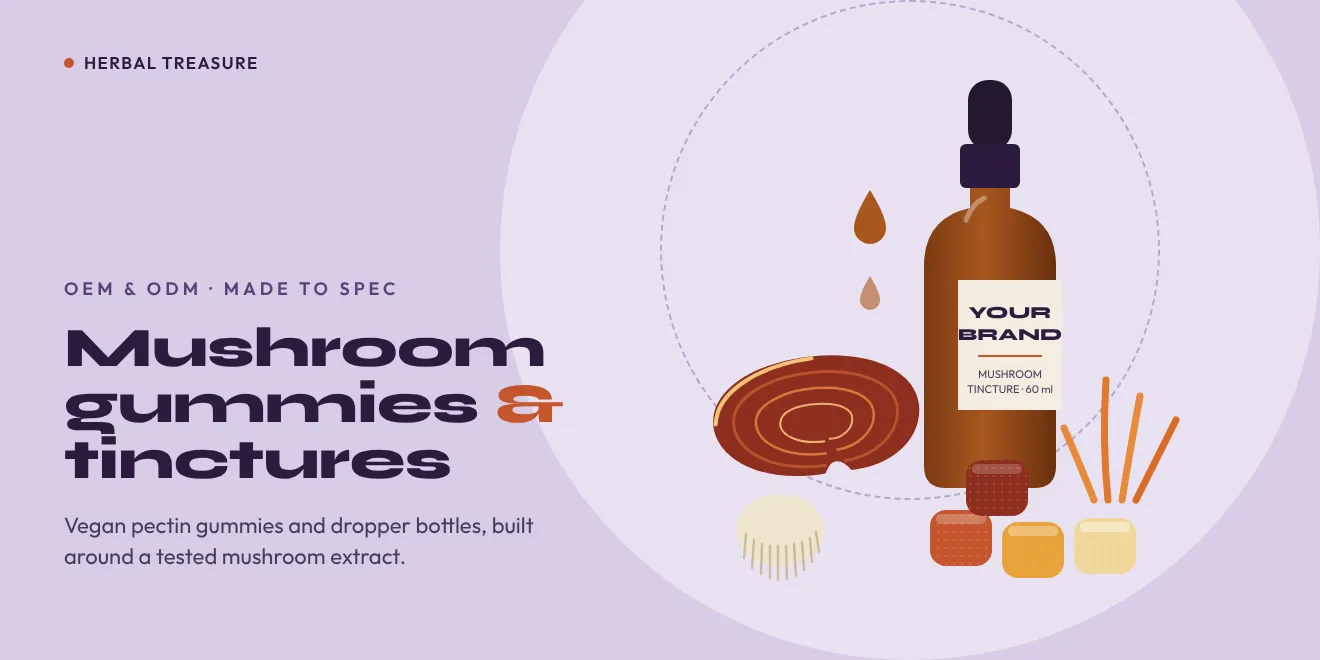
Mushroom gummies manufacturer graphic: pectin gummies, a 60 ml mushroom tincture dropper bottle with a blank brand label, reishi, lion’s mane and cordyceps
Two easy-to-take formats, one tested mushroom extract at the center.
Looking for a mushroom gummies manufacturer, or a partner who can also make mushroom tinctures? These two formats are drawing growing attention from supplement brands in North America and Europe, because many shoppers find them easier and more enjoyable than swallowing a capsule. They are also harder to make well. A good partner needs a dedicated gummy or liquid workshop, real formulation skills, and testing that confirms the mushroom content in the finished product.
This guide explains how the two formats differ, what to put on your spec sheet, and how to decide which one to launch first.
Why Mushroom Gummies and Tinctures Are Gaining Ground
Plenty of shoppers like the idea of medicinal mushrooms such as reishi or lion’s mane but do not enjoy taking pills. Gummies and tinctures solve that problem in two different ways. A gummy feels like a small daily treat. A few drops of tincture disappear into a glass of water, a cup of tea or a smoothie.
For brands, both formats are a way to stand out on Amazon and on direct-to-consumer (DTC) websites, where capsules and powders already fill most of the shelf. Gummies tend to attract shoppers who are trying mushroom supplements for the first time. Tinctures are a popular product for DTC brands that sell to people who already know natural health products and like flexible servings.
We see the same shift in our own orders. Among our North American customers, most of them in the United States, powders and capsules still make up a large share of orders, but gummy orders are growing.
Mushroom Gummies vs Tinctures: What Is the Difference?
Mushroom gummies are chewable pieces that deliver a fixed amount of mushroom extract in each piece, often sold in 90-count bottles. Mushroom tinctures are liquid extracts, usually in 60 ml (2 fl oz) dropper bottles, that people add to drinks or take straight from the dropper. Gummies lead on taste and convenience; tinctures on flexible serving size.
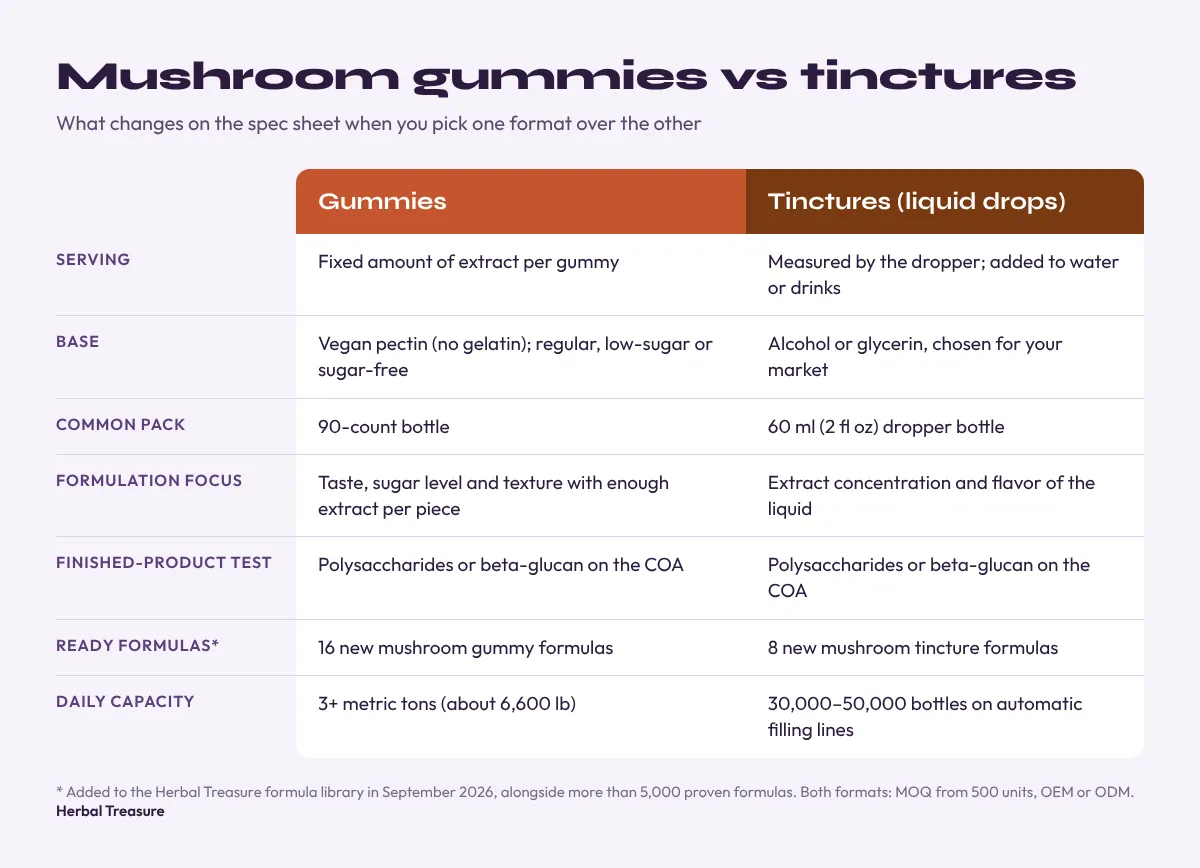
Mushroom gummies vs tinctures comparison table: serving, base, common pack, formulation focus, finished-product testing, ready formulas and daily capacity
What changes on the spec sheet when you choose one format over the other.
Beyond the obvious difference in form, the two formats ask different questions of your manufacturer:
- Serving:a gummy carries a set amount of extract; a tincture is measured by the dropper.
- Base:gummies are built on a gelling agent; tinctures on a liquid such as alcohol or glycerin.
- Formulation challenge:gummies must balance taste, sugar and texture against the amount of extract; tinctures focus on concentration and flavor.
- Packaging:a sealed bottle of gummies versus a dropper bottle.
What It Takes to Make Good Mushroom Gummies
A mushroom gummy has to taste good, hold its shape, and still carry enough mushroom extract to matter. That is why gummies cannot be made by simply buying in mushroom powder. They need a proper gummy workshop and formulation experience.
Balancing Sugar, Flavor and Mushroom Content
Mushroom extracts can taste earthy or slightly bitter, so the formula needs flavor work. At the same time, a gummy is small, and every gram of sugar, flavor or gelling agent is a gram that is not mushroom extract. Getting that balance right is the main job of gummy formulation.
At Herbal Treasure, we can make regular, low-sugar or sugar-free mushroom gummy formulas, and adjust sweetness and flavor to suit your brand.
Vegan Gummies With a Pectin Base
We make our mushroom gummies with pectin, a gelling agent that comes from plants. We do not make gelatin gummies. Our mushroom gummies are vegan and gelatin-free, which is worth stating clearly on the label if your customers look for plant-based products.
Keeping the Mushroom Content Consistent
Gummies are cooked, poured into molds and then set, so the formula and the process both have to protect the mushroom extract. The best proof that they did is a test on the finished product. We can test finished gummies for polysaccharides or beta-glucan and report the result on the certificate of analysis (COA), so you know what is in each batch, not only what went into it.
What Goes Into a Mushroom Tincture
A mushroom tincture is a liquid extract, usually sold in a 60 ml (2 fl oz) dropper bottle. It is flexible: people can take it from the dropper or add it to water and other drinks. That flexibility is one reason tinctures are a popular product for DTC brands.
Alcohol or Glycerin?
The liquid base is the biggest decision in a tincture. We make mushroom tinctures with either alcohol or glycerin, depending on what you need. Your choice will depend on the market you sell into, the claims you want to make on the label (such as alcohol-free), and any certification you plan to apply for. Discuss this with us early, because it shapes the whole formula.
Concentration and Testing
Ask for the mushroom extract, its concentration and its quality marker on the spec sheet. As with gummies, we can test the finished tincture for polysaccharides or beta-glucan and report it on the COA. Our automatic filling lines fill 30,000 to 50,000 bottles a day.
Which Mushrooms Work in Gummies and Tinctures
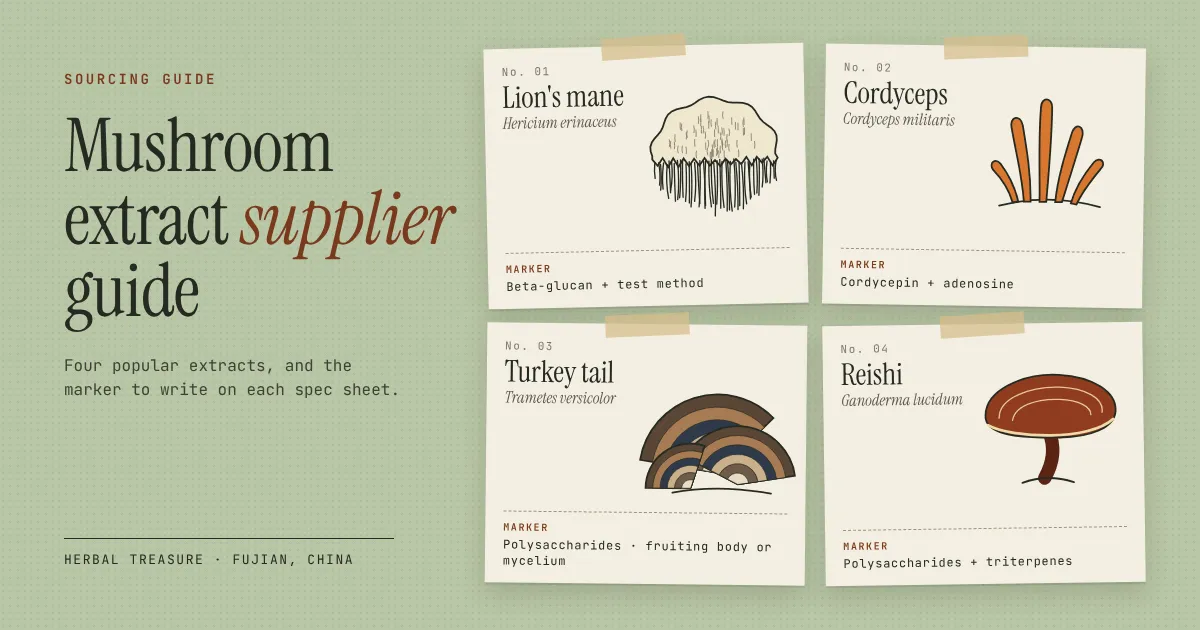
The most requested mushrooms for these two formats are:
- Reishi(ling zhi, Ganoderma lucidum), one of the best-known medicinal mushrooms in traditional Chinese practice.
- Lion’s mane(hou tou gu, Hericium erinaceus), with its shaggy, white fruiting body.
- Cordyceps(Cordyceps militaris), a cultivated cordyceps species with bright orange fruiting bodies.
- Chaga(bai hua rong, Inonotus obliquus), which grows on birch trees.
- Multi-mushroom blendsthat combine several species in one gummy or tincture.
Why Standardized Extracts Matter in Small Formats
In a gummy or a few drops of liquid, space is limited. A standardized extract concentrates the mushroom and comes with a measurable marker, such as polysaccharides or beta-glucan, that can be tested in the finished product. Raw mushroom powder takes up more room and is harder to verify. For more on reading these markers, see our guide to beta-glucan vs polysaccharides.
If you are building a reishi-only line, our private label reishi supplements guide compares gummies and tinctures with spore powder, spore oil and capsules.
Your Spec Sheet Checklist for Mushroom Gummies and Tinctures
A clear spec sheet makes quotes comparable and samples easier to judge. Before you ask for a quote, decide on the following.
For mushroom gummies:
- The mushroom extract and the marker you want on the COA
- The amount of extract per gummy and the number of gummies per serving
- Count per bottle, for example 90 gummies
- Sugar level: regular, low-sugar or sugar-free
- Flavor, color and shape
- Certifications you need, such as organic, Halal or Kosher
For mushroom tinctures:
- The mushroom extract and the marker you want on the COA
- Concentration per serving
- Base: alcohol or glycerin
- Bottle size, for example 60 ml (2 fl oz), and dropper type
- Flavor
- Certifications you need
For both: tell us your target market. Labeling and ingredient rules differ between the United States, Canada and the European Union, so the market shapes the formula and the label. Our mushroom supplement compliance guide covers the main differences.
How Herbal Treasure Makes Mushroom Gummies and Tinctures
Herbal Treasure is a mushroom ingredient and supplement manufacturer in Fujian, China, with more than 20 years in medicinal mushrooms. We grow reishi at our own forest base, run our own extraction workshop, and make finished products under one roof, so the extract in your gummy or tincture is made in the same factory as the finished product.
- Dedicated workshops:a gummy workshop producing more than 3 metric tons (about 6,600 lb) a day, and a liquid workshop for tinctures, with automatic filling lines.
- Ready formulas:in September 2026 we added 16 new ready-to-produce mushroom gummy formulas and 8 new tincture formulas to our library of more than 5,000 proven formulas.
- OEM or ODM:bring your own formula and we source the raw materials (OEM), or start from one of our ready formulas and adjust it (ODM).
- Testing:an in-house lab for active content, heavy metals, microbiology and species identity, with a COA for every batch.
- Certifications:NSF cGMP, USDA Organic, EU Organic, Canada Organic, FSSC 22000, ISO 22000, HACCP, Halal and Kosher. Organic, Halal and Kosher versions are possible when every ingredient in the formula qualifies. Our facility is FDA-registered and holds a Health Canada Foreign Site Reference Number (FSRN).
- Packaging:design support for bottles, pouches, stick packs and gift boxes.
- Orders:minimum order from 500 units per product; samples in 5–7 days for standard formulas or 7–14 days for custom ones; production in 15–20 days for standard orders or 4–6 weeks for deep customization.
Because gummies, tinctures, capsules and powders are all made in the same facility, you can launch one format and add another later without changing suppliers. Our products already reach brands in more than 40 countries and regions.
Gummies or Tinctures: Which Should You Launch First?
Start with your customer. If your shoppers are new to mushrooms and buy on Amazon, a gummy is an easy first step. If you sell on your own website to people who already use herbal products and like to control their serving, a tincture may fit better. Many brands eventually offer both, often with the same mushroom extract inside.
Whichever you choose, the rules are the same: name the extract, set the marker, and ask for a COA on the finished product. To plan your launch dates, see our supplement manufacturing timeline.
Ready to start? Request a manufacturing quote and tell us your market, format and target specification.
Frequently Asked Questions
Can mushroom gummies be made sugar-free?
Yes. Herbal Treasure makes mushroom gummies in regular, low-sugar and sugar-free versions. Sweetness and flavor are adjusted during formulation to suit the mushroom extract and your brand.
Are your mushroom gummies made with gelatin?
No. We make our mushroom gummies with pectin, a plant-derived gelling agent, so they are vegan and gelatin-free. We do not produce gelatin gummies.
Are mushroom tinctures made with alcohol or glycerin?
Both are possible. We make mushroom tinctures with an alcohol or glycerin base, chosen according to your target market, your label and any certification you plan to apply for.
What is the minimum order for custom mushroom gummies?
At Herbal Treasure, minimum orders start from 500 units per product for both gummies and tinctures. The exact quantity depends on the formula and packaging you choose.