
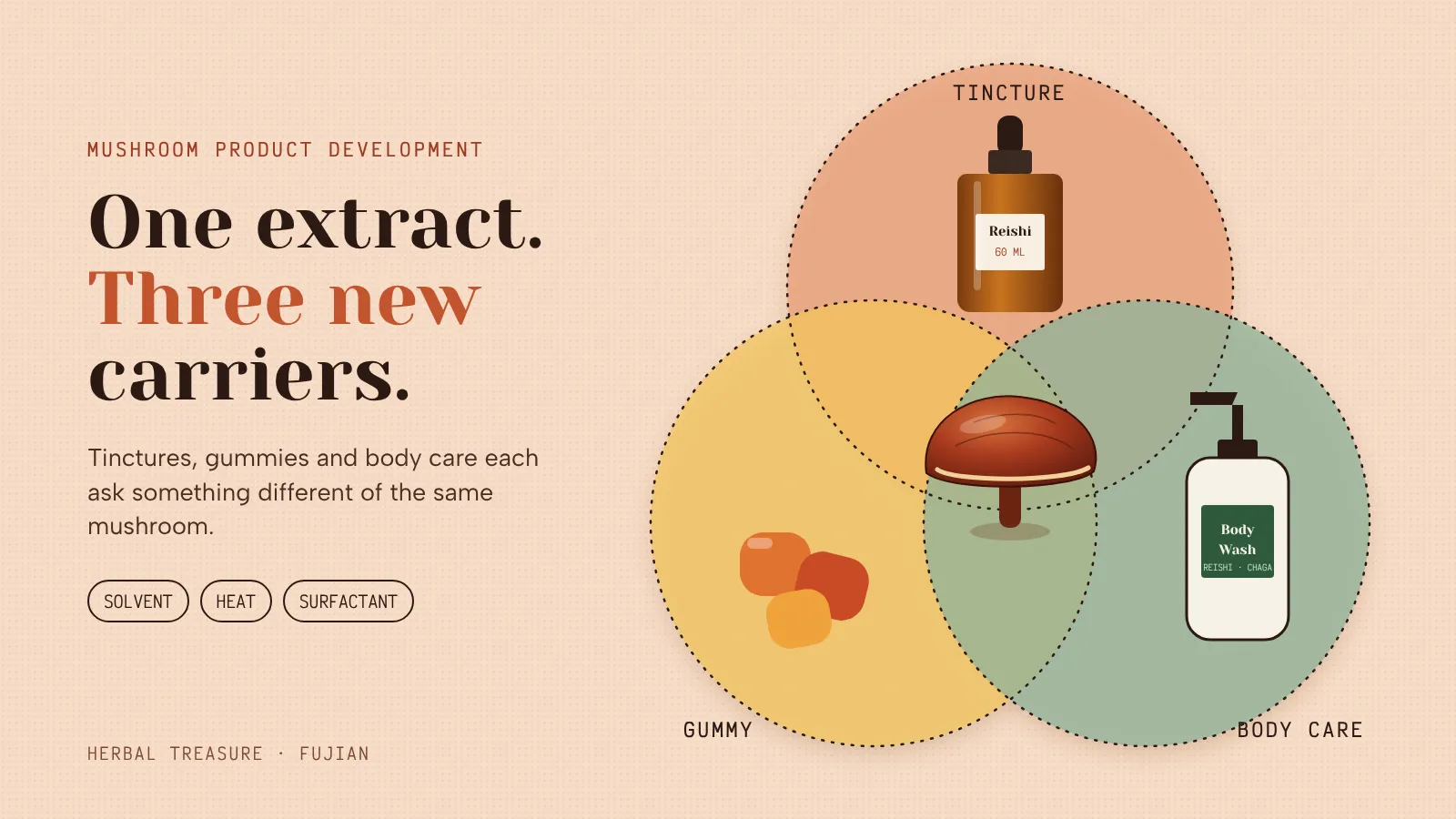
Mushroom product development shown as a Venn diagram: a reishi mushroom at the center of three overlapping circles for a tincture dropper bottle, pectin gummies and a body wash pump bottle
Same mushroom, three new carriers: a dropper bottle, a gummy and a body care pump.
Mushroom product development used to mean choosing between a capsule and a powder. Today, the same reishi or lion’s mane extract can end up in a liquid tincture, a pectin gummy or a body wash. Each of those carriers asks something different of the extract, and that is where most new-format projects succeed or stall.
Medicinal mushrooms are no longer limited to traditional powders and capsules. In overseas markets, we see more and more brands asking for mushroom tinctures, functional gummies and even body care products made with fungal extracts. This guide looks at the three new categories one by one: what the extract has to survive in each, what can go wrong, and what to ask a manufacturer before you request a sample.
What Is Mushroom Product Development?
Mushroom product development is the work of taking a mushroom ingredient, such as a reishi or chaga extract, and building a finished product around it in a specific carrier: a capsule, a liquid, a gummy, a drink mix or a topical product. It covers the extract choice, the supporting ingredients, the process and the testing that proves the finished product matches its specification.
The key word is carrier. A capsule simply holds dry powder. A tincture dissolves the extract in a liquid, a gummy cooks it into a hot pectin mass, and a body wash mixes it with surfactants and fragrance. The mushroom stays the same, but the job changes completely.
Why New Mushroom Formats Are Harder Than Capsules
New mushroom formats are harder because the extract no longer sits alone in a shell. In a tincture it must stay stable in a solvent and be filled cleanly. In a gummy it must handle cooking heat. In a body care product it must work inside a surfactant and fragrance system. Each step adds a new way to fail.
That is also why many traditional raw-material suppliers do not offer these formats. Selling an extract in a 25 kg drum is a different business from running a liquid filling line, a gummy workshop or a body care formulation program. If you plan to extend a mushroom range beyond capsules, the first question is whether your supplier actually has the capability for each format, not just the ingredient.
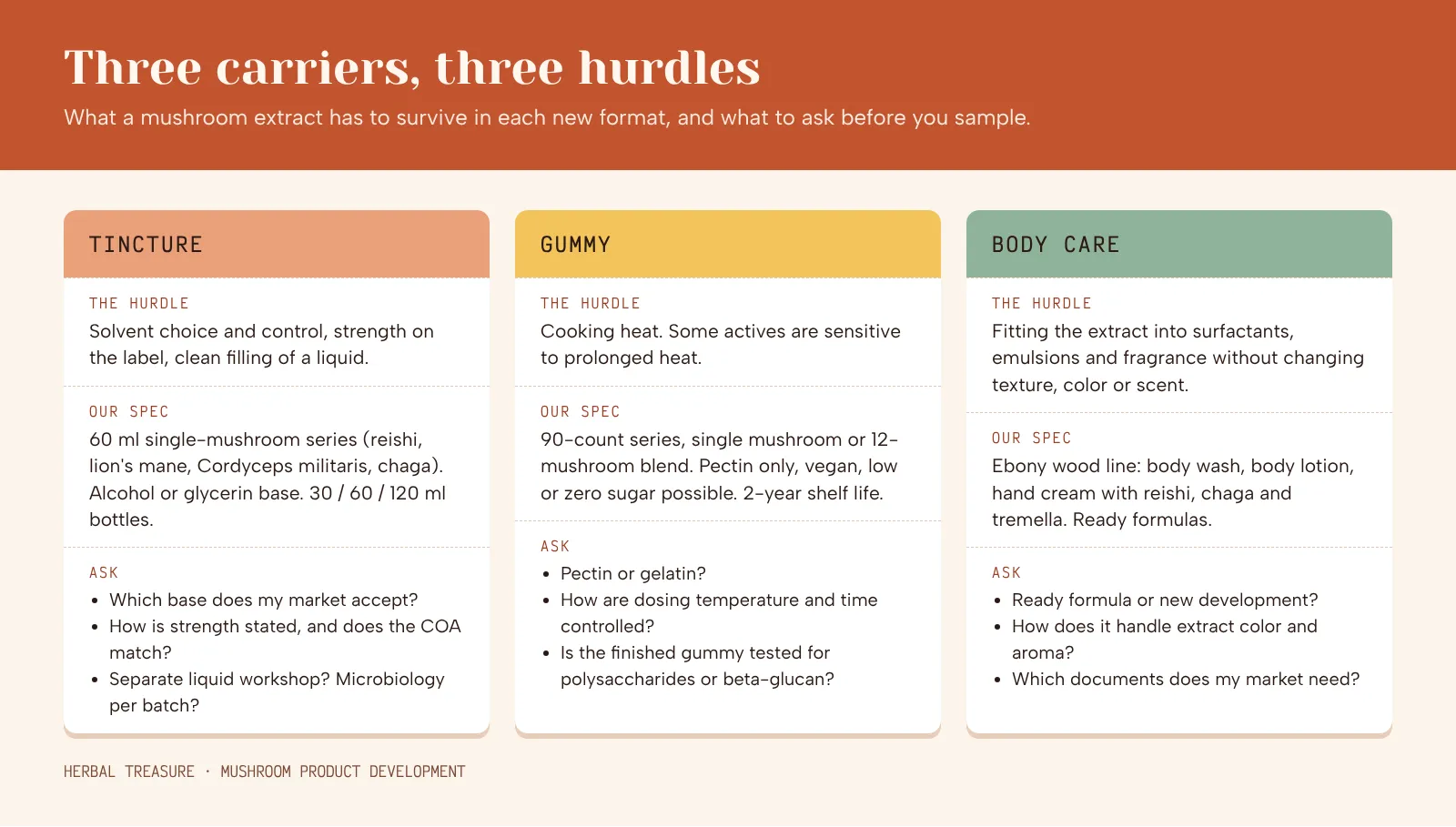
Comparison of three mushroom product formats: tincture, gummy and body care, with the technical hurdle, Herbal Treasure specification and questions to ask for each
Each carrier adds its own technical hurdle. Ask about it before the first sample.
Mushroom Tinctures: Solvent, Strength and Clean Filling
A mushroom tincture is a liquid extract taken by the dropper. It places the highest demands on three things: the extraction process, the choice and control of the solvent, and the cleanliness of filling. Because the product is a liquid, there is no shell or coating to hide a problem.
What the extract has to survive
The base is usually alcohol or glycerin. We make both, and the choice depends on your market and positioning; for Halal tinctures, for example, we use a glycerin base. For some mushrooms, dual extraction (hot water plus alcohol) is available, which draws on both water-soluble and alcohol-soluble compounds. On our labels, strength is expressed as the amount of extract added per serving.
Our 60 ml mushroom tincture series
Herbal Treasure already produces mushroom tinctures in volume. Our 60 ml tincture series covers single-mushroom formulas of reishi, lion’s mane, Cordyceps militaris and chaga, each in its own bottle, with an alcohol or glycerin base to suit the client. Bottles also come in 30 ml and 120 ml sizes, or custom. We recommend dark or amber dropper bottles for light protection.
Tinctures are made in our dedicated liquid workshop and filled on an automatic line with a capacity of 30,000 to 50,000 bottles a day. USDA organic versions are possible.
What to ask before you sample
- Is the base alcohol or glycerin, and which one does your target market and channel accept?
- How is strength stated on the label, and does the finished product COA match it?
- Is the tincture made in a separate liquid workshop, and is the finished batch tested for microbiology?
- Which bottle sizes and glass colors are standard, and which are custom?
Mushroom Gummies: Keeping Actives Through the Heat
A mushroom gummy is cooked, deposited and set, so its main hurdle is heat. Some active compounds are sensitive to prolonged heat, which means dosing temperature and time need to be controlled. The only way to know what the finished gummy contains is to test the gummy itself, not just the extract that went in.
Pectin, not gelatin
Our gummies are pectin-based only. We do not make gelatin gummies. Pectin is less heat-sensitive than gelatin, and it keeps the gummies vegan. Low-sugar and zero-sugar versions are possible, and our gummies have a two-year shelf life. A finished gummy’s COA can include polysaccharides or beta-glucan, so the label claim can be checked against the product in the bottle.
Our 90-count gummy series
Our 90-count gummy series includes single-mushroom formulas and a 12-mushroom blend. In September 2026 our team added 16 new ready gummy formulas to our library, and our gummy workshop produces more than 3 metric tons (about 6,600 lb) of gummies a day.
What to ask before you sample
- Are the gummies pectin or gelatin, and are they vegan?
- How are dosing temperature and time controlled for heat-sensitive actives?
- Can the finished gummy, not only the raw extract, be tested for polysaccharides or beta-glucan?
- What is the shelf life, and is a low-sugar or zero-sugar version possible?
Mushroom Body Care: Making Extracts Work With Surfactants and Fragrance
Mushroom body care puts the extract on the skin instead of in the body, so it must fit into a very different formula. Body washes, lotions and hand creams are built on surfactant systems, emulsions, fragrance and preservatives. The extract has to blend in without upsetting the texture, clarity, scent or stability of the base.
The formulation challenge
In the personal care industry, mild amino acid-based surfactants and essential oils are common building blocks. Both make formulation more complex. A mushroom extract brings its own color and natural aroma, and the formula has to absorb these without separating, darkening or clashing with the fragrance over the product’s life. That is formulation work, not simply adding an ingredient.
Our ebony wood body care line
Herbal Treasure develops mushroom personal care formulas. One example is our body care line with an ebony wood scent, which brings reishi, chaga and tremella (yin er) extracts into a body wash, body lotion and hand cream. These are ready formulas that brands can choose from. Reishi has a long tradition in East Asia, and tremella is used as a moisturizing-type ingredient in lotions and hand creams.
Body care follows cosmetics rules rather than supplement rules in most markets, so the product documents, labeling and claims are handled differently from your supplements. For body care, we provide a COA and the full ingredient list. Minimum orders depend on the product, and ready formulas allow a lower minimum.
What to ask before you sample
- Is this a ready formula or a new development project, and how does that change the minimum order?
- Which mushroom extracts are in the formula, and in which products?
- How does the formula handle the extract’s color and aroma alongside the fragrance?
- Which documents come with the product, and which ones does your market require?
One Growing and Extraction Base, Two Kinds of Products
Herbal Treasure’s growing and extraction system supports both oral and topical product development. Our reishi comes from our own forest base in Jiangle County, Sanming, on the southern slopes of the Wuyi Mountains in Fujian, and extraction runs in our own 1,000 m² (about 10,800 sq ft) extraction workshop.
For a brand, that matters most at the specification stage. When the mushroom raw material and its extraction are controlled by the same team, you have one point of contact for questions about origin, extract type and testing. Our in-house lab tests every batch for heavy metals, active content, microbiology and species identity, and we keep a retained sample of every supplement batch for two years. Third-party testing is available on request, at the client’s cost.
How to Plan Your Next Mushroom Format
We expect medicinal mushrooms to keep moving into new categories. Brands that can add formats quickly will find it easier to keep up as products change. A few practical steps help:
- Start from a format you can test.A 60 ml tincture or a 90-count gummy from a ready formula is faster to sample than a new development.
- Write the specification by carrier.A capsule spec does not transfer to a tincture or a gummy. Define base, strength, serving and finished-product tests for each one.
- Ask for finished-product testing.For gummies and tinctures, check the finished product COA, not only the raw extract.
- Plan the timeline.Samples take 5–7 days for standard formulas and 7–14 days for custom ODM. Production takes 15–20 days for standard orders and 4–6 weeks for deep custom work. Samples are free; you pay shipping.
- Check minimums early.Supplements start from 500 units per SKU. Body care minimums depend on the product.
About Herbal Treasure
Herbal Treasure grew out of a family business growing reishi and was formally registered in 2018. We are based in Jiangle County, Fujian, at the southern foot of the Wuyi Mountains, and specialize in medicinal mushroom OEM and ODM. We have our own growing base, a cGMP facility with extraction and multi-format production, and the R&D to develop tinctures, gummies and personal care formulas. We have worked with more than 1,000 brands. Tell us which format you want to add, and we can tell you whether a ready formula fits.
Frequently Asked Questions
Can mushroom extracts be used in both supplements and body care?
Yes. Mushroom extracts such as reishi and chaga are used in supplements and also in body care such as body wash, lotion and hand cream. The formula work is different, and body care follows cosmetics rules rather than supplement rules in most markets.
Are mushroom tinctures made with alcohol or glycerin?
Both are used. We make mushroom tinctures with an alcohol or glycerin base, chosen per client. Glycerin is used for Halal tinctures. Dual extraction (hot water plus alcohol) is available for some mushrooms.
Does heat in gummy production affect mushroom actives?
Some active compounds are sensitive to prolonged heat, so dosing temperature and time need to be controlled. The best check is a COA on the finished gummy, which can include polysaccharides or beta-glucan.
What is the minimum order for a new mushroom format?
For supplements, including tinctures and gummies, the minimum is from 500 units per SKU. For body care, it depends on the product, and ready formulas allow a lower minimum.