
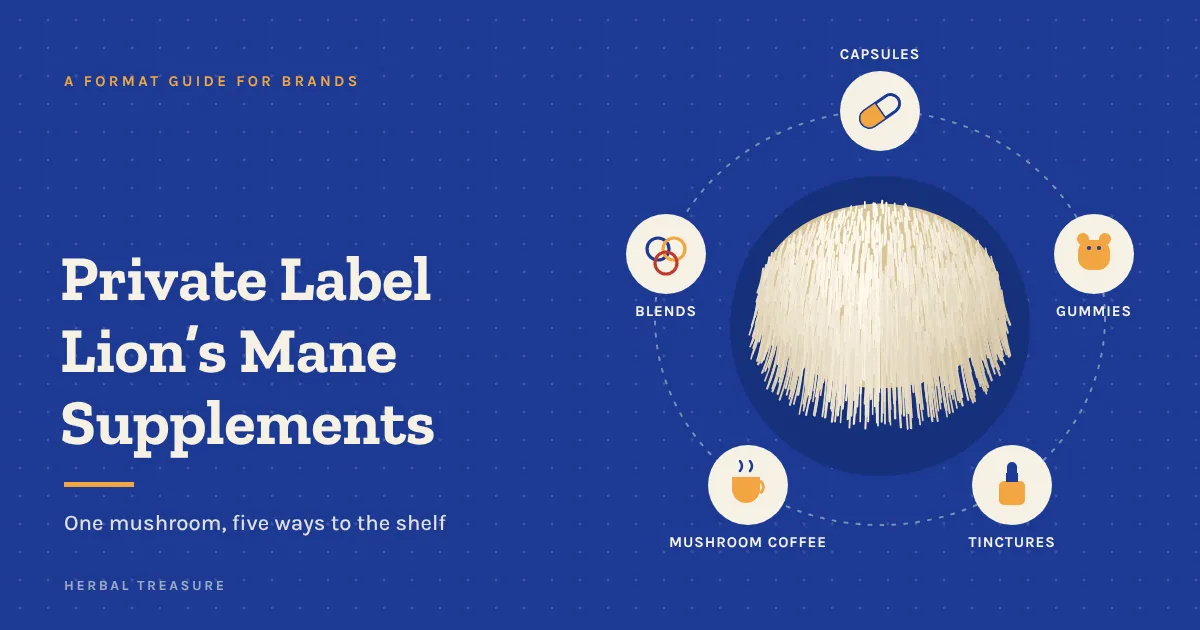
Launching private label lion’s mane supplements starts with one decision: the format. Capsules, gummies, tinctures, mushroom coffee and multi-mushroom blends each reach a different kind of shopper, and each one changes what you need to write on your specification sheet.
This guide walks through the five lion’s mane formats brands ask us about most, what to specify for each, and how to make sure the extract inside matches the label on the outside.
Why Brands Are Building Lion’s Mane Product Lines
Lion’s mane (hou tou gu, Hericium erinaceus) is one of the best-known functional mushrooms in North America and Europe. With its shaggy white spines, it is easy to recognize, and it has become a staple for Amazon sellers and direct-to-consumer (DTC) brands alike.
Overseas, lion’s mane products are mostly positioned around focus, cognition and gut wellness. That positioning is a marketing choice, not a health claim, so check which wellness statements are allowed in each market before you write your label or product listing. The rules in the European Union are stricter than those in the United States and Canada.
What has changed is the way people buy. Shoppers no longer look only for a plain lion’s mane capsule. Many want a gummy they can keep on the desk, a few drops in their water, or a mushroom coffee that fits into the morning routine they already have. A single format rarely covers all of them.
Start With the Ingredient: Lion’s Mane Powder, Extract or Blend
Every lion’s mane product starts with one of two ingredients. Lion’s mane powder is the dried mushroom, milled fine. A lion’s mane extract has been processed to concentrate the mushroom’s compounds and is standardized to a measurable marker, usually polysaccharides or beta-glucan. Extracts give you a number to put on the spec sheet and to check on every batch.
Three questions are worth settling before you choose a format:
- Which part of the mushroom?Lion’s mane contains two groups of compounds that buyers often ask about: hericenones, found mainly in the fruiting body (the mushroom itself), and erinacines, found mainly in the mycelium (the root-like network it grows from). Ask your supplier which part the ingredient comes from, and make sure the label says the same.
- Which marker?Total polysaccharides in lion’s mane extract can usually be set anywhere from 20% to 50%. Beta-glucan, a specific group of polysaccharides, says more about extract quality than the total figure does. Our guide to beta-glucan vs polysaccharides explains why.
- Single mushroom or blend?Some brands want a pure lion’s mane product. Others combine it with other mushrooms, which changes the spec for every ingredient in the formula.
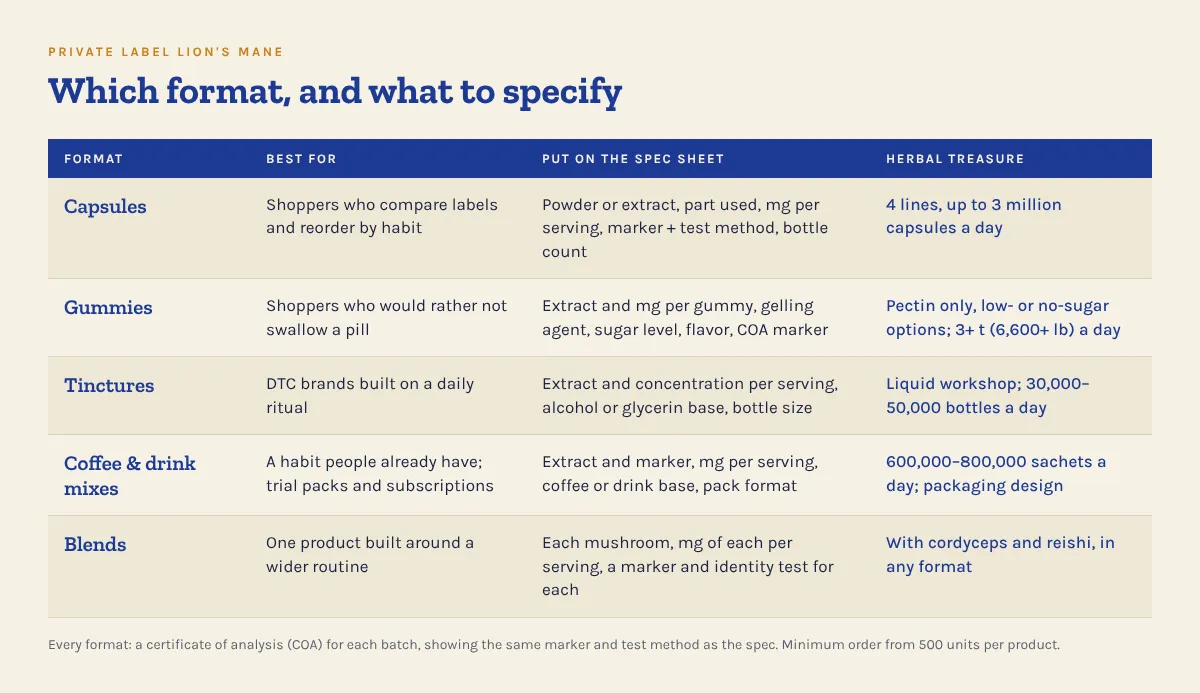
5 Private Label Lion’s Mane Supplement Formats, and What to Specify
1. Lion’s Mane Capsules
Capsules remain the most familiar way to take lion’s mane, and they are the easiest format for shoppers to compare on price per serving. They suit brands that want a clean, single-ingredient product with a clear number on the label.
- Specify:the ingredient (powder or extract), the part of the mushroom it comes from, the amount per capsule and per serving, the marker (polysaccharides or beta-glucan) and its test method, and the bottle count.
- Ask about:capsule material, for example plant-based capsules if you want a vegan claim.
- Capacity:four capsule lines with a combined output of up to 3 million capsules a day.
2. Lion’s Mane Gummies
Gummies reach shoppers who would rather not swallow a pill, and they make a daily habit feel less like a chore. A gummy has limited room for active ingredients, so the strength of the extract you put in it matters more than in a capsule.
- Specify:the lion’s mane extract used, the amount per gummy, the gelling agent, the sugar level, flavor, and the marker you want reported on the certificate of analysis (COA).
- Herbal Treasure gummies:made with pectin only, never gelatin, so they suit vegan positioning. Low-sugar and sugar-free versions are possible.
- Capacity:more than 3 metric tons (about 6,600 lb) of gummies a day, from a dedicated gummy workshop.
3. Lion’s Mane Tinctures
Tinctures give shoppers a liquid option they can take by the dropper or add to water, coffee or tea. They are a natural fit for DTC brands that sell on a story of daily ritual.
- Specify:the lion’s mane extract, its concentration per serving, the base (alcohol or glycerin), and the bottle size.
- Herbal Treasure tinctures:made in our liquid workshop, with an alcohol or glycerin base chosen to suit your brand and your markets.
- Capacity:automatic filling lines that fill 30,000–50,000 bottles a day.
4. Lion’s Mane Coffee and Drink Mixes
Mushroom coffee and powdered drink mixes put lion’s mane into a habit people already have. They are usually packed in single-serve stick packs or resealable pouches, which makes them easy to sell as trial packs and subscriptions.
- Specify:the lion’s mane extract and its marker, the amount per serving, the coffee or drink base, and the pack format.
- Ask about:whether the manufacturer can also design the packaging, so the stick pack, pouch and outer box match.
- Capacity:600,000–800,000 powder sachets a day, with packaging design available for stick packs, pouches and gift boxes.
5. Multi-Mushroom Blends
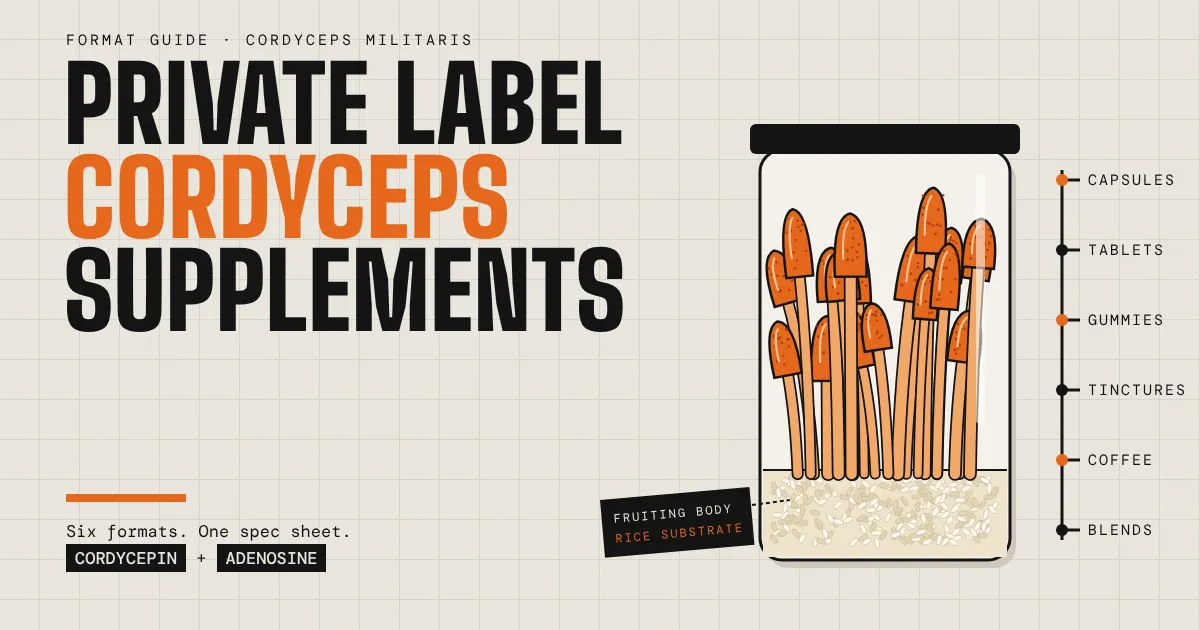
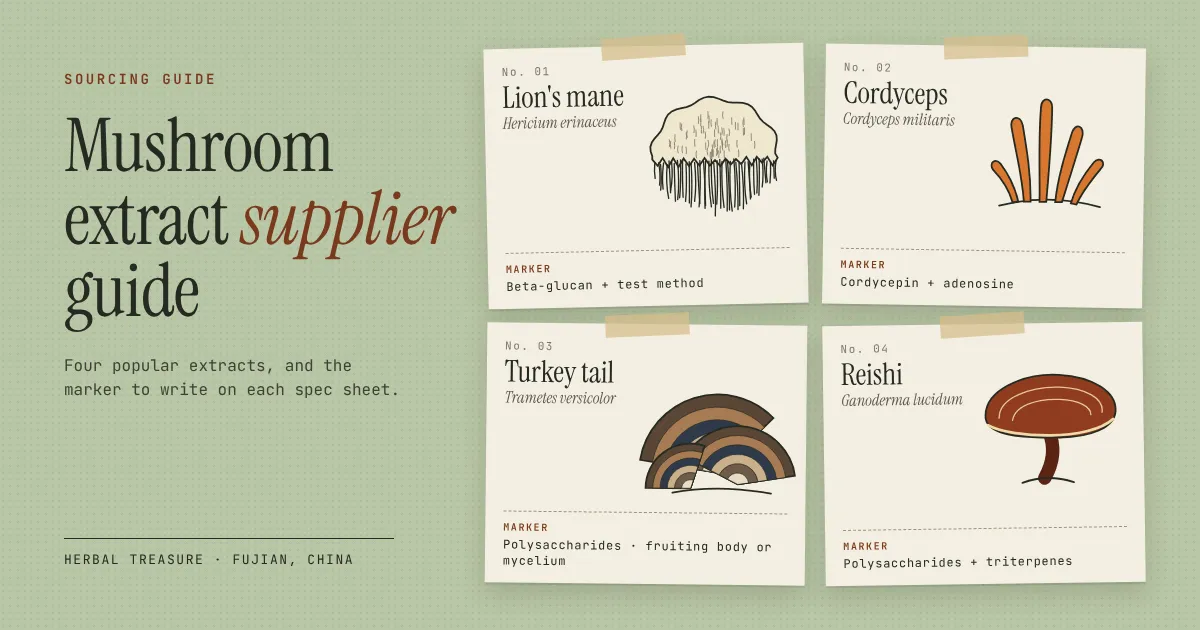
Lion’s mane is often blended with cordyceps (chong cao) and reishi (ling zhi), and a blend can be made in any of the four formats above. Blends let a brand offer one product built around a wider routine instead of a single mushroom.
- Specify:each mushroom in the formula, the amount of each per serving, and a marker for each ingredient, not just one figure for the whole blend.
- Ask about:how the factory tests each mushroom in the blend for identity. Learn more about one common blend partner in our guide to cordyceps militaris extract.
What to Put on Your Lion’s Mane Spec Sheet
Whatever format you choose, your specification sheet is the document that ties the product together. The label, the factory’s batch records and any third-party test all get checked against it. A complete lion’s mane spec sheet includes:
- Ingredient identity:Hericium erinaceus, the part used (fruiting body or mycelium), and whether it is a powder or an extract.
- Marker and test method:for example, a beta-glucan or polysaccharide target, with the method used to measure it named on the sheet.
- Amount per serving:in milligrams, matching the label exactly.
- Contaminant limits:heavy metals and microbiology.
- Batch documentation:a COA for every batch, showing the same marker and method as the spec.
If you sell on Amazon’s US store, a third-party lab will test your finished product against its label before the listing goes live. We cover what that testing involves in our private label reishi supplements guide. For a ready-made template, see our mushroom extract supplier spec sheet guide.
Why Extraction Temperature Matters for Lion’s Mane
Hericenones and erinacines are heat-sensitive, and high processing temperatures can break them down. That is why the extraction method is worth asking about before you compare prices.
Low-temperature processing combined with cell-wall disruption helps release more of the mushroom’s active constituents into the finished extract. Ask any supplier how their lion’s mane extract is made, and at what stage heat is used. Our lion’s mane extract manufacturer guide covers the four checks to run on an extract supplier.
How Herbal Treasure Makes Private Label Lion’s Mane Supplements
Herbal Treasure has worked with edible and medicinal mushrooms in Fujian, China, since 2003. Here is how we support lion’s mane brands:
- Raw material:lion’s mane cultivated in greenhouses, then processed with our proprietary low-temperature cell-wall disruption method.
- Ingredients:lion’s mane powder and standardized lion’s mane extract, with polysaccharides customizable from 20% to 50% and beta-glucan of 15% or higher available.
- Finished products:capsules, gummies, tinctures, mushroom coffee and drink mixes, and multi-mushroom blends with cordyceps and reishi.
- Testing:an in-house laboratory that tests active content, heavy metals, microbiology and species identity, with a COA for every batch.
- Certifications:NSF cGMP, ISO 22000, FSSC 22000, HACCP, USDA Organic, EU Organic, Canada Organic, Halal and Kosher. Our facility is FDA-registered and holds a Health Canada Foreign Site Reference Number (FSRN). Each certificate applies within its stated scope.
- Formulas:bring your own formula (OEM), or start from more than 5,000 proven formulas (ODM), including 16 gummy and 8 tincture formulas added in September 2026.
- Orders:minimum order from 500 units per product; samples in 5–7 days for standard products or 7–14 days for custom formulas; production in 15–20 days for standard orders or 4–6 weeks for deep customization.
More than 1,000 brands in over 40 countries and regions work with us, many of them selling on Amazon and their own websites.
Choosing Your First Lion’s Mane Product
The right first product depends on who you are selling to. Capsules suit shoppers who compare labels and reorder by habit. Gummies and tinctures reach people who want something easier than a pill. Mushroom coffee fits a morning ritual, and a blend lets you build a range around one product.
Whichever format you start with, name the ingredient and the part of the mushroom, set the marker and the test method, and ask for a COA that matches every batch.
Ready to plan your lion’s mane line? Request a manufacturing quote and tell us your market, format, formula and packaging.
Frequently Asked Questions
Which lion’s mane supplement format should I launch first?
It depends on your customer. Capsules are the easiest to compare and reorder, gummies and tinctures suit shoppers who dislike pills, and mushroom coffee fits a daily routine. Many brands start with one capsule or gummy product and add formats later.
What is the difference between lion’s mane powder and lion’s mane extract?
Lion’s mane powder is the dried mushroom, milled fine. A lion’s mane extract has been processed to concentrate its compounds and is standardized to a marker such as polysaccharides or beta-glucan, so its quality can be checked batch by batch.
Are Herbal Treasure’s lion’s mane gummies vegan?
Yes. Our gummies are made with pectin only, never gelatin, so they suit vegan positioning. Low-sugar and sugar-free versions are also possible.
Can lion’s mane be combined with other mushrooms?
Yes. Lion’s mane is often blended with cordyceps and reishi, in capsules, gummies, tinctures or drink mixes. Ask for a marker and identity test for each mushroom in the blend, not just one figure for the whole formula.